Clay in Neptune's Rings Came From Inside a World That No Longer Exists

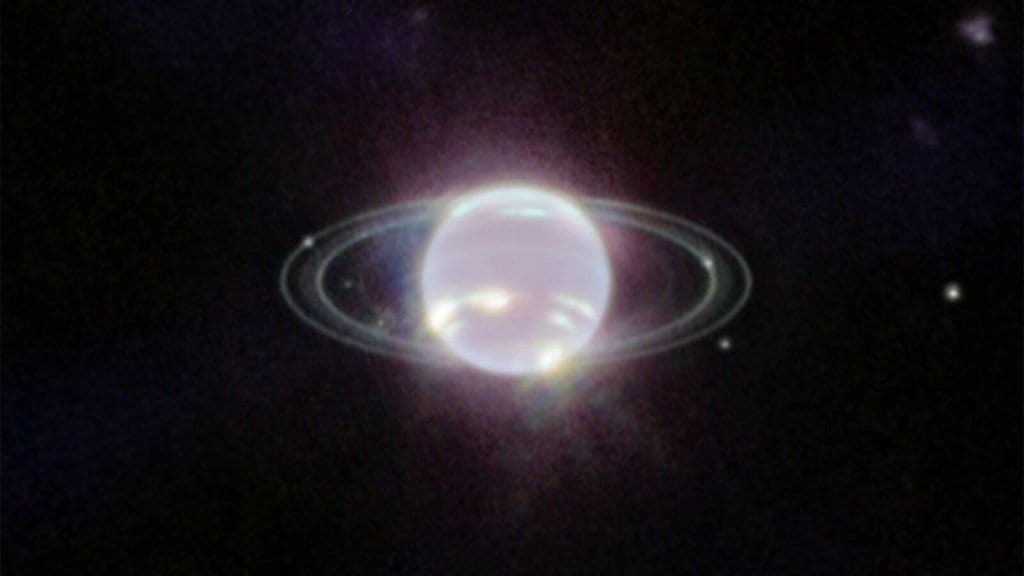
Ryleigh Davis was not looking for clay. She and her colleagues at Caltech had aimed the James Webb Space Telescope at Neptune's rings and three of its small inner moons to answer a plainer question: how much water ice is on them, and what is making them so dark? Voyager 2 flew past Neptune in August 1989 and found the inner moons dark and grey. For nearly four decades the standard reading was water ice, dirtied by the carbon-rich material that coats so much of the outer solar system.
Webb's spectra showed no water ice at all: not on Larissa, not on Galatea, not on Proteus, and not in the rings. That is despite a deep absorption feature near 3 microns, the sort of signal that ordinarily means something in the surface carries an OH group.
The absence of ice matters more than it sounds. Water ice is the default surface material of the outer solar system; it is what Neptune's inner moons were assumed to be made of, and the assumption came from spectra taken before Webb, which were read as ice buried under dark organics. Webb has better resolution and a longer wavelength reach, and at that quality the ice bands simply are not there. Something else is producing the deep absorption near 3 microns, and hydrated minerals do it comfortably.
Then there was the other band. In the rings and on two of the three moons, Larissa and Galatea, the spectra carry a narrow absorption at 2.72 microns. That wavelength is a fingerprint for magnesium-rich phyllosilicates: clays. On Earth they are the stuff of mudstone and pottery, and they are common enough on Mars and on asteroids in the inner belt. In the outer solar system they were unheard of.
"Phyllosilicates had never been detected anywhere in the outer solar system beyond Jupiter, so that was not on our list of things to look for," Davis said in a Caltech statement. Her supervisor, Michael Brown, put it more bluntly: "Sometimes in science you are trying to find evidence to evaluate a specific hypothesis, and, sometimes, something that you had not been thinking about just hits you in the face."
The measurements were made with Webb's near-infrared spectrograph, and the analysis by Davis, Matthew Belyakov, Ian Wong, Zachariah Milby and Brown appeared in Science Advances on July 29. It is peer-reviewed work.
What clay requires
Phyllosilicates are not something rock does on its own. They form when silicate minerals sit in contact with liquid water long enough for the water to take them apart and rebuild them, a process geologists call aqueous alteration. Liquid water is the hard part. On a body a couple of hundred kilometres wide, orbiting four and a half billion kilometres from the Sun, water is frost and stays frost. Keeping it liquid takes a parent body big enough to hold its internal heat, whether left over from formation or generated by radioactive decay in its rock. And the clay forms where the rock and the water meet, deep inside, not on the surface.
None of Neptune's inner moons qualifies. Proteus, the largest, is about 420 kilometres across; Larissa is roughly 190 and Galatea about 175. They are far too small to have ever run a warm, wet interior. So the clay on their surfaces is not theirs. It was made somewhere else, in something much bigger, and the moons and rings we see now are what became of that something after it came apart.
The rings are part of the same story. Neptune's are thin, dark and dusty, nothing like Saturn's bright ice, and the brightest of them, the Adams ring, is famously clumped into arcs. Dust that fine does not last; it is continually resupplied by micrometeorite impacts chipping away at the small moons embedded among the rings. So the rings and the inner moons are effectively the same material at two different grain sizes, which fits the clay band turning up in both.
The suspect, and the alternative
The obvious suspect is Triton. Neptune's one large moon is 2,700 kilometres across, bigger than Pluto, and it goes around the planet backwards, on an orbit tilted steeply out of Neptune's equatorial plane. Nothing that forms in place does that. Triton is almost certainly a captured Kuiper Belt object, and capture is not a gentle procedure. A body that size arriving on a wild orbit and then grinding its way down to a circular one would have scattered, collided with and pulverised whatever family of moons Neptune already had.
"If Neptune once had a system of moons that looked something like what we see at Uranus today, we expect it would've been completely destroyed by the process of Triton getting captured," Davis said.
That is the team's favoured story, and it is not the only one the data allows. The paper offers a second: that a single dwarf planet, something Pluto-sized wandering in from the Kuiper Belt, passed close enough to Neptune to be torn apart by tides, and that its debris settled into the orbits the inner moons and rings occupy now. Either way the requirement is the same. Something large and internally warm was destroyed, and its inside is what we are looking at. The authors do not choose between the two, and the Caltech release says the dwarf-planet route cannot be ruled out.
An inside-out moon
Planetary scientists have wanted to see the inside of a differentiated icy body for a long time, and there has been no way to do it. Europa, Enceladus and Ganymede all separated into rock and ice early on and then sealed themselves under crusts tens of kilometres thick. Everything a spectrograph can reach is surface. Neptune's inner moons, if the reading holds, are the exception: bodies whose deep material was excavated wholesale and then reassembled facing outward. The clay is not a curiosity on top of them. It is what they are made of.
There is a wrinkle worth keeping. Proteus was observed along with the other two and shows the same absence of water ice, but the 2.72 micron clay band is reported for Larissa, Galatea and the rings, not for Proteus. Whether that reflects a genuinely different surface, a different history, or the limits of the measurement is not settled here. Nor does one spectral band, however clean, identify a specific mineral beyond argument; laboratory work on candidate clays and better spectra of the fainter inner moons are the obvious next steps.
What the result changes is the standing picture of Neptune's inner system. Voyager 2 catalogued those moons during a single rushed pass and left them as small, dark and uninteresting. Thirty-seven years later, a spectrum taken from a telescope a million and a half kilometres from Earth has turned them into the best available sample of the inside of a world nobody has ever seen.
Sources
- Science AdvancesPeer-reviewed
- arXivPreprint
- www.caltech.edu