A New Moon Crater Left a Wide Patch of Cooler Ground

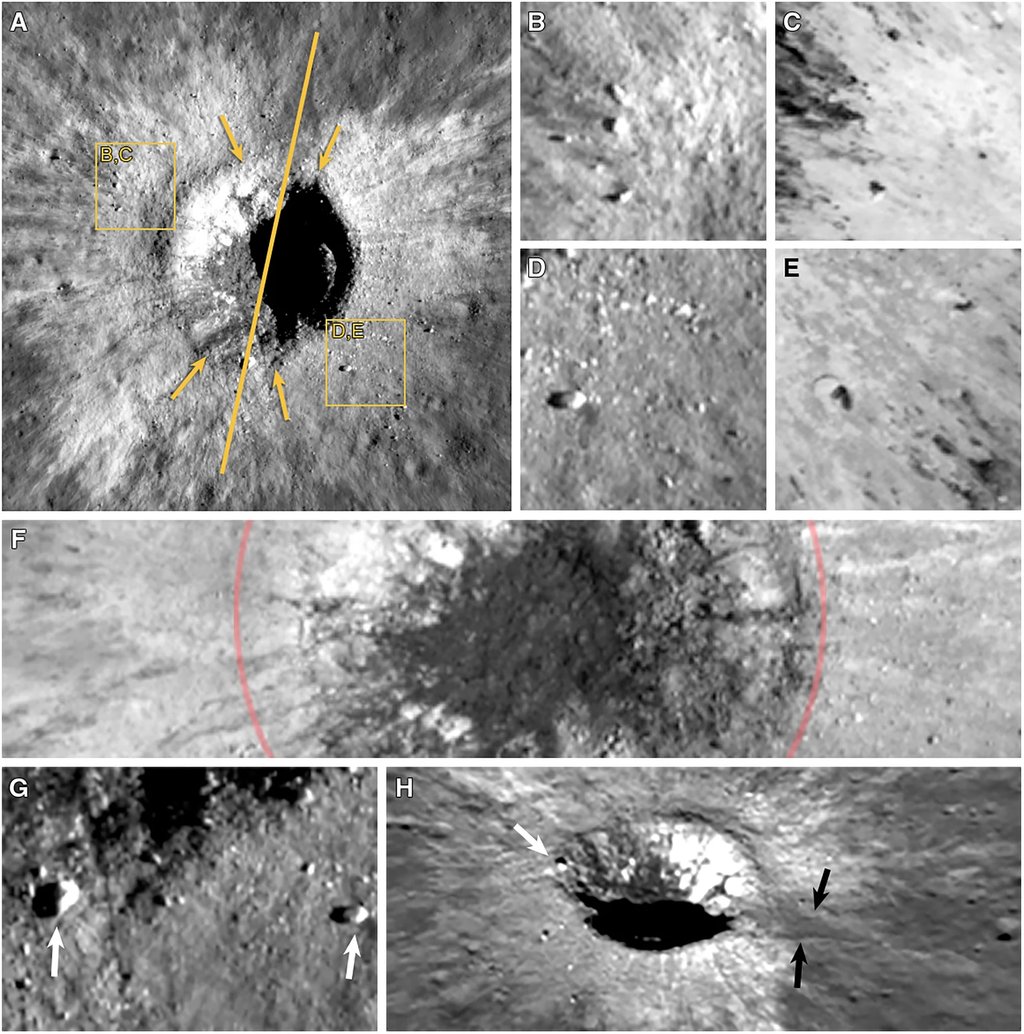
On Oct. 24, 2025, Robert Wagner was doing something routine: checking the quality of a map of the whole Moon, stitched together from hundreds of frames taken years apart. The software he uses turns anything unchanged between the two sets gray and leaves anything different bright or dark. Near the Moon's eastern edge sat a bright smear ringed by a dark halo, far larger than the program's usual false alarms.
"I just stopped, dropped everything, and started looking into what that spot was," said Wagner, an image-processing specialist at Intuitive Machines who works with the camera system aboard NASA's Lunar Reconnaissance Orbiter.
The smear was not the crater. It was the debris thrown out of one. The hole at its center is 222 meters across, about the length of two football fields, and it is absent from the older frames: something hit the Moon between April 11 and May 22, 2024. Mark S. Robinson of Intuitive Machines and colleagues report it in Science Advances as the largest newly formed impact crater yet found in the solar system and, on current models, an event expected roughly once every 132 years. It has been named McGetchin, after the lunar scientist Tom McGetchin.
It had been sitting there for a year and a half. The Wide-Angle Camera aboard the orbiter photographs the whole Moon every month, but the routine close-up searches look for far smaller changes. The comparison that catches large features, built by making a global map and setting it against an older one, runs only every few years. Wagner was in the middle of one of those when McGetchin appeared.
The crater's discovery is only half of what the orbiter saw. A second paper in the same journal, published the same day, is about something much larger and entirely invisible in a photograph.
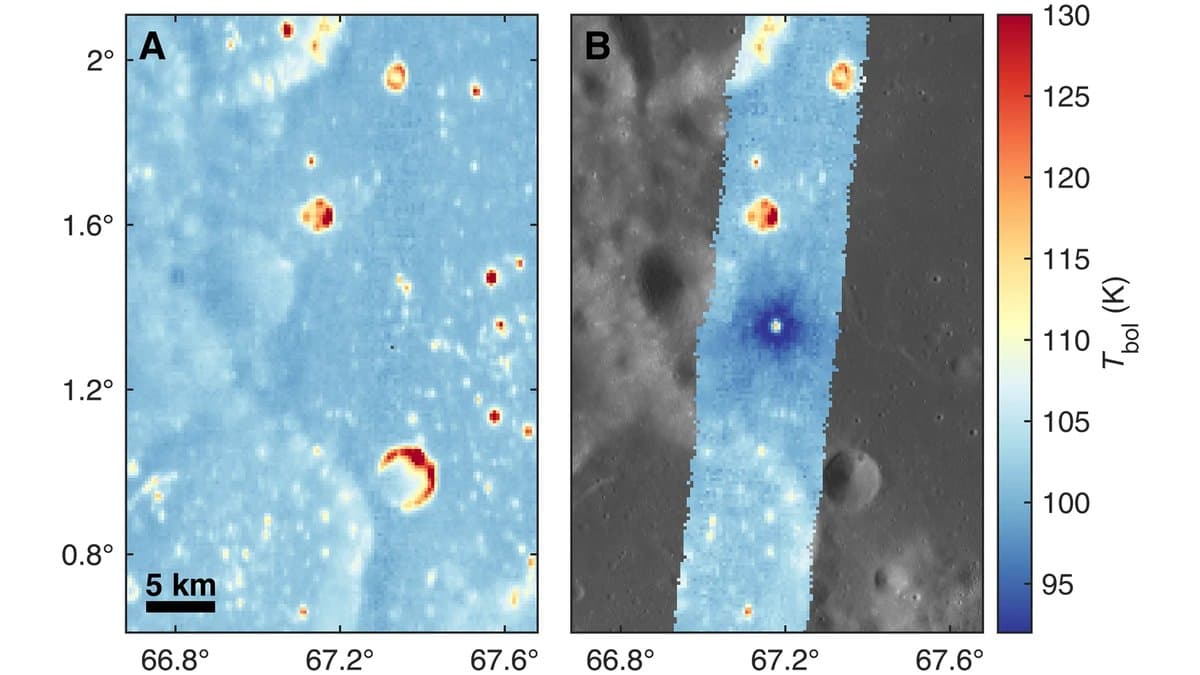
In follow-up passes over the site in late 2025 and early 2026, Diviner, the orbiter's thermal instrument, measured ground temperatures at night. It found a patch about 7 kilometers across that is 8 to 9 kelvin cooler after dark than the terrain around it. The patch extends roughly 3.5 kilometers beyond the rim in every direction, about 30 times the crater's own radius. Tyler M. Powell of the Johns Hopkins University Applied Physics Laboratory and colleagues report the measurement.
Night temperature on an airless world is largely a question of packing. Tightly packed soil holds the day's heat and gives it up slowly through the long lunar night. Loose material sheds it faster and reads colder by dawn. The cold spot, Powell and colleagues write, is consistent with the top few centimeters to decimeters of regolith, the Moon's loose surface soil, having been shaken up and left less dense. That is what the temperatures fit. Nobody has been there to dig.
NASA's own account of the work puts it without the hedge: the impact fluffs up the regolith around the crater, making it less dense and therefore less able to hold heat. The paper is the more careful of the two.
The more consequential result is not about McGetchin alone. Powell and colleagues examined newly formed craters larger than 20 meters identified on the Moon to date. All of those larger than about 30 meters show a detectable cold spot. The authors keep their own generalization modest: cold spots are a common consequence of fresh lunar impacts.
The size of the temperature difference also tracks the size of the crater. Bigger craters are associated with colder spots, which suggests that the disturbance extends deeper around them.
That scaling is what turns a curiosity into a claim about the whole surface. The Moon's topsoil is turned over constantly by small strikes, a slow churn called impact gardening, and the pace of it sets how long anything at the surface stays where it was put. Carrying the size relation across the population of fresh craters, the authors suggest that cold spots may be reworking the shallow soil at rates comparable to the gardening done by the craters themselves. The verbs are theirs. It is an extrapolation from a size relation, not a rate anyone has measured.
If it holds, the implication runs past the Moon. The authors end there: cold spots as a potentially substantial driver of how the surface evolves on airless bodies covered in loose soil, asteroids included.
NASA's account adds two things the papers do not. Loosened ground kilometers from a crater could change how a rover's wheels behave, in terrain a mission would have no reason to treat as disturbed. And the agency's estimate for the object that dug McGetchin, a comet or asteroid roughly the size of a three- to six-story building, comes with a caveat: the estimate belongs to a paper that has not yet been published.
What makes the crater worth two papers at once is that it is new. Impact scars fade as the surface is worked over, and Diviner had maps of that ground from before the strike as well as after. The hole is the small part of what the impact did.
Sources
- Science AdvancesPeer-reviewed
- doi.org
- science.nasa.gov
- allatra.media