A Marsquake Places Active Faulting Inside Valles Marineris
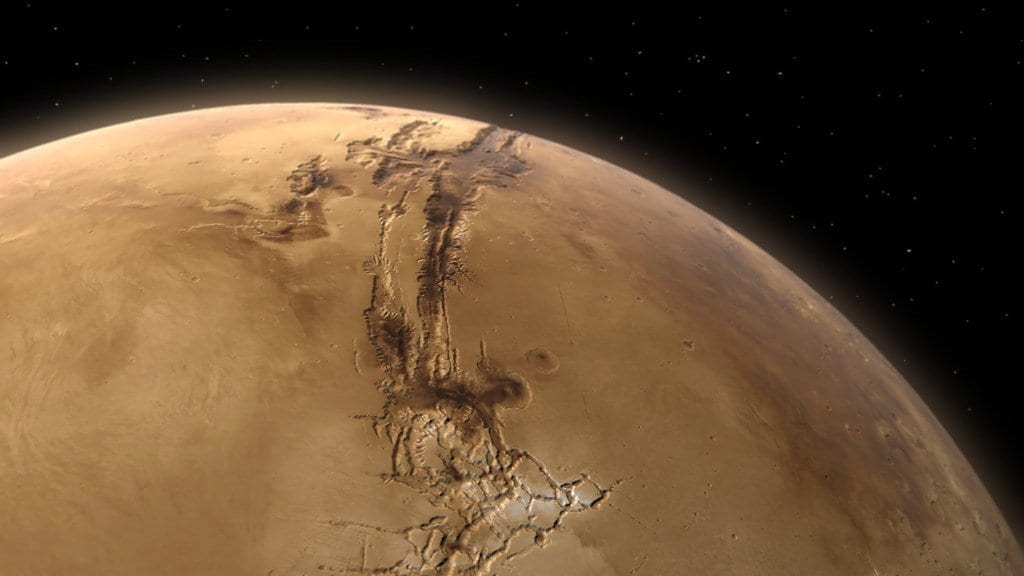
A marsquake recorded by NASA's InSight lander came from inside Valles Marineris, the vast canyon system near Mars's equator, and was produced by rock sliding sideways deep in the crust along faults that were already there. Jung-Hun Song and colleagues report the identification in a paper published in Nature Communications on Oct. 15, 2026.
The paper sets the work against a question the authors describe as poorly tested by direct observation: whether old tectonic structures can still concentrate seismic failure under the stresses a planet carries now. They report that this event is direct seismic evidence that inherited fault systems on Mars can stay mechanically favorable for reactivation over billion-year timescales.
The event is cataloged as S0976a, and InSight picked it up in Mars's western hemisphere, far from the lander. Song and colleagues place it inside Valles Marineris and identify strike-slip faulting, where two blocks of rock grind past each other sideways, in the deep crust. From the focal mechanism (the geometry of the slip), they infer a stress direction that matches the reactivation of faults that were there before. They attribute the stress field Mars carries today mainly to three causes: the planet's long-term cooling, loading from the neighboring Tharsis volcanic region, and local unloading as erosion stripped material off the surface.
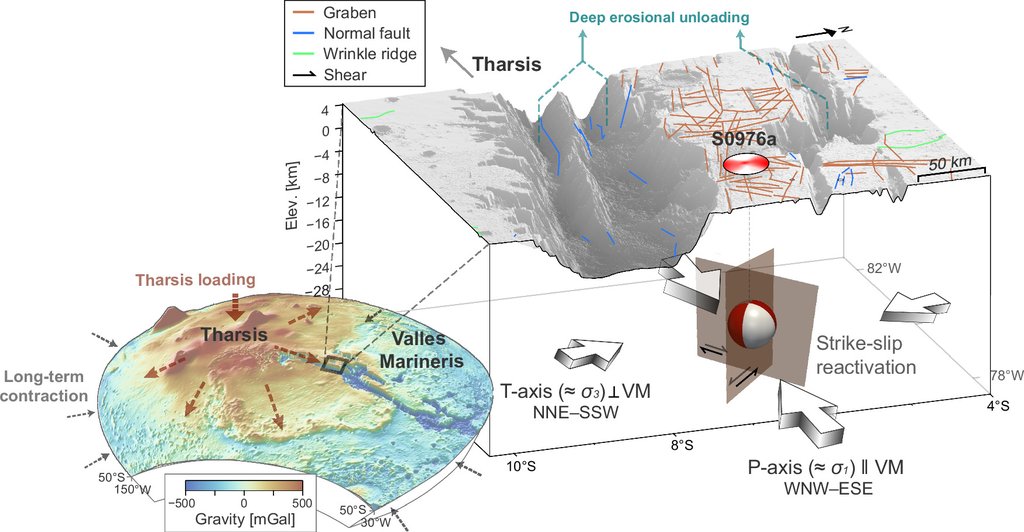
Orbiters have mapped the canyon's faults and landslides for decades, but a surface feature shows that the ground moved at some point, not that it moves now. A quake fixes the motion in time, because the rock slipped while an instrument was listening. It also reaches depths no camera sees, which is how this slip was placed in the deep crust rather than in the canyon walls.
The finding rests on one event: the paper reports a single marsquake, not how often the canyon's faults slip. Mars has no moving tectonic plates, and the authors present deep fault slip as a mechanism of long-term strain release in a cooling planet with one unbroken outer shell.
Nature Communications published the paper open access under a CC BY license.
Sources
- Nature CommunicationsPeer-reviewed