Exploding Stars Supply Enough Energy to Keep Andromeda's Gas Stirred

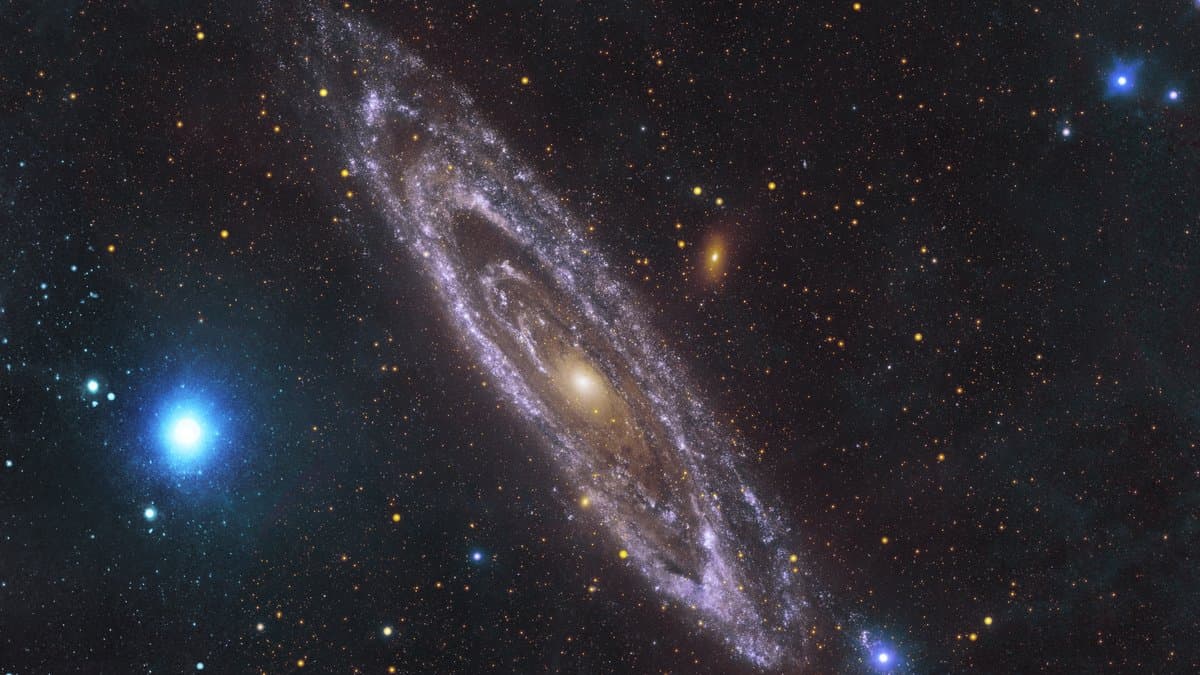
Photograph the Andromeda galaxy in ordinary starlight and you get the poster image: a calm banded spiral, the nearest giant spiral to our own. Map the same galaxy in the radio glow of neutral hydrogen, the cold gas that lies between the stars, and the calm goes. The disk is pocked with holes and shells, each one a patch of gas that something has shoved aside.
That something is stellar feedback from massive stars. A massive star can burn through its fuel in a few million years and end as a supernova, while in a cluster dozens of massive stars can explode in roughly the same region over a few tens of millions of years. Their blast waves, together with winds from massive stars, can drive the surrounding hydrogen outward into a large expanding shell, a superbubble.
Writing in Nature Astronomy Sept. 17, 2026, a team led by Fanyi Meng of Tsinghua University, with Di Li as corresponding author, reports a count of those shells across the entire disk of Andromeda: 118 superbubbles, with ages of up to 40 million years inferred from their sizes and expansion velocities. That upper age is itself a clue. It is comparable to the timescale over which supernovae can continue to occur in a single star cluster.
Turbulence is the reason any of this counts as a puzzle. The gas in a galaxy does not sit still. It churns on many scales, and that churning helps support the gas against gravity, influences where clouds can collapse into new stars, and keeps a disk thicker than it would otherwise be. But turbulence is a losing proposition. Left alone, it cascades to smaller and smaller eddies and eventually dissipates as heat, fading within a few tens of millions of years. Something has to keep paying for it.
So the test is arithmetic. How much kinetic energy do the bubbles inject into the gas, and how fast does the turbulence lose it? The two rates closely match, the team reports, both in magnitude and in how they vary from place to place across the disk: the regions where bubbles are doing the most work are the regions where turbulence is dissipating fastest. The second half of that is the harder thing to get by accident.
Both rates were derived from the same combined dataset, by separate routes: the energy going in and the energy coming out are two readings of one survey of Andromeda, not two independent measurements of the same galaxy.
What the numbers support, in the paper's own phrase, is that clustered supernova feedback is "sufficient to sustain" turbulence on the scale of a whole galaxy. Sufficient is not the same as dominant, and the authors keep the two apart. The paper begins by describing the open question as whether superbubbles dominate a galaxy's turbulent energy budget, and showing that they could carry the load on their own is not the same as showing that nothing else helps.
Nor is it the first look at Andromeda's holes, and the paper does not claim it is. Brinks and Bajaja cataloged 141 of them in 1986, and in 2020 Bacchini and colleagues published evidence that supernova feedback can sustain gas turbulence in nearby star-forming galaxies; both papers sit in this one's reference list. What is new is the completeness. A survey sensitive enough to cover the whole disk is what lets the team put numbers on both sides of the ledger at once.
Neither telescope could have done that alone. FAST, the 500-meter dish set into a natural bowl in Guizhou, picks up faint gas spread over wide areas but sees it at lower spatial resolution. The Jansky Very Large Array in New Mexico resolves fine structure but filters out much of the smooth, extended component. Together they give both the sharp edges and the faint, spread-out gas around them. The Tsinghua announcement carried by People's Daily calls FAST's measurement of that large-scale diffuse gas the key to reconstructing what the explosions did.
Andromeda is the test case for a reason a resident of the Milky Way will recognize. "The Andromeda galaxy is about 2.5 million light years from Earth, and it is our close neighbor," Li told People's Daily, in remarks translated from Chinese. "Although we cannot see the whole of our Milky Way home, we can study our close neighbor carefully, and so better understand our own home and the evolution of Earth."
The result is also unusually easy to scrutinize. The combined data cube is posted on a Tsinghua cloud server, the bubble catalog and the analysis code are on GitHub, and the archival array observations are in the public NRAO archive. The paper names its two referees, Blakesley Burkhart and Christoph Federrath, and publishes their reports; one co-author performed an independent blind consistency check. "The richness of the universe has never disappointed us observers," Li said. "Look a little deeper and you see things people had not imagined."
Sources
- Nature AstronomyPeer-reviewed
- github.com
- doi.org
- m.gmw.cn