Gaps in the Tilted Kuiper Belt Look Carved by the Planets, Not Inherited From Birth

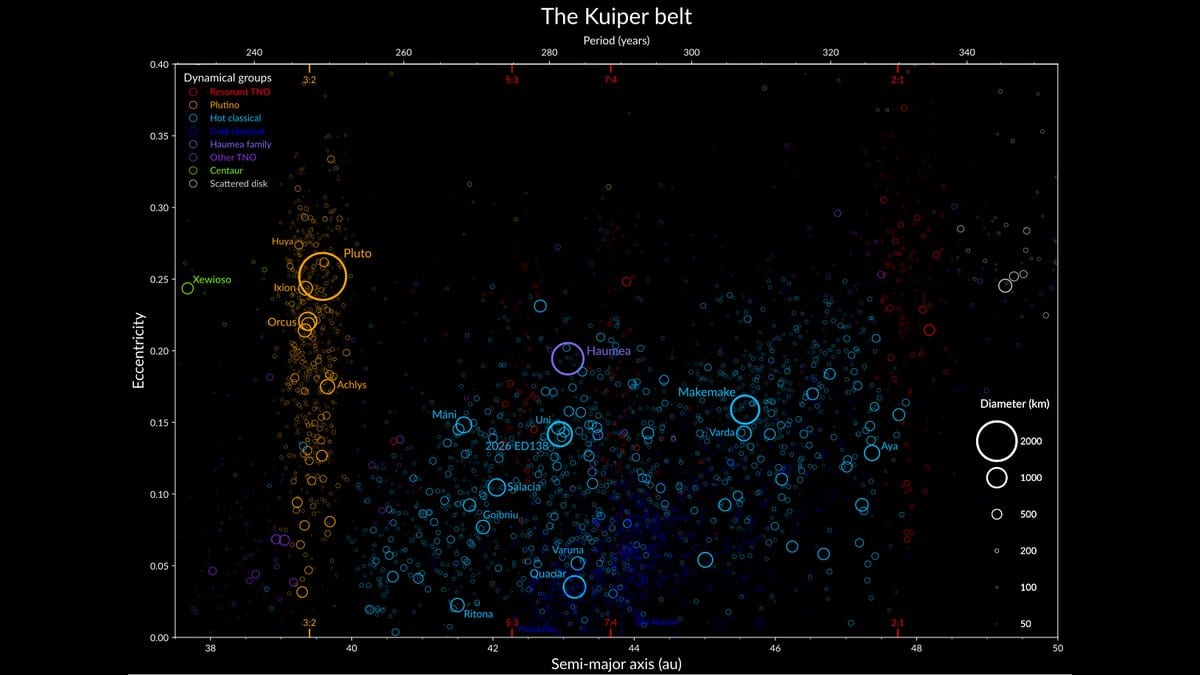
An icy body on a steeply tilted orbit beyond Neptune crosses the plane of the planets twice per orbit and spends the rest of its time well above or below it. Almost every survey that has gone looking for such objects has pointed at that plane anyway, because that is where the sky is richest. So the tilted part of the outer solar system has been mapped by whatever wandered through the frame.
The Large inclination Distant Objects survey (LiDO) went looking where these objects actually spend their time. Mike Alexandersen of the Center for Astrophysics | Harvard & Smithsonian and 22 colleagues pointed the Canada-France-Hawaii Telescope at two tall, narrow blocks of sky 14 to 21 degrees north and south of the planets' plane and found 148 objects, all steeply tilted by the survey's design. The results were published Nov. 24, 2026, in The Planetary Science Journal, which is open access.
Of those, 125 fell within the survey's brightness and motion limits. That is what makes them a characterized sample: the team measured how efficiently it would have detected an object of a given brightness and motion, so a model belt can be run through the same filter and compared with the actual detections. Tracking ran on CFHT for three years, with additional positions from Magellan, Gemini North, archival Subaru images and the Minor Planet Center's records. For the near-resonant objects, it pinned the orbital size to about one part in a thousand. The campaign carries its scars: COVID-19 shutdowns and weather cost the planned first discovery season, and the fields closest to the plane never received usable discovery images.
One of the survey's sharpest results is an absence. "No objects beyond 63 au were detected, despite sensitivity to objects as far as 150 au," the authors write; an astronomical unit (au) is the Earth-Sun distance. Astronomers have long known that the belt thins out beyond the classical region; what LiDO adds is a quantified sensitivity alongside that emptiness.
The standard description of the hot classical belt, the population of tilted objects in the main classical region, came out of the OSSOS surveys: take the real detections, correct for the survey's biases and smooth the result. Alexandersen and his co-authors report that this model became statistically rejectable once LiDO's 38 characterized hot classical objects were included. They attribute the failure to the sample, not to the idea. At high inclinations, detections are sparse and spread over a much larger volume, so the debiased model never adequately covered that space. Adding LiDO to the same recipe would only defer the problem.
So they built the belt from scratch instead. The team filled the classical region with 13,100 massless test particles on smooth initial distributions, then integrated them for a billion years under the gravitational influence of the four giant planets in their present-day orbits, using REBOUND's MERCURIUS integrator. Everything still locked to a planet's orbital rhythm, or still being scattered by one, was discarded. What was left was a belt that had never been given structure, only had structure taken out of it.
Run through the same filter as the real survey, that sculpted population cannot be ruled out by LiDO's detections, by those from OSSOS++, or by both sets at once. It also opens two of the gaps seen among the real objects, in the right places. The model implies about 21,000 tilted classical objects down to the brightness limit used in the OSSOS estimates, in line with those estimates. The gaps it produces are considerably narrower than the real ones, though, and the authors say the model is "intended to be a proof of concept." They also found "other slightly different weighted distributions that were also nonrejectable", making this one a plausible history of the belt rather than the definitive one.
A billion years is not the age of the solar system, either. The planets remained in their current positions throughout the simulation; no early migration was modeled. The authors note that sculpting over the full 4.5 billion years would probably remove the tail of very steeply tilted particles that the model produces but the real sky does not show.
None of this makes the claim an exotic one. Neptune's resonances clearing lanes through the belt has been modeled for decades; what LiDO changes is how much of the tilted belt's structure that mechanism can explain. In the paper's own summary, the majority of the structure "appears to be created by long-term steady-state sculpting by mean motion and secular resonances, with a few features plausibly resulting from primordial emplacement"
The survey's other half is an inventory. Its abstract counts 62 detections as resonant, including 21 Plutinos, which share Pluto's resonance with Neptune. The team also reports six objects securely caught in mixed resonances that exchange orbital inclination for eccentricity, and as many more temporarily trapped in them, a population the conclusions describe as unpredicted. One object the survey tracked but did not characterize sits securely in the 5:1 resonance, with one of the most distant known perihelia and the lowest eccentricity known for an object in that resonance.
That is the case for aiming off the plane, and it arrives just before the flood. Rubin Observatory's Legacy Survey of Space and Time and the Roman Space Telescope's high-latitude survey will both find tilted objects in large numbers. The people who have to sort them now have a characterized sample, a catalog of unusual orbits and a model of the tilted belt built entirely from dynamical stability.
Sources
- The Planetary Science JournalPeer-reviewed