Skip to content
See the World Through ScienceA project of ALLATRA

Hera Finds a Stadium-Sized Crater Where DART Struck Dimorphos
Space

Republish this story

Our work is licensed under Creative Commons BY-NC 4.0. You may republish this piece for free — with credit to ALLATRA Media and a link to the original, unedited beyond length trims, and not for commercial use.

Read the full license

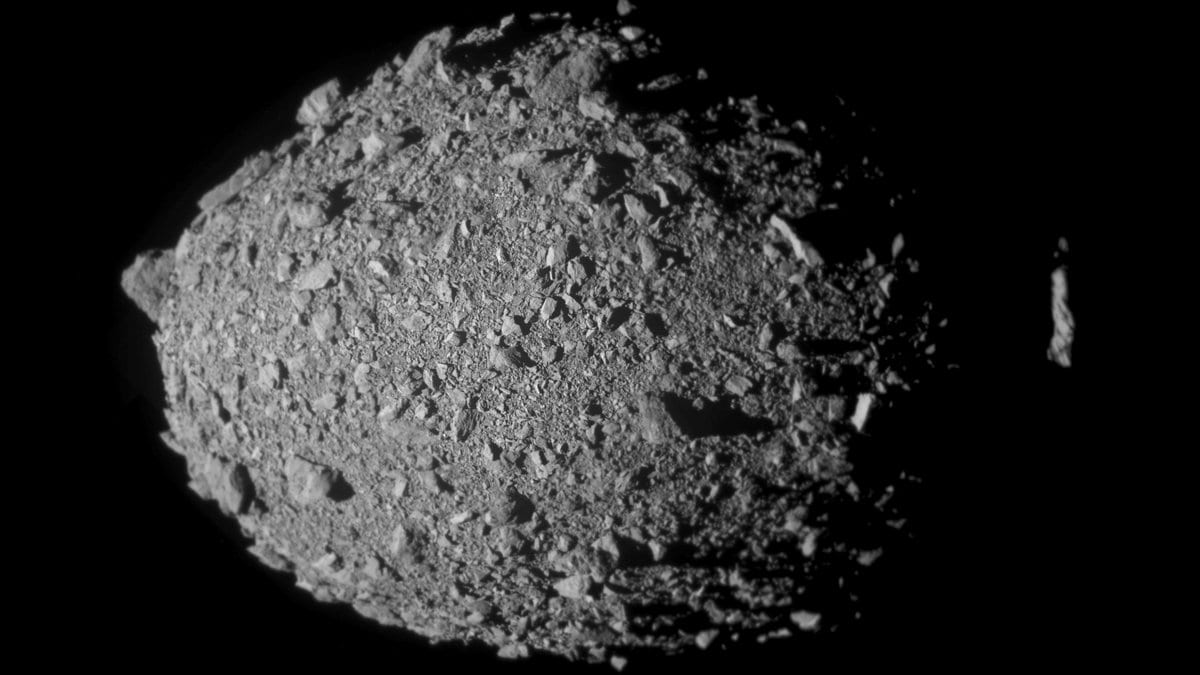
The asteroid moonlet Dimorphos, a rounded body covered in boulders, seen against black space with loose rocks drifting off its right-hand edge.
Dimorphos, the 151-meter moonlet, assembled from the last full-frame images NASA's DART returned before it struck this face Sept. 26, 2022 (illustrative). Hera has now photographed the same face and reports it flattened into a crater."Dimorphos North-Up Image Composition reduced bloom" by NASA/Johns Hopkins APL, via Wikimedia Commons, Public domain

ESA's Hera spacecraft has returned the first close-up images of Dimorphos, the small asteroid NASA's DART spacecraft struck on Sept. 26, 2022, and ESA says the struck face has been flattened into a crater as wide as the asteroid itself.

ESA released the images Nov. 25, 2026, when Hera mission manager Ian Carnelli unveiled them in the dinosaur hall of the Museum für Naturkunde Berlin. The agency calls Hera its first planetary defense mission and says its task is to supply the scientific detail needed to understand how DART's deflection worked. Telescopes on Earth measured the orbit change at the time — what the impact had done to the asteroid itself stayed an open question.

"Scientists debated whether Dimorphos had sustained an impact crater, changed its shape or stayed the same," Hera principal investigator Patrick Michel, of CNRS and the Observatoire de la Côte d'Azur, said in the agency's announcement. The answer, in his account, is all three at once: "The face struck by DART has been flattened into an impact crater the size of a sports stadium, which extends across the asteroid's entire width."
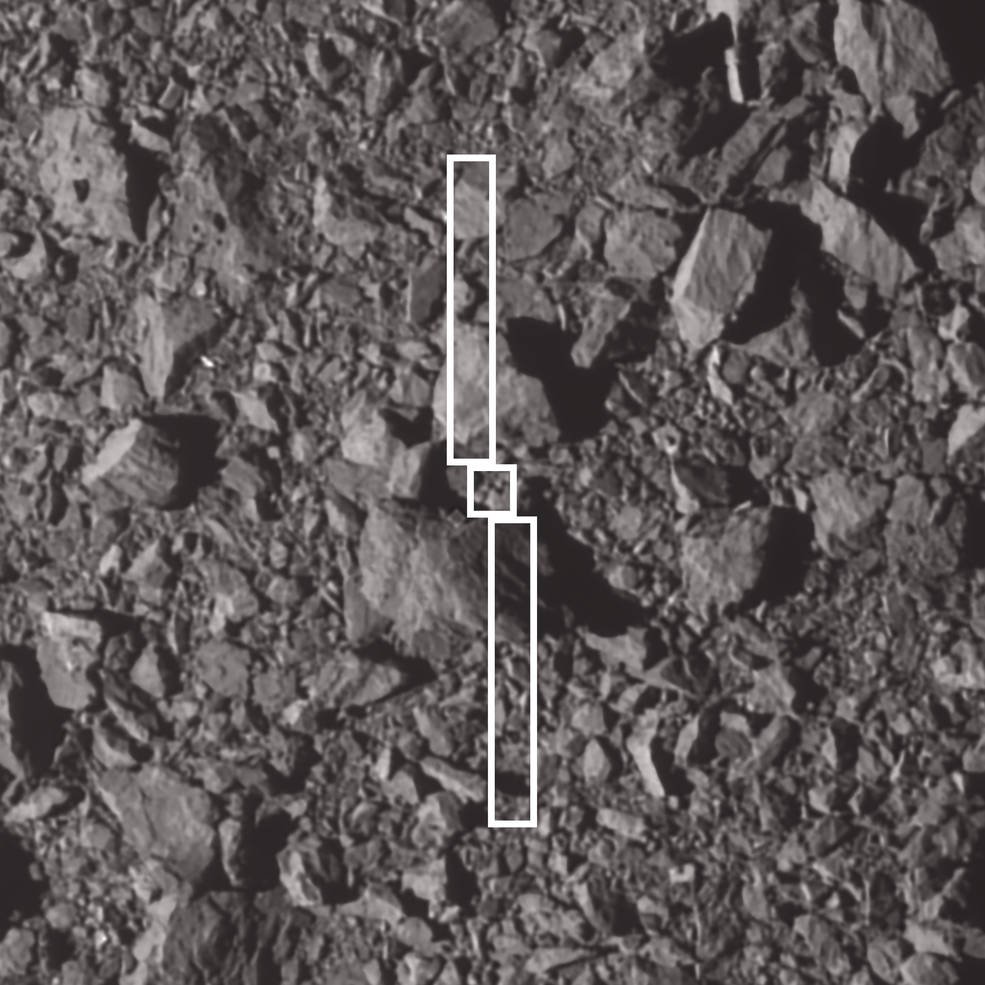
A white outline of a spacecraft body with two long solar arrays, drawn over a patch of boulder-covered asteroid surface.
The outline, drawn to scale with the solar arrays extended, marks the boulders the probe came down among on Sept. 26, 2022. Hera has now imaged the same ground and finds it reshaped into a crater. "Footprint of DART spacecraft over the spot where it impacted asteroid Dimorphos" by NASA/Johns Hopkins APL, via Wikimedia Commons, Public domain

According to Michael Kueppers, ESA's Hera mission scientist, the impact "has left Dimorphos tumbling wildly in its orbit." The pictures also show what the agency calls previously unknown boulders: "the asteroids are surrounded by hundreds of orbiting boulders, just a few metres in size," which Kueppers said the team will have to take into account as the spacecraft moves closer.

Away from the impact site, ESA reports no major change: the boulder fields over the rest of Dimorphos look as they did in DART's 2022 pictures. Dimorphos is about 151 meters across and circles the 730-meter asteroid Didymos. The agency says DART shortened that orbit by 33 minutes, much more than predicted. Hera's first close-up of Didymos, the larger of the two, was released earlier in November 2026.
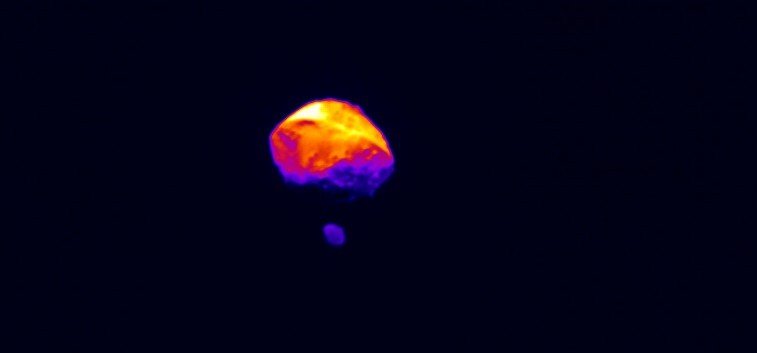
A false-color thermal view showing a large glowing orange and purple body above a small, faint round dot against a dark background.
Heat radiating from the asteroid pair on Nov. 6, 2026, measured by the Japanese thermal instrument Hera carries. The glowing body is the 730-meter primary; the faint dot below it is Dimorphos, the moonlet DART struck. "TIRI image of Didymos and Dimorphos" by ESA, via Wikimedia Commons, CC BY-SA 3.0 igo

ESA says Hera is scheduled to close to about 13 km from the asteroids in December 2026, and in January 2027 to release two shoebox-sized CubeSats, Juventas and Milani.

Sources

Spot an error?

Spot an error?

Report an error

Spotted a mistake on this page? Tell us what's wrong and our editors will take a look.

What kind of problem?

Only if you'd like us to be able to follow up. We won't use it for anything else.

We correct mistakes openly. Select any text to flag it. Fixes are logged under our Corrections Policy.

Report an error

Reporting on

Hera Finds a Stadium-Sized Crater Where DART Struck Dimorphos

What kind of problem?

Only if you'd like us to be able to follow up. We won't use it for anything else.

We read every report. Corrections are logged publicly.