A Movie Was Already Hiding in Every JWST Image

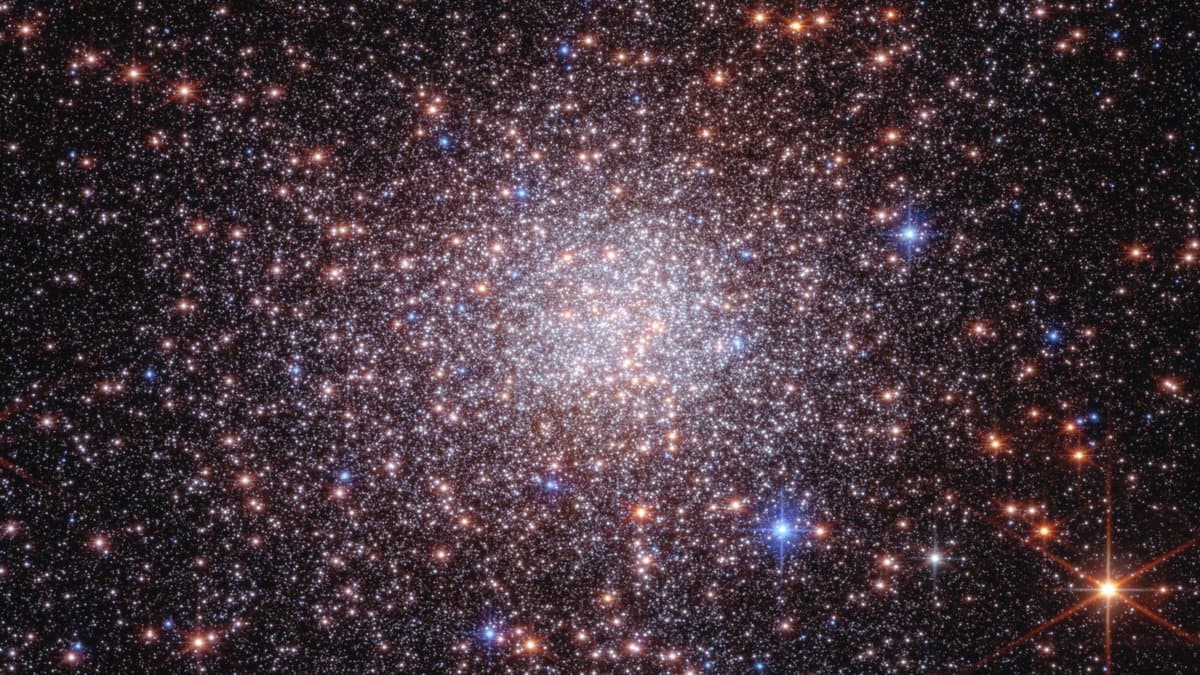
Every image the James Webb Space Telescope sends home is really a stack of images. Its near-infrared camera does not gather light for a few minutes and then read the detector once at the end. It reads the detector over and over while the charge piles up, without wiping it, and fits a line through those readings to work out how bright each star was. Roughly 21 seconds separate successive reads. Those intermediate readings have been flowing into the public archive since the telescope began observing, and the team used them to make a time series for individual sources rather than a whole field at once.
Kevin B. Burdge and colleagues report what happens when you subtract each read from the one before it: an ordinary exposure becomes a short movie of everything in the frame, and it costs nothing in observing time. Their paper was submitted to The Astrophysical Journal on Sept. 28, and has not been through peer review. They tried the method on two of the least promising fields in the sky. Terzan 5 and Liller 1 are dense, globular-cluster-like systems near the center of the Milky Way, veiled by so much dust that almost none of their visible light gets through.
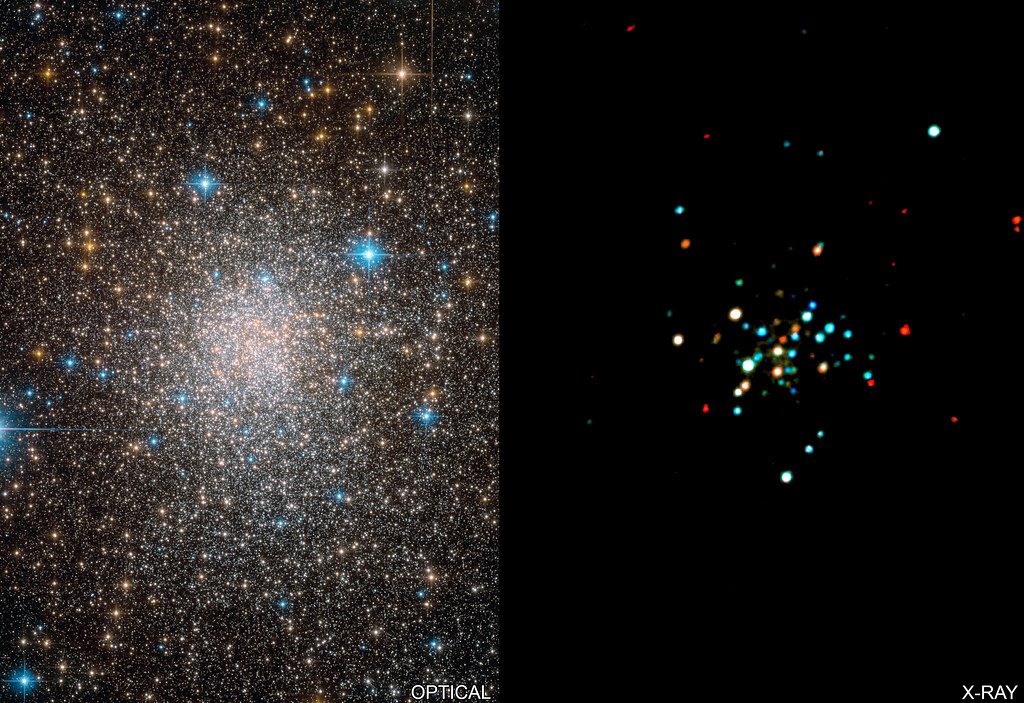
That combination is why the two are nearly blank in the record of things that change. Neighboring stars smear into one another, and the dust takes most of what visible light there is. The standard reference catalog of variable stars in globular clusters lists 53 entries in these two fields, all in Terzan 5 and none in Liller 1.
What the movie turned up
The two fields together hold 1,315 variable sources. Liller 1's field, which had none on record at all, accounts for 915 of them, nearly double the count in Omega Centauri, the runner-up and until now the most variable-rich globular cluster in the Galaxy. More than a century of observing has cataloged 5,604 variable stars across the Galaxy's globular clusters, most of them pulsating single stars. This one census accounts for 23% of that total and holds more brightness-varying pairs of stars than previous catalogs of globular clusters combined.
Burdge and colleagues have not established which of these sources belong to the clusters and which are foreground stars of the Galactic bulge lying along the same line of sight, and they say so in the caption of the paper's headline figure. In Liller 1 the colors and brightnesses alone already show that some are interlopers. The catalog also contains dozens of shallow dips of the kind something passing in front of a star would make. The authors do not assign them a specific cause: a dip that repeats fits a planet and a grazing or blended pair of eclipsing stars equally well, and they expect the blends and the grazing pairs to dominate a sample like this one.
A burster that hid for fifty years
One of the flickering points in Liller 1 had been hunted since 1976. The Rapid Burster is the only neutron star known to produce both Type I and Type II X-ray bursts, which makes it a test case for how matter falls onto a neutron star. For nearly five decades, the dust in front of Liller 1 hid what it looks like in ordinary light. Malina M. Desai and colleagues, in a companion preprint submitted to The Astrophysical Journal Letters, report that in the JWST movie the source fades by roughly 2.5 magnitudes, or a factor of ten, in one near-infrared band, with strong swings from one minute to the next. It was in an X-ray active state at the time.
A candidate for that counterpart already existed. In 2025 Cristina Pallanca, Francesco R. Ferraro, Barbara Lanzoni and their co-authors proposed a star as a possible identification in Astronomy & Astrophysics and wrote that confirming it would need further coordinated observations. The new time series shows that their candidate is a separate object, an eclipsing pair with a 17.8-hour period, which accounts for its strong variability in visible light. The candidate lies about 0.98 arcseconds from the Rapid Burster's X-ray position, while the newly identified source lies about 0.19 arcseconds away and is consistent with the updated Chandra localization. Pallanca, Ferraro and Lanzoni are co-authors on both new papers, so the new result supersedes their earlier candidate rather than representing a contest between groups.
The companion paper's abstract calls the identification unambiguous. Its own text is more careful: it records a modest offset between the new source and the Rapid Burster's radio position and describes the result as a first glimpse of the counterpart. The X-ray position is the stronger positional constraint.
A period found blind, and a period already known
The second identification carries the cleanest check in either paper. Terzan 5 holds a large population of millisecond pulsars, neutron stars that spin extremely fast, and none of them had ever been matched to a star anyone could see in visible or infrared light; X-ray counterparts to several, including this one, were already known, so the gap was specific rather than total. Searching the whole catalog blindly for periodic signals, with the radio measurements set aside, the team recovered a 108-minute period at the position of PSR J1748-2446A. Radio timing had already fixed that pulsar's orbit at 108.93 minutes. The infrared minimum falls where the radio measurements put the pulsar on the far side of its companion.
That makes it the first counterpart in visible or infrared light to any pulsar in Terzan 5, and the first infrared identification of a millisecond pulsar's companion in any globular cluster.
The method is the part that travels furthest. Differencing reads within an exposure has been done before, on Hubble, on a JWST mirror-alignment measurement and on a light curve of one object, V404 Cygni, but the authors say those applications focused on individual targets rather than an entire field. The authors scope their own claim to what is new, which is doing it to every source in a field at once, and they hedge the census itself as the first JWST variability survey of a globular-cluster-like object to their knowledge. Because the reads sit inside every exposure the instrument has ever taken, the same subtraction can be run on JWST images that have been in the archive for years, taken for reasons that had nothing to do with variable stars.
The two systems were never unwatchable. The movie was already in the archive, frame by frame, waiting for someone to subtract one frame from the next.
Sources
- arXivPreprint
- arXivPreprint
- Astronomy & Astrophysics