A Star Cannot Look Green. The Models Say This One Would.

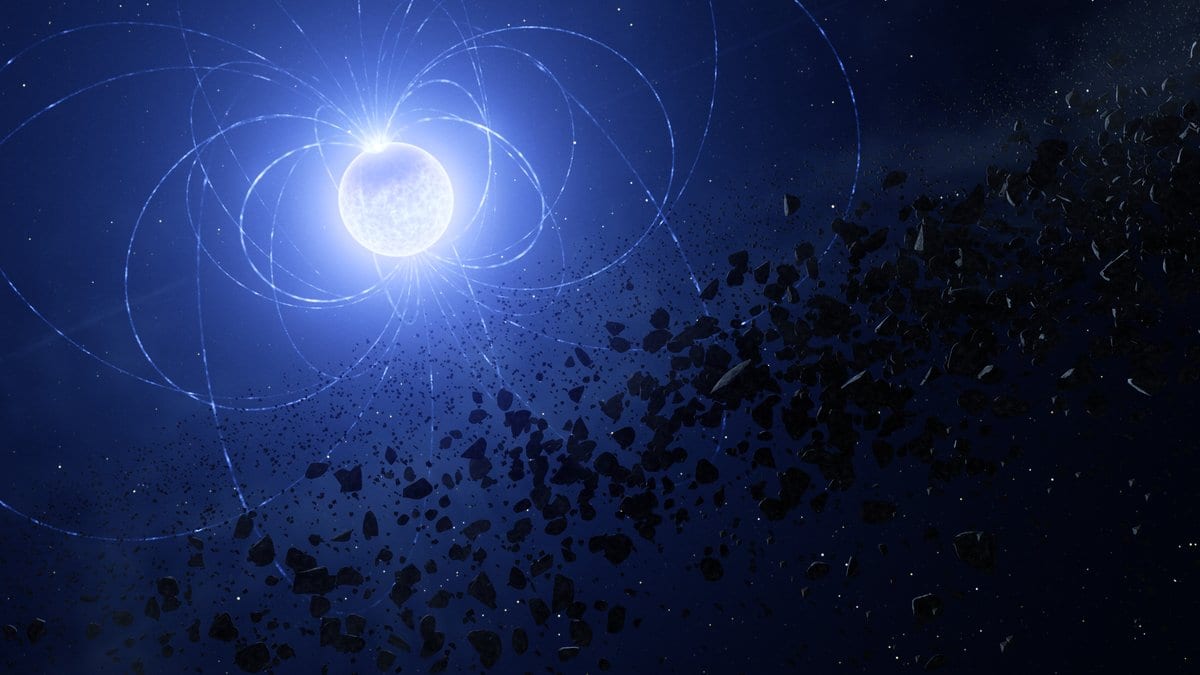
Heat a bar of iron and it reports its own temperature in color: red, then orange, then white. Stars do the same thing, which is why a photograph of the night sky doubles as a temperature map. Orange is cool, white is roughly solar, pale blue is hot. Green is the color that ordinary stars skip. A star glowing purely from heat does not appear green, and the reason is not that nobody has looked.
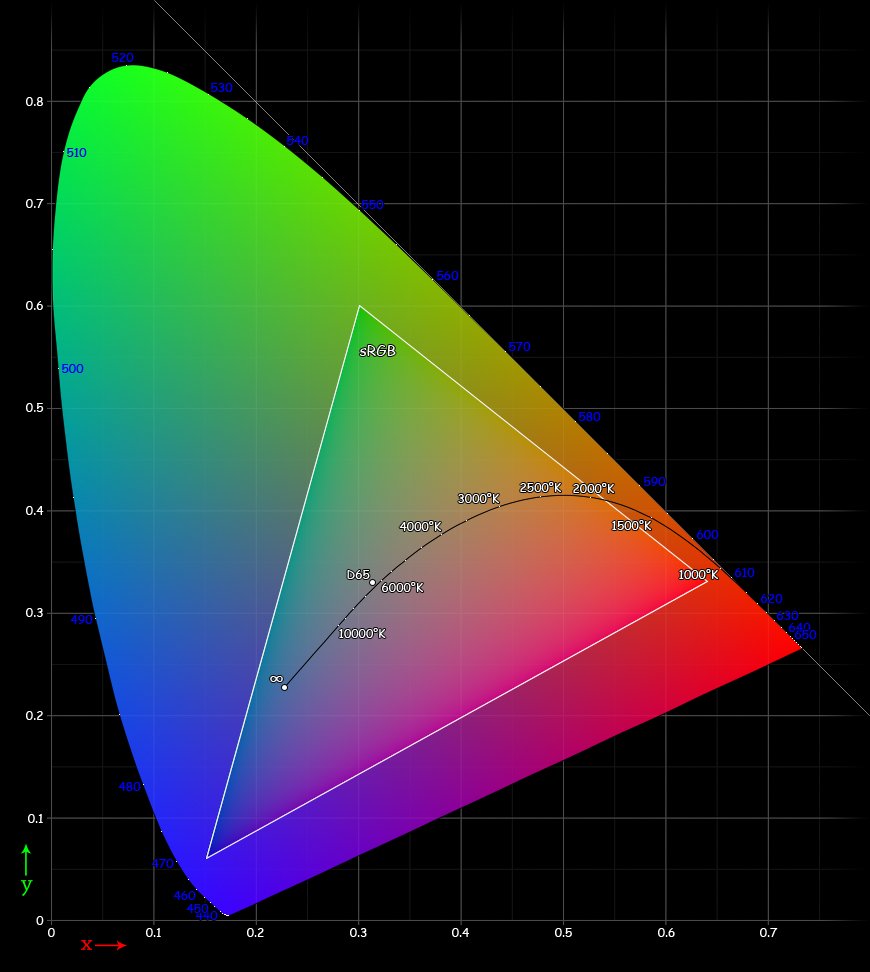
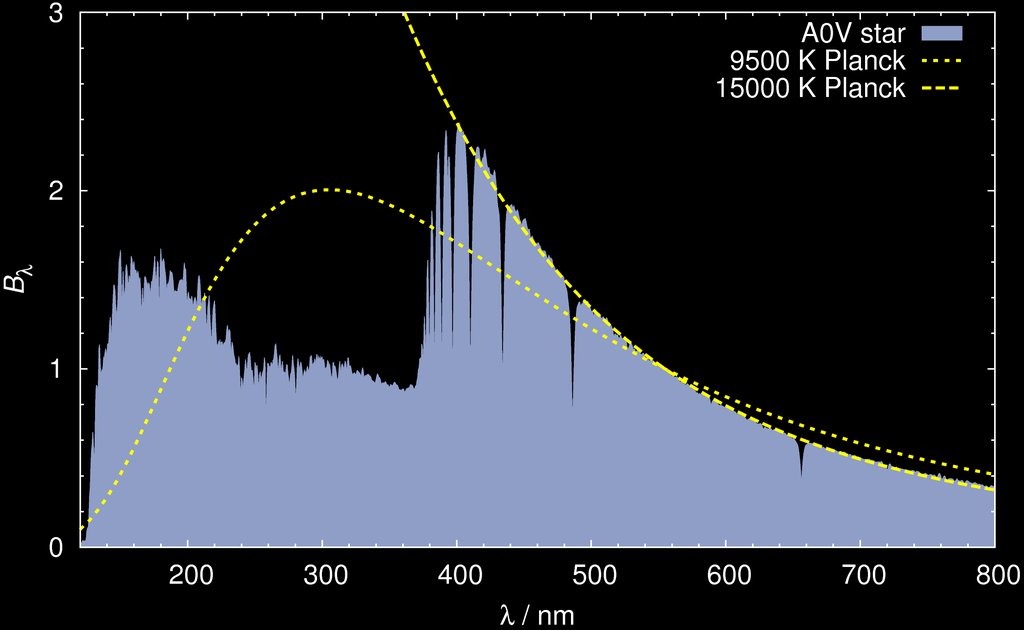
The reason is arithmetic. A hot surface does not glow in a single color but in a broad hump of them, wide enough to span the whole visible range. Push the peak of that hump into the green and the surface is still pouring out red on one side and blue on the other. The eye combines the light reaching it, and red plus green plus blue can be perceived as white. There is no temperature at which a perfect radiator, glowing purely by heat, looks green to a human being.
White dwarfs, the dense cinders left when stars like the Sun run out of fuel, were taken to be the cleanest case of that rule. Mark Hollands, Boris Gänsicke and Pier-Emmanuel Tremblay at the University of Warwick, with Detlev Koester at the University of Kiel, asked what else might be possible. Their answer, published Oct. 15, in RAS Techniques and Instruments, is that most white dwarfs are indeed close to perfect radiators, and that a few are not. One of them would look green.
No white dwarf is close enough for its disc to appear as anything but a point of light, so none of these colors has been seen. The team took spectra, the fingerprints left when starlight is split up by wavelength, and ran them through a model of human color vision. The authors keep the scope explicit: these are colors the stars would show "if viewed close enough for their stellar discs to be resolved."
Where the arithmetic stops working
What breaks the rule is density. A white dwarf packs the mass of a star into the volume of a planet, and the thin skin of gas on top is compressed to match. The coolest known ones reach atmospheric densities of about 1 gram per cubic centimeter, the density of water and millions of times that of the Sun's visible surface. At that pressure an atom is never left alone. Jostled constantly by the helium around it, sodium or calcium or carbon stops absorbing light in narrow, tidy lines and starts absorbing it across broad swaths of the spectrum. Whole bands of color are simply removed from what gets out.
That is how one star gets out of the trap. WD J1330+6435 is a cool remnant at roughly 4,000 °C that has pulled in rocky material from its own planetary system, enriching its atmosphere with calcium, lithium and sodium. According to the University of Warwick's announcement of the work, the sodium takes out the yellow, orange and red, and what is left reads as green. "The traces of sodium in the atmosphere of this white dwarf absorb the orange part of the spectrum, leaving behind a ghostly green glow," Hollands said in the release. In the team's rendering the star is chartreuse.
Whether that makes it the first green star is a qualified claim, not a definitive historical finding. The Warwick release says that as far as the researchers are aware, no other star, living or dead, has ever been credibly reported as green. Observers have called the occasional bright star greenish for more than a century, Beta Librae being the stock example, and no accepted explanation has ever come of it. The paper itself makes a similarly qualified claim, noting that, to the authors' knowledge, no other star has been claimed to exhibit a green hue.
The stains come from two directions
Sodium is one of several ways to stain a star, and the colors sort into groups by what is in the atmosphere. Debris accreted from the shattered asteroids and comets of an old planetary system pushes a white dwarf toward yellow, and in this case toward green. Carbon arrives from the opposite direction: in some cool remnants a convection zone, a churning of hot gas, reaches down to the carbon core and hauls material up. The carbon pairs off into molecules that absorb blue, green and yellow together, and the star reads pink or purple. WD J0902+2010 is the example given in the announcement. A third group, cool stars with mixed hydrogen and helium, turns cyan or pale blue, which Warwick attributes to hydrogen molecules colliding with helium atoms.
The extreme case of carbon is WD J1011+2845, a white dwarf 48 light-years away whose carbon molecules absorb much of its light at shorter wavelengths, leaving a spectrum weighted toward wavelengths longer than 600 nanometers. The announcement calls it a candidate for the reddest star ever recorded.
And the typical white dwarf is still white
Against those extremes the team also ran a census that nobody picked for being interesting: the 151 white dwarfs within about 65 light-years of Earth. Five of them come out oddly colored, two yellow and three pink. The green star is not among them. That matters, because the two scales in this work are different: the chartreuse one turned up in a search of the whole sky, while the one-in-thirty estimate comes from the local census alone. For the other 146 the median effective temperature is about 6,800 kelvin, consistent with a white appearance.
"Yet if we take the median across a representative population of white dwarfs, we found that the average white dwarf really is white," Gänsicke said in the announcement. That corrects a long-standing impression: white dwarfs look blue. The ones that look blue are the hot ones, and hot ones are brighter, so they can be seen from much farther away. A survey that picks stars by brightness therefore collects them preferentially. A census of a defined volume of space, by contrast, gives a different picture.
The practical residue is a new use for data astronomers already collect. A spectrum has long yielded a star's temperature and its chemistry; the same spectrum, run through a model of the eye, now yields a color as well. The colors computed for these stars cannot be checked by looking, and in practice are unlikely to be, since no white dwarf appears large enough in the sky for its disc to be resolved from Earth. Every colored picture of one, the chartreuse star included, is a simulation rather than a photograph.
Sources
- RAS Techniques and InstrumentsPeer-reviewed
- warwick.ac.uk