A Second Young Star Appears to Be in the Phase That Dates Our Solar System's Oldest Rocks


Almost everything anyone knows about when the Solar System began rests on a few pale specks inside meteorites. They are calcium-aluminum-rich inclusions, grains condensed from hot gas close to the young Sun, and the date locked in them is the zero point of the whole timeline. Astronomers have wanted to watch that chapter happen somewhere else for decades. The difficulty is where it happens: deep inside a disk still buried in the cloud collapsing onto it, which is exactly where dust hides things best.
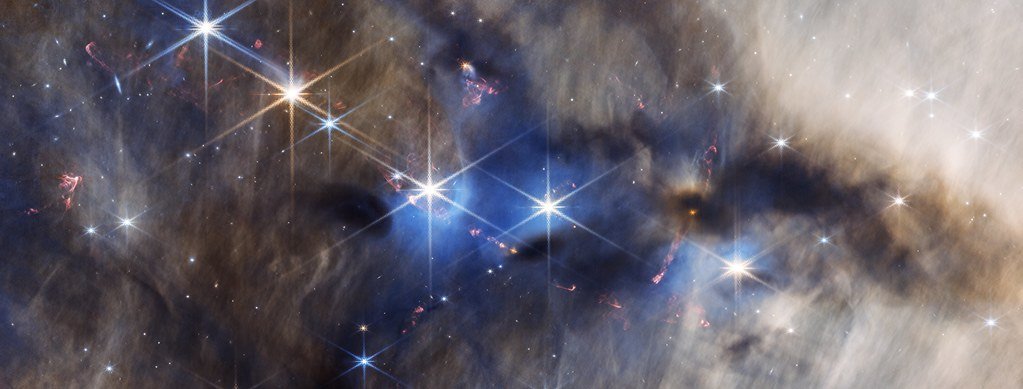
A second candidate has now turned up. On Oct. 13, a Leiden Observatory group led by F. J. Ballieux posted observations of HOPS-68, a young star in the Orion Molecular Cloud that is still drawing its mass out of the envelope around it. Webb watched it with two infrared spectrographs, NIRSpec and MIRI, in February and March 2023, under a program led by M. K. McClure. The paper has been accepted for publication in Astronomy & Astrophysics and has not yet appeared there.
What the spectra show is absorption. Molecules sitting in front of a bright background leave their fingerprints in it, and the team fitted those fingerprints with simple models of a warm slab of gas. Silicon monoxide, water, carbon dioxide and two forms of carbon monoxide all turn up in a single layer at 300 to 500 kelvin, lying above the disk's hot middle plane and extending between 0.3 and 16 astronomical units from the star, one unit being the distance from Earth to the Sun. Every band is shifted toward the blue by 33 to 53 kilometers per second relative to the star's own velocity, which means the gas is coming toward us, consistent with material rising off the disk in a wind rather than simply orbiting with it.
Where the rock is supposed to be boiling
The reading the authors put on that is a thermostat. In a disk still being fed at a high rate, friction heats its middle plane until, somewhere above roughly 1,400 kelvin, the dust there vaporizes; with the dust gone the gas turns transparent, heat escapes upward, and the temperature stops climbing. Rock vaporizing at that boundary releases silicon and oxygen into the gas. Ballieux and colleagues place HOPS-68's thermostat about two astronomical units out and interpret the warm layer above it as the base of a wind lifting the enriched gas clear of the middle plane. ALMA, the millimeter-wave array in Chile, separately resolves a jet and a wind leaving the system rich in silicon monoxide, at velocities consistent with those measured in the infrared bands.
No instrument in this work saw rock turn to gas, and none saw it turn back. The solid half of the story is fifteen years old. In 2011, Poteet and colleagues found forsterite, a magnesium silicate, in HOPS-68's spectrum from the Spitzer Space Telescope, and interpreted it as evidence of crystals annealed in the hot inner disk and then carried outward in the star's outflow. Webb's new contribution is the cooler silicon monoxide gas above the hot middle plane. The authors put the two together and conclude that crystalline silicates are condensing out of that gas at HOPS-68 now. The conjunction is the argument. It is an inference, not a picture of rock changing state.
That is what makes HOPS-68, in the team's own framing, the second source identified as being in this cycle of vaporizing and condensing rock. The first was HOPS-315, reported in Nature on July 16, 2025, by a group McClure led. Four of that paper's authors are on this one, so the count is one team extending its own result rather than a sweep of the literature. Two objects are all that have been identified in this state, which is not the same as two being all there are. Both happen to be tilted at a helpful angle, so the line of sight runs down into the inner disk instead of across it.
Why the younger star is the interesting one
The part that reaches past either object is the timing. HOPS-68 is the younger of the two, with a cooler overall output, deeper ice bands and warm gas sitting farther out from a hotter middle plane. The authors argue that if a star this young and one as far along as HOPS-315 are both in the same state, the oxygen enhancement may indicate a prolonged epoch rather than an instant.
The surrounding numbers point the same way. Models give a thermostat region a life of roughly 50,000 years, and Solar System meteorites put the phase that made the inclusions at between 40,000 and 200,000 years, a stretch comparable to the duration of the early stage a star like HOPS-68 is in. On those figures, a large share of such stars should be passing through this phase at any moment, which the authors read as a sign that it may be a common one.
The oxygen claim needs its boundary. What is enhanced is the molecular layer in the inner few astronomical units, with the wind carrying material from there up and out into the outer disk, not the disk as a whole. The inner disk is already expected to gain oxygen as ice-coated grains drift inward past the line where water freezes, and the authors suggest that vaporizing oxygen-rich minerals add to that close to the thermostat. What any of it does to a planet is not in this paper. Nothing resembling a planet or a planetesimal, the kind of rocky body a planet is built from, is measured at either star, and the paper's one sentence linking this moment to a disk's first planetesimals is hedged and refers to HOPS-315.
What would settle it is a third star
What the team wants next is more objects. With two, the effects of age, sudden bursts of accretion and viewing angle cannot be separated from one another, and the paper says so. HOPS-68's own solids are also still unexamined: strong ice and silicate features run through the same Webb spectrum, untouched by this work. If the forsterite there has only just condensed and has not yet clumped together, as the team suspects given the star's youth, then the two stars would not be two snapshots of one instant. They would be the first two frames of a sequence.