Physicists Turn a Crystal's Edge Into a Probe for Magnetism That Cancels Itself Out
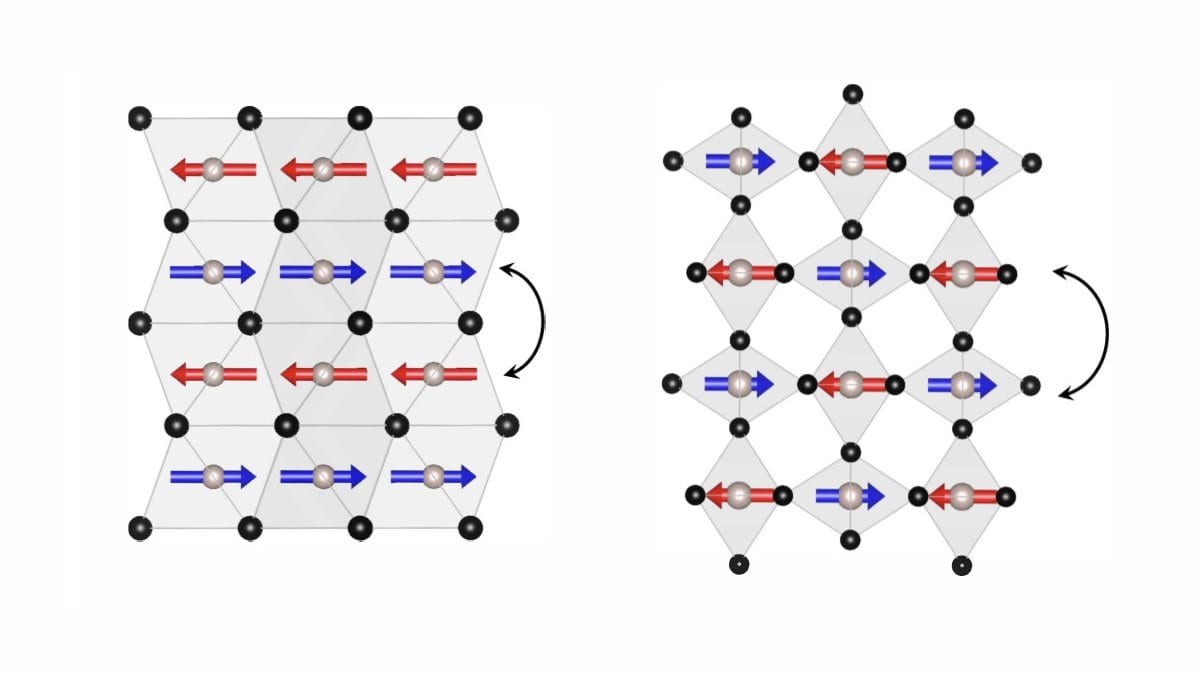
Physicists in China have turned the conducting edge of one crystal into a microscope probe sensitive to the spin of single electrons, and used it to gather evidence that the top layer of a second crystal carries magnetism that leaves no net magnetic field behind. Zhuying Wang and colleagues published the measurement Oct. 13, 2026, in Nature.
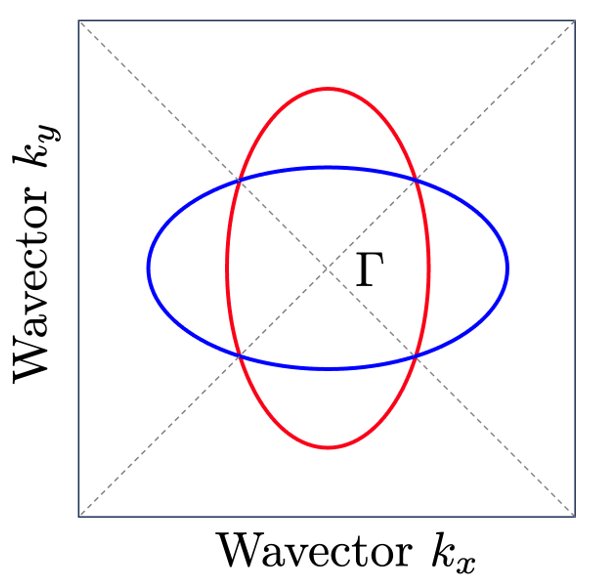
The target is a class of material called an altermagnet, in which electrons of opposite spin carry different energies depending on which way they travel, even though the crystal as a whole is not magnetic. That leaves little for ordinary magnetic instruments to detect. The authors say reading such an order calls for a measurement sensitive to spin at the scale of single atoms, mapped both by position and by electron motion. They describe that combination as an experimental milestone not previously achieved.
Their probe is α-Bi4Br4, a crystal whose edges conduct electricity in a way that ties an electron's direction of travel to its spin. Used as the sensing tip of a scanning tunneling microscope aimed at the surface of KV2Se2O, it returned three kinds of evidence.
The paper reports that atom-by-atom maps showed how the two vanadium sublattices sit against a periodic ripple in the lattice, in patterns consistent with a checkerboard arrangement of alternating spins. In a magnetic field, excitations running along two perpendicular directions shifted in energy, in opposite directions. Measurements of how electrons scatter favored one of two otherwise equivalent directions, and flipped when the measurement voltage was reversed.
Together, the authors call these converging evidence for two-dimensional d-wave altermagnetic order on the surface of KV2Se2O, consistent with that order rather than proof of it. They present the method as a route to atomic-scale spin sensing in other quantum materials.
The 22 authors are based mostly at the University of Science and Technology of China in Hefei, with colleagues in Hong Kong, Beijing, Chongqing and Texas. Nature has posted the accepted manuscript ahead of the final version, which it says is subject to further edits.
Sources
- NaturePeer-reviewed