A Cold Giant Planet the Standard Models Do Not Build

The Planet Finder Spectrograph has been measuring the back-and-forth motion of HIP 88962 since 2010, and the star still has not shown it one complete lap. HIP 88962 is a small orange dwarf about 89 light-years away, cool enough to sit at the edge of the red dwarfs, and an earlier campaign on a smaller telescope had watched it and found nothing moving at all.
Alan P. Boss and R. Paul Butler of Carnegie Science, with colleagues at Shanghai Jiao Tong University and Tsinghua University, now report a cold gas giant circling it. Their paper, in press at The Astrophysical Journal Letters and posted to the arXiv preprint server on Nov. 11, 2026, has been through peer review and is not yet published. The spectrograph sits on the Magellan Clay Telescope at Las Campanas Observatory in Chile, and the measurements behind the detection end in 2025.
The wobble on its own gives only a lower limit on the planet's mass, because it registers only the part of the star's motion aimed toward or away from Earth. The long gap between the positions the Hipparcos satellite recorded for this star and the ones Gaia has recorded since pins down how the orbit is tilted. Gaia's individual measurements are not yet public, so the team generated synthetic ones from the mission's published scanning forecast and checked them against Gaia's catalog solutions. Out of the combined fit comes a planet of 4.83 Jupiter masses, orbiting at 6.15 times Earth's distance from the Sun. Its orbit has an eccentricity of 0.718, where a circle would be zero. The tilt stays loosely constrained, but the orbit is near enough to edge-on across the whole allowed range that the mass barely depends on it.
The planet's mass is only as firm as the star's, and the star's was never measured. HIP 88962 is missing from the catalog of well-characterized cool dwarfs, so the team took 0.62 solar masses from a standard relation between a star's color, its temperature and its mass, then held that figure fixed while fitting the planet. About 4.8 Jupiter masses is as far as that chain honestly reaches.
The orbit is not closed either. The fitted period is 7,055 days, close to 19 years, with an uncertainty of several hundred days, and the measurements cover less than one revolution. The team also tried fits that let the star drift slowly underneath the orbit; the data do not clearly prefer any of them, and one more than doubles the period, to 17,726 days. Boss and colleagues keep the shorter solution and say why: "Given the limited orbital coverage, we believe that it is reasonable to retain the original orbital solution and to avoid over-interpreting the alternative fits."
A planet that heavy, that far out, on an orbit that stretched is what makes the system awkward. The conventional route to a gas giant builds a solid core first and lets it draw in gas once it is massive enough, and a small star comes with a smaller disk to build from. Four published studies have grown whole populations of simulated planets that way, around stars of a range of masses, and the authors set HIP 88962 b against all four. One of those studies does make gas giants around stars of this mass, but almost none heavier than a single Jupiter beyond Earth's distance from the Sun. Another produces no heavy giant at all on an orbit longer than about 1,000 days. The giants that do form in them average eccentricities below 0.2, against 0.718 here. It is the combination that the models miss, not any one of its parts.
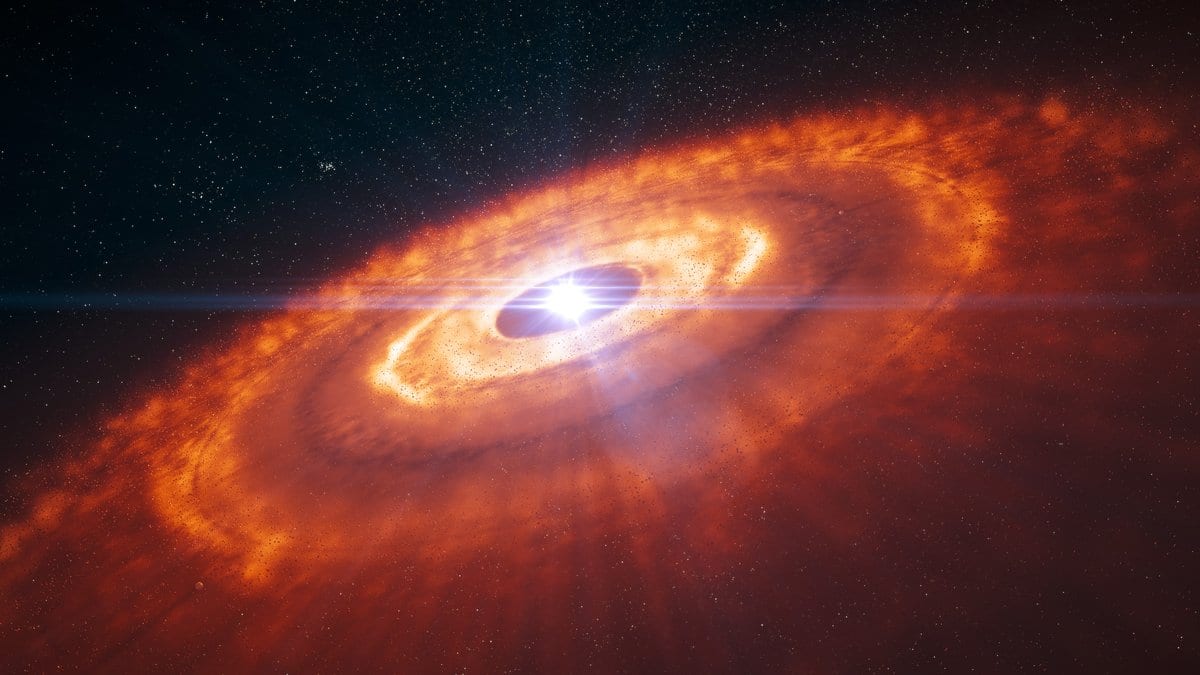
The mechanism the team favors instead is gravitational instability: a young disk cold and heavy enough to collapse on itself, making a giant planet in one step rather than assembling it from a core outward. Models of that process put the clumps it makes on starting orbits of roughly four to ten times Earth's distance from the Sun, which brackets where this planet is now. The reading is the first author's own. Boss proposed disk instability as a route to giant planets in 1997, and he is an author on four of the five studies the paper cites in its support.
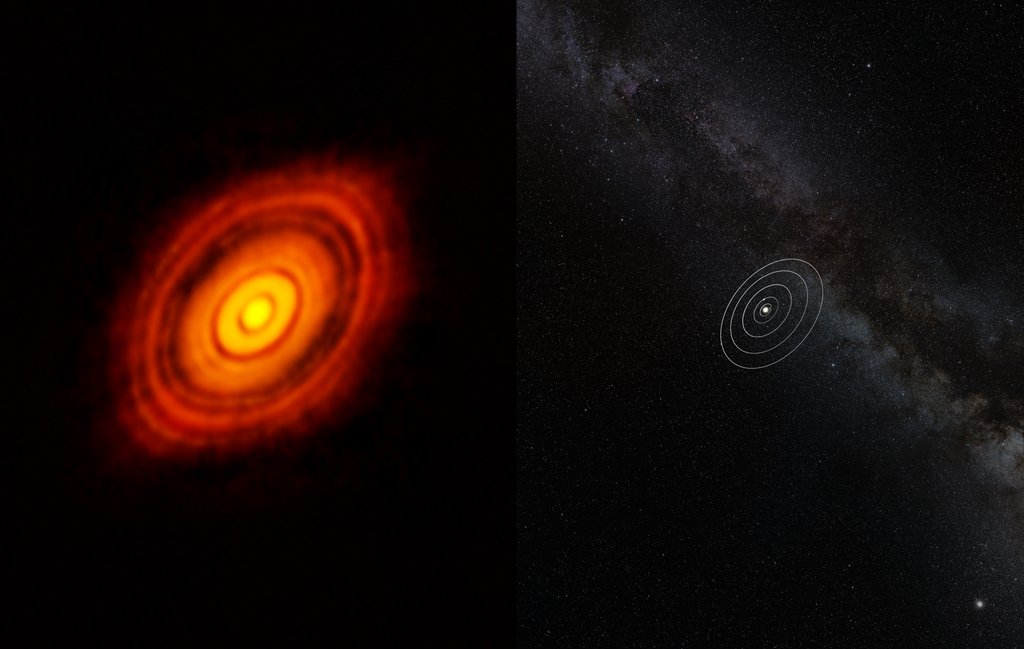
The paper is candid about the asymmetry in that comparison. None of those disk-instability models was ever run at the scale of the core-accretion population studies it is weighed against, and what the authors claim for it is narrower: that the mechanism is plainly capable of making a planet like this one.
The fit also leaves more scatter than the instrument alone should: about 6 meters per second, roughly twice what it records on comparable quiet stars. HIP 88962's calcium lines emit about twice as strongly as theirs, and its brightness varies on a timescale near 17 days, so the team reads the excess as the star rather than as something else in orbit. A 4.1-day signal in what is left over survives a first statistical screen, and they still decline to call it a planet: "Therefore we do not consider the 4.1-day signal to be a robust planet candidate."
HIP 88962 b is not the first planet to fall outside the models, and the paper says so. It names a giant found around a smaller star in 2023 by the same pairing of Doppler and position measurements, and two heavier ones around red dwarfs reported in 2025; both of those teams also read their planets as the work of a collapsing disk. The conclusion Boss and colleagues draw is not that core accretion is wrong. It is that the field needs "a hybrid, universal model of exoplanet formation combining both extremes." Which mechanism built this one is a question for the telescope, and the answer waits on the star finishing a lap.
Sources
- arXivPreprint