Radio Flashes Measure How Far Galaxies Push Their Gas

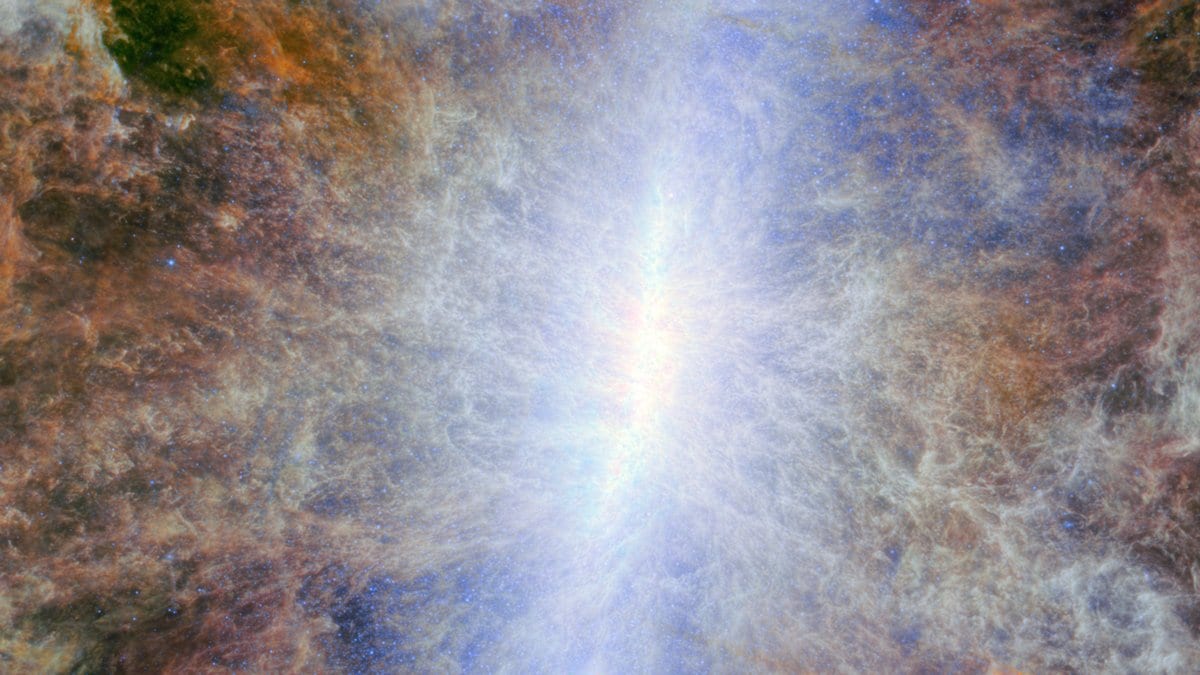
A fast radio burst lasts about a thousandth of a second, and then it is gone. What survives the trip is a smear: the burst's low frequencies arrive slightly behind its high ones, delayed in proportion to the free electrons the flash crossed on the way here. Each burst is a tally of ordinary matter along one line of sight through the universe. In a paper published on Sept. 8 in Nature Astronomy, a team led by Kritti Sharma at Caltech uses 114 of those tallies to get at something cosmologists have struggled to pin down: how far galaxies have thrown their own gas.
Galaxies are leaky. Exploding stars, and the outflows driven by the black holes at galactic centers, push gas out past the edge of the galaxy that made it and across millions of light-years. Cosmologists call this feedback, and it is a nuisance as much as a phenomenon. The big lensing surveys read how matter clumps together, using the way the gravity of everything in the foreground distorts the shapes of distant galaxies. They mine that clumping for what it says about dark energy, the nature of dark matter and the summed mass of the neutrinos. Gas that has been shoved outward smooths the clumping on smaller scales, and a survey cannot easily tell the smoothing from the cosmology.
Fast radio bursts offer a way to see that gas directly. The delay a burst picks up counts the free electrons along its path, and current samples reach only the nearby universe: out to a redshift of about 0.3, where galaxy groups and clusters sit. That, the paper argues, is exactly the range needed to interpret lensing surveys and to settle the disagreements among X-ray measurements.
From the bursts and the distances of their host galaxies, the team infers how the density of ordinary matter varies from place to place, and converts that into two quantities. One is the fraction of gas still held by halos of 10^13 solar masses and above, group and cluster scale. The other is how much feedback has flattened the clustering of matter at k ≈ 0.1–3 h Mpc⁻¹, the shorthand cosmologists use for structures a few to a few tens of megaparsecs across.
The company those constraints already keep is the striking part. They are "already competitive with the legacy measurements from Atacama Cosmology Telescope and eROSITA," the team writes in the Nature Astronomy paper: a microwave telescope that has spent years mapping the sky from Chile, and an X-ray survey that cataloged the clusters across half of it. Those are mature instruments with long observing campaigns behind them.
One published check makes the case that this is about intergalactic gas and not about assumptions. Split the sample by distance into two halves of 57 bursts, and the inferred strength of the feedback stays put, within the uncertainty of the measurement. The two halves are not interchangeable. The nearer bursts pin down how much of the delay the host galaxies themselves contribute; the farther ones carry most of the sensitivity to feedback.
Sharma's group is not alone, and the paper does not claim a first. In June, Robert Reischke and Steffen Hagstotz reported in the Open Journal of Astrophysics that the scatter in the dispersions of about 100 localized bursts rejects a no-feedback universe at better than 99.7% confidence: a different group, a different simulation suite, a different statistic. Sharma and colleagues cite that paper. Two independent teams reaching strong feedback from the same kind of data says more for the method than either result alone.
The paper's own argument for what comes next is a forecast rather than a result. Adding burst measurements from the Deep Synoptic Array to the galaxy clustering and lensing analysis planned for the LSST survey would, on the team's projection, pin the summed mass of the neutrinos to within about 0.12 eV and tighten the numbers that describe whether dark energy has changed over cosmic time. It assumes burst catalogs far larger than today's.
The claim the authors make for the work itself is narrower. It "establishes FRBs as a sensitive probe of feedback-regulated structure formation," they write, and is "poised to deliver leading constraints on baryonic physics" as the catalogs grow. The sample of bursts and a full reproduction package are posted on GitHub alongside the paper, so the next group with more flashes can run the analysis again and see whether it holds.
Sources
- Nature AstronomyPeer-reviewed
- Nature AstronomyPeer-reviewed
- GitHub Sharma (2026)
- The Open Journal of Astrophysics