Euclid's First Big Data Release Starts Turning a Flat Sky Into a 3D Map

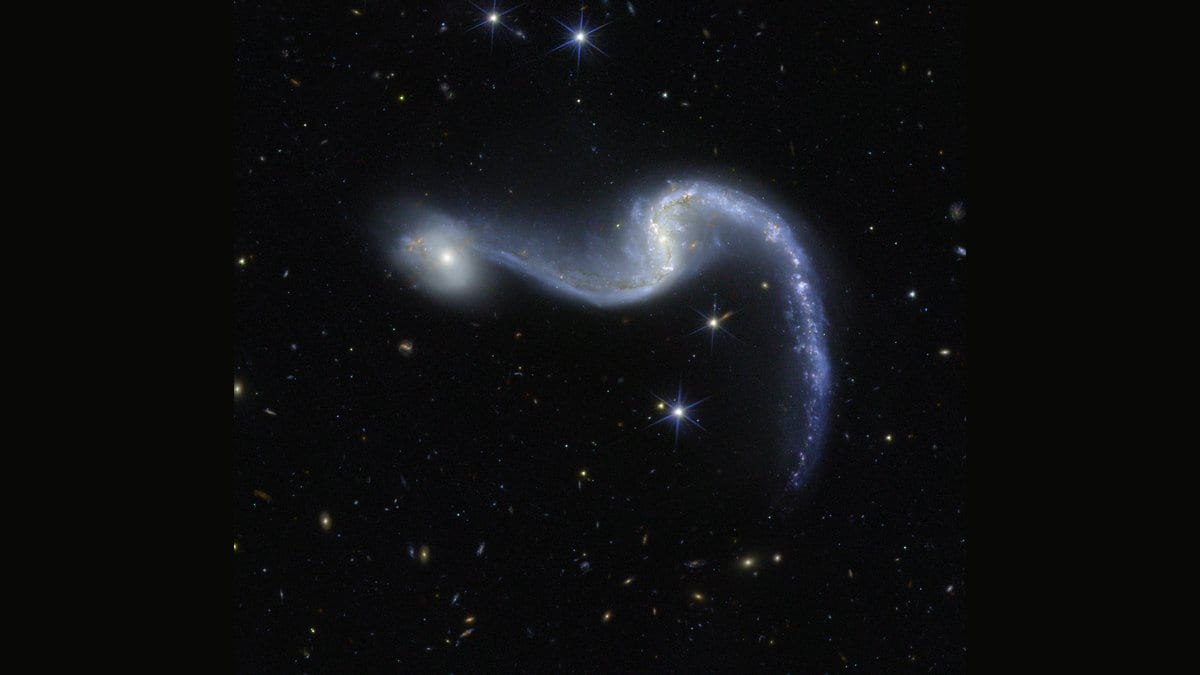
A deep picture of the night sky is a beautiful thing and a frustrating one. Everything in it lands on the same flat plane. A galaxy a few million light-years away and one far behind it can sit side by side in the frame, and the image itself says nothing about which is which. Depth has to be measured, object by object, and depth is what cosmology actually needs.
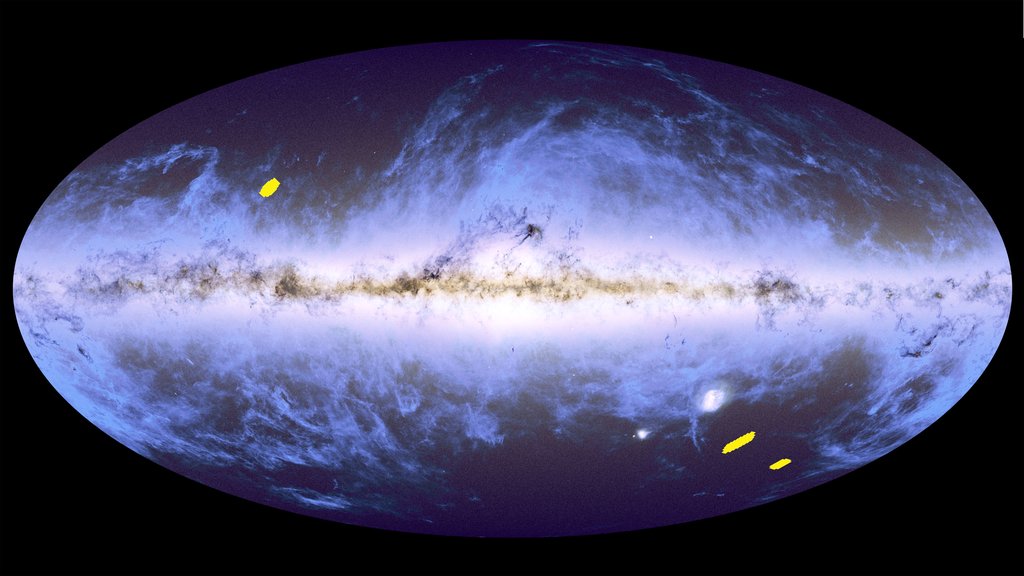
On Nov. 12, the European Space Agency's Euclid mission released the material for doing that at scale. The release, named DR1-Foundation, is the first major batch of survey data from the telescope since its launch in July 2023: around 13 months of observations, from spring 2024 to spring 2025, covering around 1,900 square degrees of sky. ESA's own way of picturing that area is a stretch of sky as big as 9,500 full Moons.
Inside it, Euclid cataloged more than 900 million galaxies, more than 60 million quasar candidates, the brilliant cores of distant galaxies, and around 15,000 strong gravitational lensing candidates, systems in which the gravity of a foreground object bends and magnifies light from something behind it. The release captures light from more than a billion objects in total.
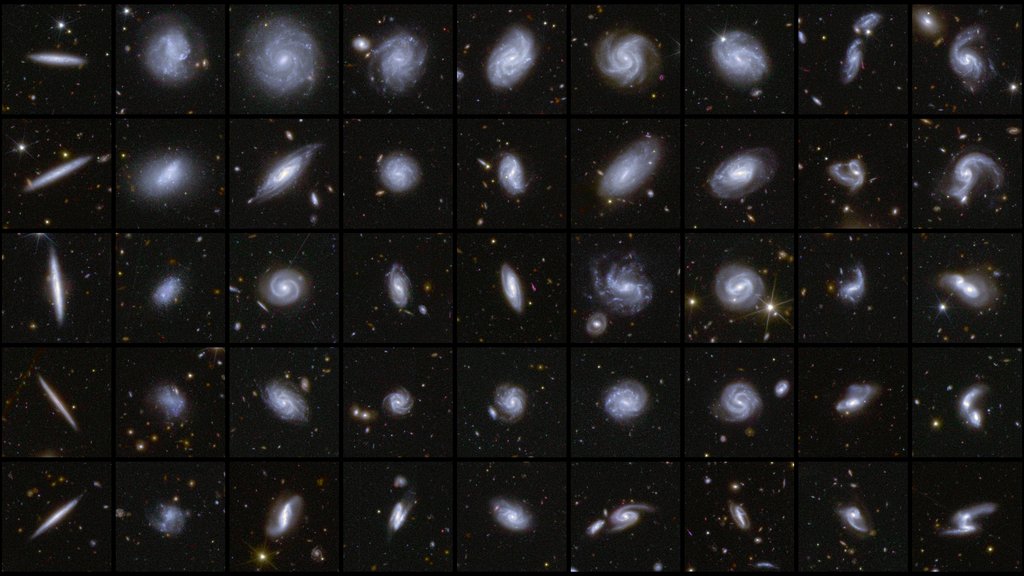
"This is a change in scale from Euclid's previous releases, which included a few days of observations over around 60 deg² of sky," says Valeria Pettorino, ESA's Euclid project scientist. "We're now releasing more than a year of data covering a significantly larger area. This unlocks ground-breaking science."
What the release does not contain is a result about dark energy or dark matter. Euclid was built to study both, and DR1-Foundation provides the raw material such a result would have to be built from: calibrated images, catalogs and spectra. Eight accompanied papers appeared on arXiv the following day, describing the data and its first scientific applications. They have not yet been peer-reviewed.
ESA's director of science, Carole Mundell, called the release a milestone in its own right. "These are far more than beautiful pictures; today marks a scientific milestone in our study of the cosmos," she says.
Depth comes from splitting light, not from taking pictures
The part of the release that does the three-dimensional work sounds like the smallest of them: the spectra from more than 160 million sources. Euclid sends the light of a galaxy into an instrument that acts like a prism, spreading it into a rainbow. Gas in the galaxy leaves markers at particular places in that rainbow, and the one Euclid hunts for comes from clouds of hydrogen where stars are forming. Where that marker falls tells you how far away the galaxy is.
That is what turns a list of positions into a map. ESA describes the next step as a capability rather than an achievement: scientists can mine the dataset for the distances to individual galaxies and place them in the three-dimensional structure of the Universe. That structure is the cosmic web, a mesh of filaments shaped largely by dark matter, along which galaxies gather. Mapping it in detail is the main goal of Euclid's spectroscopy, and it is work that begins with this release rather than work the release has done.
Fifteen thousand places where gravity acts as a lens
The lens catalog is the other reason the release matters more than its size suggests. When a massive galaxy sits almost directly in front of a more distant one, its gravity distorts the light traveling past, and the more distant galaxy reaches us bent out of shape. How much the light bends depends on the total mass doing the bending, including dark matter, which makes a strong lens one of the few ways to weigh a single galaxy.
"Strong lensing provides unique insight into the dark Universe, allowing us to 'weigh' individual galaxies, including their invisible dark matter, and explore how the Universe is expanding," says Natalie Lines of the University of Portsmouth in the UK, a member of the Euclid Consortium.
Rarity is what has kept the field small: only one galaxy in several thousand acts as a lens, and from the ground the atmosphere blurs most of the smaller ones away. ESA calls the new set "the largest strong lens catalogue ever" and says it is bigger than all previous catalogs combined. The 15,000 systems are candidates, not confirmed lenses. Machine-learning models helped identify promising examples, which were then examined by thousands of volunteers through the Space Warps project and assessed by expert researchers. What makes them unusual as a set is that one telescope found them all in a uniform survey, which lets strong lenses be studied as a population instead of a scatter of individual curiosities.
"Over 10 years ago, we forecast that Euclid would revolutionise the field of strong lens discovery," Lines says. "That day is finally here."
The map is one-seventh drawn
DR1-Foundation covers about 14% of the sky area Euclid will survey across its six-year mission. The full Data Release 1 is due in mid-2027, and ESA says it will add the pieces this one leaves out: weak-lensing measurements and calculations of how galaxies and galaxy clusters fit into the cosmic web. Weak lensing is the subtler version of the same bending effect, detected statistically across many galaxies at once.
For anyone outside the consortium, the plainest fact in the release is the useful one: the data are public, all 1.7 million GB of them, and can be queried and visualized through ESA's Euclid Data Space rather than requested from anyone. "Storing and sharing such large catalogues, with more than a billion objects, was no mean feat," says ESA archive scientist Bruno Altieri. The 3D map Euclid was built to make does not exist yet. The measurements it will be built from now do.