As the Moon Pulled Away, Earth Changed Shape and Its Crust Had to Move

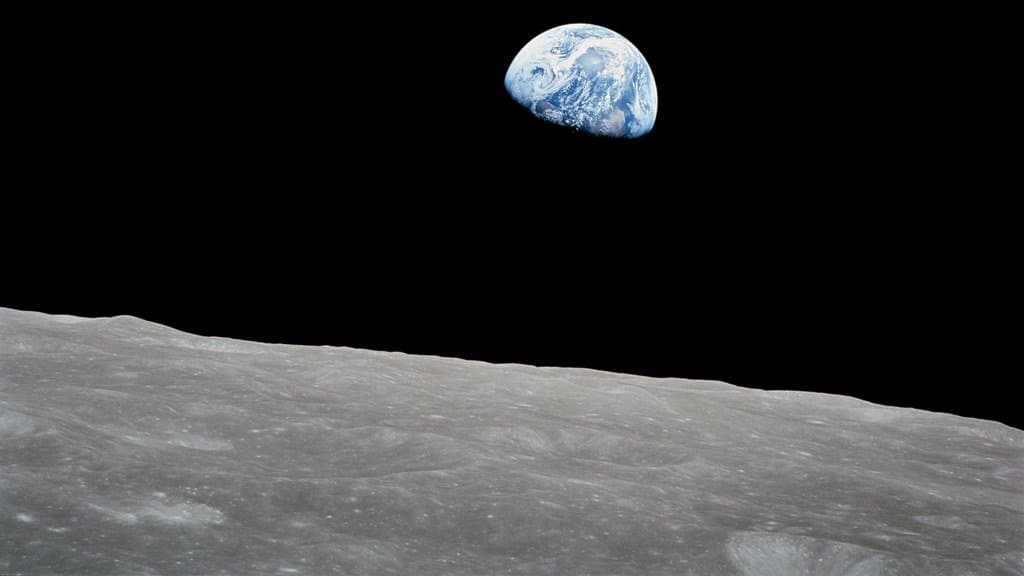
Stand on Earth in the first few million years after the Moon formed and almost nothing is familiar. The Moon hangs close, far bigger in the sky than it is now. The day ends before five hours are out. And the ground beneath you is not wrapped around a sphere. Spinning that fast, the planet is strongly distorted, its equator bulging outward while its poles are compressed, and in the most extreme cases the equator can sit twice as far from the center as the poles do.
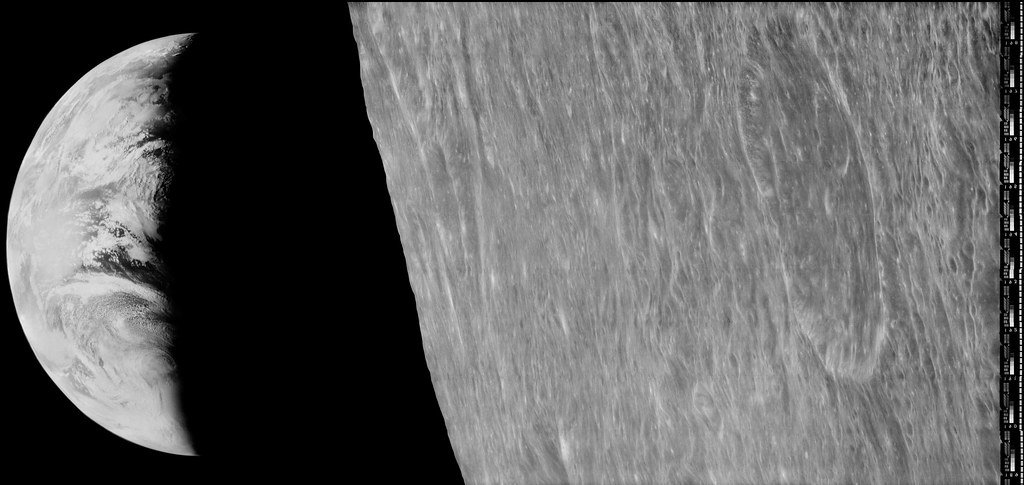
Then the ordinary business of tides takes over. The Moon drifts outward, Earth's spin slows, and the bulge relaxes. Simon J. Lock, a planetary scientist at the University of Bristol, has modeled how that relaxation could have affected the first crust sitting on top of it. His single-author paper was accepted by the journal JGR: Solid Earth on Aug. 31, 2026, and the accepted manuscript was posted on arXiv on Sept. 18. The argument is compact. He writes that previous work on the early Earth has neglected an important component: rotation.
The geometry does most of the work. As a squashed planet rounds out, the surface near the equator has to shrink and the surface near the poles has to stretch. The dividing line falls between roughly 20 and 40 degrees of latitude, north and south: inside it the crust is pushed together, outside it pulled apart. And unlike the strain at a plate boundary today, which is concentrated along a boundary, this strain acts in every direction at once.
The spin had already left its mark before any of that. Effective gravity at the equator of a fast-spinning Earth is weaker, because the centrifugal effect of rotation works against gravity, so the mantle there can melt at greater depth, with more melt available to rise and freeze into crust. In the canonical case (the one in which the Earth and Moon have carried the same angular momentum, a measure of total spin, since the impact), the first crust is about 15% thicker at the equator than at the poles. In model runs that start with far more angular momentum, the difference could reach a factor of ten.
The squeeze would have run all the way around
How fast, and for how long, depends on which model of the Earth-Moon system you use. In the canonical case, the equatorial convergence rate exceeds an average subduction zone today, about 60 millimeters a year, for the first few million years. Near the poles, the extension rate remains above that of a slow-spreading mid-ocean ridge for a comparable stretch of time.
Some Moon-formation models start the system with much more angular momentum than it has today, and there everything is larger and slower to fade. Deformation rates run about ten times the canonical ones, and equatorial convergence stays above a typical subduction zone's rate for 30 million years. Those runs also do something the canonical ones do not. The lunar orbit passes through an instability, the Moon's distance drops abruptly, and each of those episodes drives a spike in deformation lasting roughly a million years. In the runs that begin with the most spin, those brief peaks reach rates comparable to the average rate across the Himalayan convergence zone today, about 2 millimeters per degree of arc per year, a rate averaged over the width of the belt. Lock supplies the contrast himself: "unlike the Himalayas, the deformation on early Earth would be occurring at this rate around the entire equator."
That comparison is the most striking line in the paper and the most conditional. It belongs to short-lived peaks, and only in the high-angular-momentum runs. The sustained claim sits an order of magnitude lower: extension near the poles and compression near the equator "at rates equivalent to the deformation accommodated by plate boundaries on Earth today," for millions to hundreds of millions of years after the Moon formed. The high-angular-momentum scenarios are themselves disputed, and the paper says so, citing "considerable debate" over how the Earth and Moon could have shed that much angular momentum.
What all that moving could have made
If the crust were pushed around this way, the consequences could reach well past tectonics. Squeezing at the equator would carry weathered, water-bearing surface rock down to depth, and water and carbon lower the melting point of rock; melting it again yields magmas that freeze into lighter, silica-rich rock, the family that includes granite. Stretching near the poles would let deeper material rise and melt on the way up, much as mid-ocean ridges work today. And if the crust was thick enough, garnet could grow at its base and make the lowest layers denser than the mantle beneath them, so parts of the crust could peel away and sink.
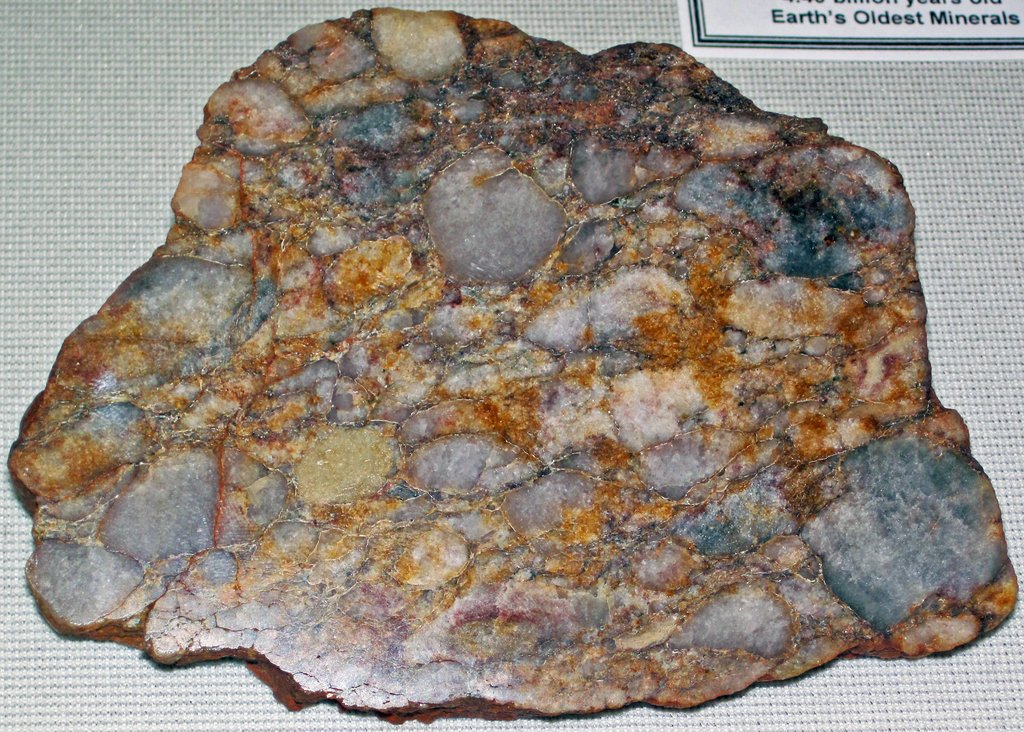
That chain is aimed at a real puzzle. Ancient zircon crystals and the oldest surviving rocks suggest Earth had varied, silica-rich crust within tens of millions of years of the Moon-forming impact, earlier than a single, uniform first crust would be expected to produce it. Lock offers the mechanism as something that could explain that record. Nothing in the paper is measured from rocks.
The same deformation could have reached the air and the sea. Stretching near the poles could have driven melting and outgassing from the interior. Weathering of even short-lived high ground could have pulled carbon out of a thick, carbon-rich early atmosphere and locked it into carbonate rock, and a surge of hot water circulating through broken crust could have carried elements into the young ocean. The verb attached to all of it, in the paper, is "could."
A first pass, and the paper says so
Lock is direct about what kind of study this is. He calls it an "exploratory study" offering "first-order calculations and qualitative descriptions," because "we lack tools capable of making quantitative predictions" for a planet this distorted and this fast-changing. The shape-change idea is not new in itself; it has been studied for smaller bodies in the solar system. He writes that what has not been explored is the possibility that the same thing happened to the early Earth.
Settling the question will take more sophisticated modeling: mantle convection models that account for a planet's changing shape, and models that follow the thermal and orbital histories of the Earth and Moon together. In the meantime, the pieces are open. The HERCULES structure code behind the calculations is open source, and the scripts and data behind the figures are published with the paper under a CC BY license, so another group can run them and disagree.
Sources
- arXivPreprint