Skip to content
See the World Through ScienceA project of ALLATRA
Source: Peer-reviewedCommunications Earth & Environment1 source

Mud Kept Erupting in a Mars-Like Chamber Instead of Freezing Shut
Space

Republish this story

Our work is licensed under Creative Commons BY-NC 4.0. You may republish this piece for free — with credit to ALLATRA Media and a link to the original, unedited beyond length trims, and not for commercial use.

Read the full license

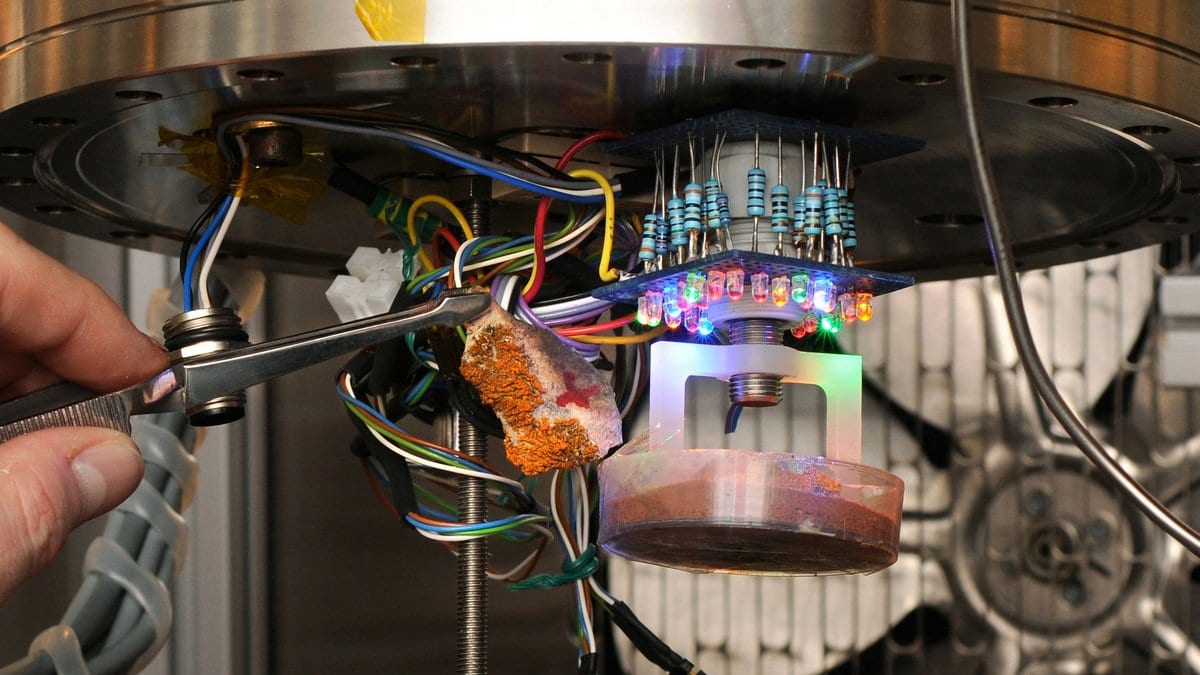
A gloved hand uses tweezers to place a rock sample inside a metal planetary simulation chamber ringed with lamps and wiring.
A sample goes into a planetary simulation chamber at the German Aerospace Center, the class of rig that holds gas pressure down to a few thousandths of Earth's for laboratory work (illustrative; the eruptions reported here were run in the Open University's Hyper Velocity Impact facility)."Martian conditions in miniature (7494313830) (2)" by DLR German Aerospace Center is licensed under CC BY 2.0. To view a copy of this license, visit https://creativecommons.org/licenses/by/2.0/.

In a chamber held at about the surface pressure of Mars, erupting mud kept itself going instead of freezing shut. Ondřej Krýza of the Institute of Geophysics of the Czech Academy of Sciences and colleagues report that rapid boiling, commonly assumed to quench such an eruption almost at once, is what sustained it.
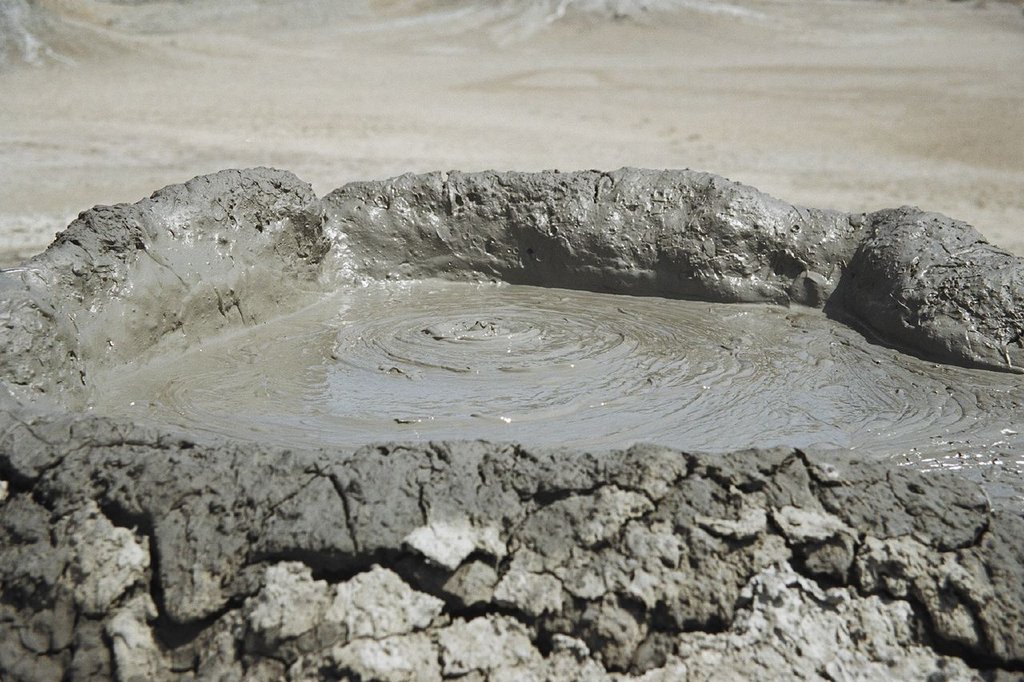
A low crater of dried gray mud on cracked ground, its pool rippled in rings from the center.
Gas pushes wet sediment up through a vent at Gobustan in Azerbaijan, on Earth. The chamber work asked how an eruption like this would behave at the air pressure of Mars. "Mud Volcano in Gobustan 01" by Bruno Girin is licensed under CC BY-SA 2.0. To view a copy of this license, visit https://creativecommons.org/licenses/by-sa/2.0/.

The work is a laboratory reproduction of the process, not an observation of an eruption on Mars. The authors say it bears on sedimentary volcanism on Mars, which erupts mud rather than lava, and on ice eruptions on frozen moons. They say that how boiling, cooling and freezing act together to govern such an eruption has remained largely unknown. The paper appeared in Communications Earth & Environment on Oct. 21, 2026, open access under a CC BY license.

Krýza and colleagues held the chamber at about 4.5 millibars, near Martian surface pressure, and sealed the mud reservoir with ice so the eruption was driven by overpressure from its own boiling. Short-lived fountains threw mud clear of the vent first. The eruption then settled into pulses of outward flow, and mud that had landed near the vent pooled and merged into sustained flows even as it cooled and froze.
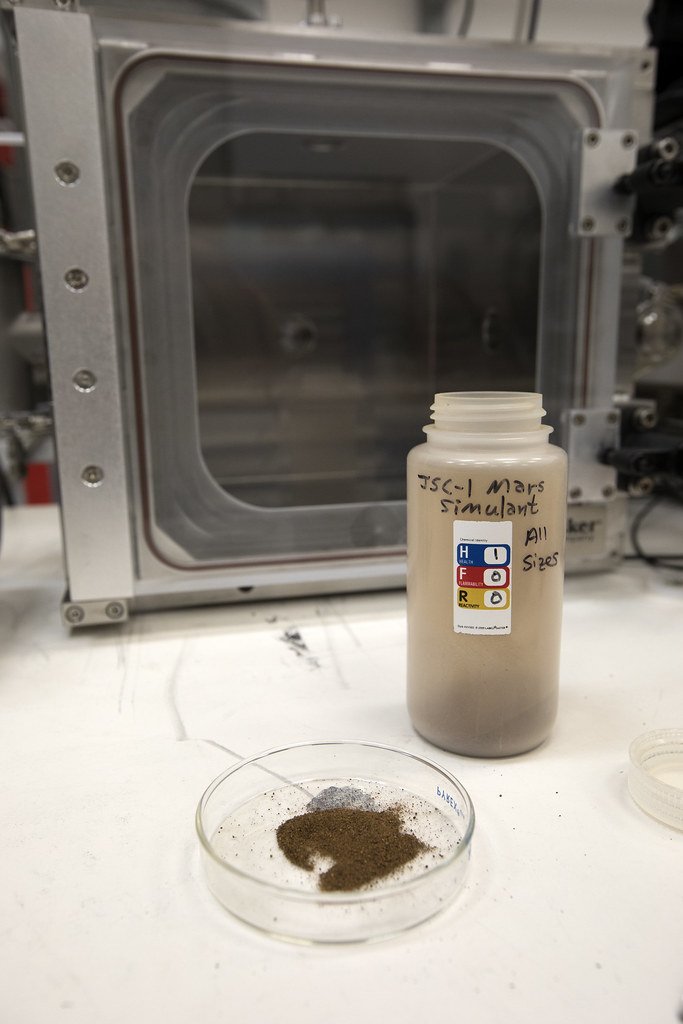
A jar labeled Mars simulant by hand and a petri dish of brown powder on a bench in front of a laboratory chamber.
A jar of Mars soil simulant and a dish of the powder sit in front of a laboratory chamber at NASA's Kennedy Space Center. Work on Martian surface processes uses ground analog material like this (illustrative). "KSC-20170609-PH_KLS01_0082" by NASAKennedy is licensed under CC BY-SA 2.0. To view a copy of this license, visit https://creativecommons.org/licenses/by-sa/2.0/.

Numerical modeling in the same paper indicates that mud thrown from such a vent would stay largely unfrozen in flight under Martian gravity. The authors conclude that rapid boiling does not suppress this kind of volcanism at low pressure but instead sustains both the transport of the mud and its spread across the surface. They describe that as providing new constraints on the process on Mars, and as a broader physical framework for eruptions of liquids that cannot last at the surface elsewhere in the solar system.

The experiments used the Open University's Hyper Velocity Impact facility in Milton Keynes, UK, according to the paper's acknowledgments. A peer-review file is published alongside the paper, and the journal is serving the accepted version, which it says is subject to further edits before the final version of record replaces it.

Sources

Spot an error?

Spot an error?

Report an error

Spotted a mistake on this page? Tell us what's wrong and our editors will take a look.

What kind of problem?

Only if you'd like us to be able to follow up. We won't use it for anything else.

We correct mistakes openly. Select any text to flag it. Fixes are logged under our Corrections Policy.

Report an error

Reporting on

Mud Kept Erupting in a Mars-Like Chamber Instead of Freezing Shut

What kind of problem?

Only if you'd like us to be able to follow up. We won't use it for anything else.

We read every report. Corrections are logged publicly.