A Relic Older Than the Sun: What the Chemistry of 3I/ATLAS Reveals About the Early Galaxy

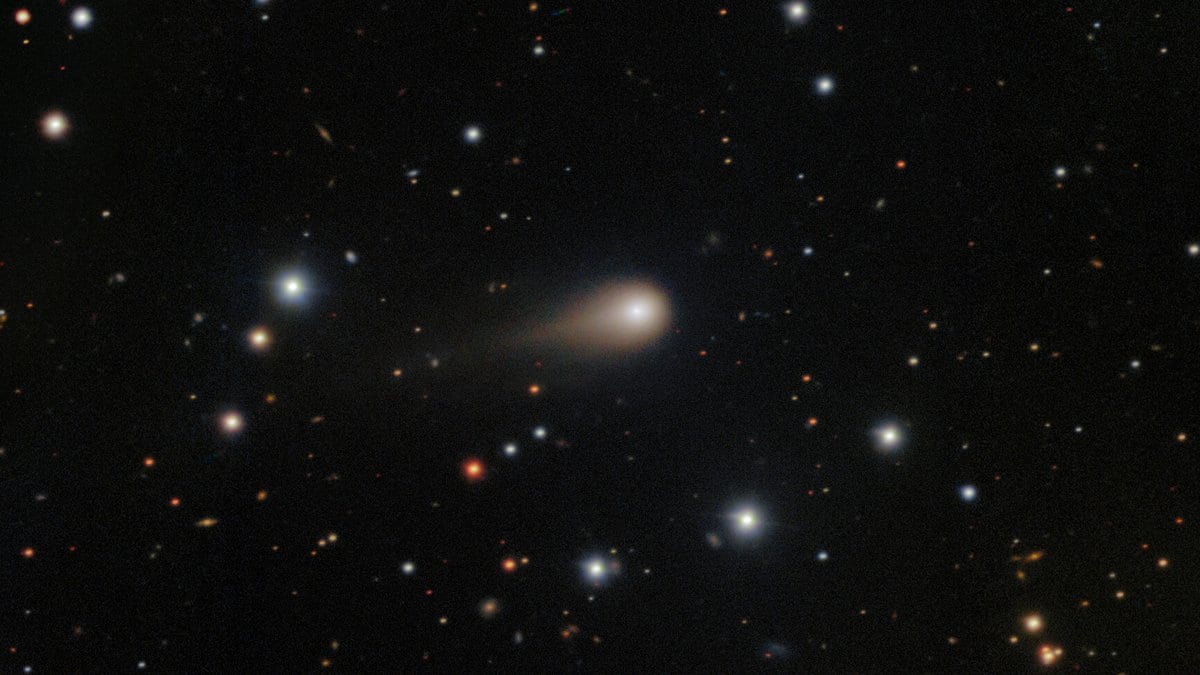
A comet is, in the most literal sense, a piece of frozen memory. The ice that makes up its body records the temperature, the chemistry, and the company it kept when it first congealed out of a cloud of gas and dust. And because comets spend most of their lives in a deep freeze far from any star, that record can survive almost untouched for the age of a galaxy. So when something arrives from outside the Solar System entirely, the question is irresistible: where, and when, was this thing born?
For 3I/ATLAS, the answer that James Webb returned is staggering. The comet appears to be older than the Sun.
Discovered in 2025 by the NASA-funded Asteroid Terrestrial-impact Last Alert System (the survey that lends the object its name), 3I/ATLAS is the third confirmed interstellar visitor on record, after 1I/'Oumuamua in 2017 and 2I/Borisov in 2019. Unlike the comets and asteroids native to our system, it is not bound to the Sun; it fell in from interstellar space on a hyperbolic path, will swing once past our star, and will leave again forever. That single pass is the only chance anyone will get to read it.
A team led by astrochemist Martin Cordiner of NASA's Goddard Space Flight Center won approval to interrupt Webb's scheduled program and point its Near-Infrared Spectrograph, NIRSpec, at the comet in December 2025, as it warmed near the Sun and shed gas into the bright halo astronomers call a coma. The results were published on 22 June 2026 in Nature.
Reading a comet by its isotopes
The trick is in the isotopes: the slightly different weights an element can carry depending on how many neutrons sit in its nucleus. Two of them did the heavy lifting here.
The first is deuterium, a heavier form of hydrogen with an extra neutron. The ratio of deuterium to ordinary hydrogen in a comet's water, the D/H ratio, is one of the most reliable clocks and thermometers astronomers have, because deuterium is preferentially locked into water ice at extremely low temperatures. Webb found that the water of 3I/ATLAS holds roughly 30 times more deuterium than the comets born in our own Solar System. That points to ice that formed in brutal cold, somewhere around or below 30 kelvin (about minus 240 degrees Celsius), and that has never been warmed enough since to reset the count.
The second fingerprint is carbon. As generations of stars are born, fuse elements, and die, they steadily enrich the galaxy with carbon-13, the heavier stable isotope of carbon. A region that has seen a lot of stellar life and death is comparatively rich in it. 3I/ATLAS is the opposite: Webb detected only trace amounts of carbon-13 relative to ordinary carbon-12. That scarcity is the signature of a metal-poor environment: chemically pristine, with little of the heavy-element seasoning that later generations of stars would supply.
Webb's NIRSpec also mapped how water, carbon dioxide, and carbon monoxide were distributed through the coma. The comet runs unusually rich in the carbon-bearing ices, another clue consistent with a frigid, early-galaxy origin rather than the warmer, more chemically processed nurseries that produced the Solar System's comets.
A birthplace at cosmic noon
Put together, the cold-formation signature and the carbon-13 scarcity point in one direction: backward in time. The team estimates that 3I/ATLAS accreted from its parent cloud roughly 10 to 12 billion years ago, during the epoch astronomers call cosmic noon, when star formation across the Universe peaked. For comparison, the Sun and its planets are about 4.6 billion years old. If the estimate holds, the comet had already existed for some 6 billion years before our own star ignited.
Two parts of this result rest on different footing. The chemistry (the heavy-hydrogen excess, the carbon-13 depletion, the cold-and-pristine birthplace) rests on direct Webb spectra and is peer-reviewed. The 10-to-12-billion-year age is an inference drawn from that chemistry, and the authors frame it as such: the comet may have accreted that long ago. It is a well-reasoned estimate built on a real measurement, not a stopwatch reading.
That measurement does not stand alone. An independent study in Nature Astronomy arrived at a similarly high D/H ratio for 3I/ATLAS, putting it in the same regime seen in cold protostellar cores (the dense, freezing knots of gas where stars and their comets begin). When two teams converge on the same extreme value by different routes, a surprising number stops looking like a fluke.
One comet, another planetary system
There is a larger reason to care about a comet that will never return. Each interstellar object is a free sample from another planetary system, delivered to a telescope that could never travel there. 'Oumuamua was a tumbling enigma; Borisov looked reassuringly like a familiar comet. 3I/ATLAS is something else again: a chemically distinct relic apparently forged in a different, older chapter of the galaxy's history.
"Analysis of these interstellar objects is a major step towards learning how common, or uncommon, the conditions for the evolution of life are in the Universe," said co-author Stefanie Milam of NASA Goddard, in the agency's announcement. The ices that 3I/ATLAS carries are the same kinds of molecules that, in our own system, were folded into worlds and oceans. The European Space Agency's parallel release made the same point: by reading the chemistry of a body from elsewhere, astronomers are testing how universal, or how rare, our own beginnings really were.
3I/ATLAS will not wait. It is already on its way back out, headed for the dark between the stars with its frozen archive intact. For a few months, though, a piece of the early galaxy passed close enough to read, and Webb was watching.