A Hidden Giant May Orbit Tabby's Star, but the Signal Is Faint

Few stars have carried as much baggage as KIC 8462852. Better known as Tabby's star, after astronomer Tabetha Boyajian, it made headlines in 2015 for dimming in ways no ordinary planet could produce: dips of up to 20 percent, irregular in timing and depth, unlike the clean, repeating shadow a transiting world casts. In the speculation that followed, one idea outran the rest, that an advanced civilization had built a vast structure around the star to harvest its light. That notion never had evidence behind it, and later work pointed toward mundane dust as the more likely culprit. But the underlying question stuck around: what stirs the dust in the first place?
A new study, accepted by Monthly Notices of the Royal Astronomical Society and posted to the arXiv preprint server, offers a candidate answer, and does so with unusual honesty about how thin the evidence still is. Led by Cristina Madurga-Favieres, the team combed through data from NASA's Transiting Exoplanet Survey Satellite (TESS) and added radial-velocity measurements, the small back-and-forth wobble a star shows when an unseen companion tugs on it. In the TESS record they found something the star had never clearly shown before: a single, clean, symmetric transit, the kind of dip a solid body makes when it passes in front of its star.
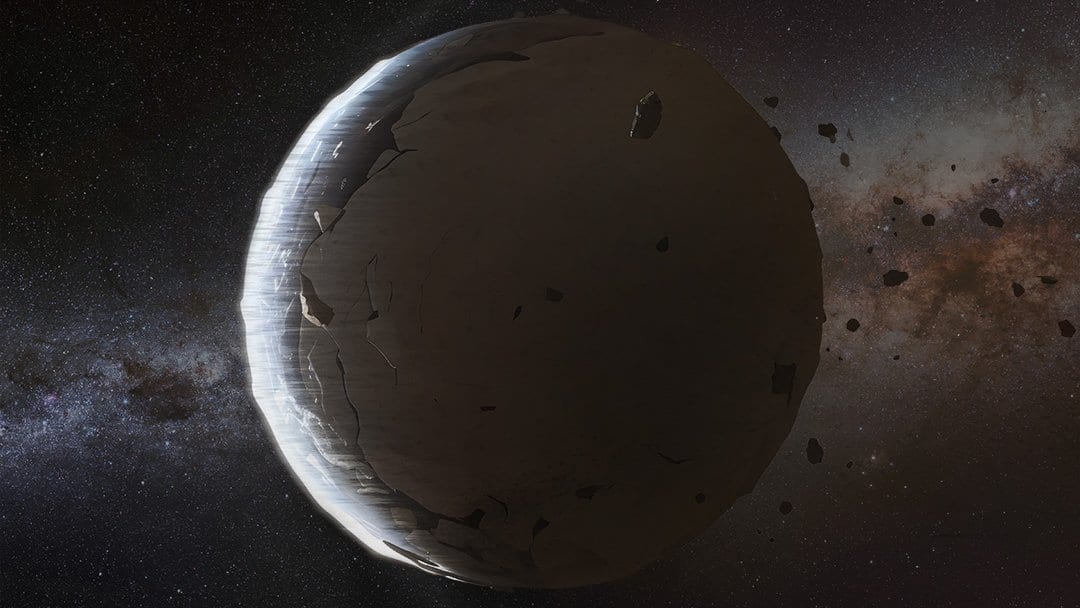
From that transit and the wobble data, the authors sketch a possible companion. They estimate a mass around 9.4 times that of Jupiter, with a radius about 1.7 times Jupiter's, and an orbital period of roughly 1,030 days. That mass lands in the fuzzy borderland between the largest giant planets and the smallest brown dwarfs, the failed stars too light to sustain ordinary fusion. If confirmed, it would be the first massive companion pinned to Tabby's star.
The word doing the heavy lifting is if. The detection registers at only about 2.3-sigma, well below the roughly 5-sigma bar astronomers usually demand before calling something real. In plain terms, the signal is suggestive, not established; a fluctuation in the data could still mimic it. The authors are candid about this. They put a 3-sigma upper limit on the object's mass at under 28 Jupiter masses, and they state plainly that more radial-velocity observations are needed before anyone can confirm the companion exists at all. This is a lead worth chasing, not a discovery to bank.
Should it hold up, though, it would tie neatly to the star's original mystery. A massive body on a wide orbit could gravitationally disturb a reservoir of comets in the outer system, sending some of them plunging toward the star. Comets shredded and vaporized near the star would shed dust, and a passing dust cloud would dim the starlight irregularly, without the tidy periodicity of a planet, much like what Tabby's star actually shows. The paper frames this as a plausible mechanism rather than a settled one. It is a hypothesis that a confirmed companion would support, not a conclusion the current data can carry.
There is a clean way to find out. The authors point to Gaia DR4, the next major data release from the European Space Agency's star-mapping mission, whose exquisitely precise astrometry can trace a star's tiny path across the sky as an orbiting companion tugs it around. If a giant body is really there, Gaia should see its fingerprint in the star's motion and reveal whether it is a planet, a brown dwarf, or nothing at all. That release, expected to sharpen many such marginal cases, would move this one out of the realm of "maybe."
For now, the honest summary is a modest one. A famous, once-sensationalized star may harbor a large hidden companion, and if it does, plain gravity and dusty comets could account for the strangeness that made it famous. No megastructure required. But the case rests on a faint signal that the authors themselves label tentative, and until a stronger detection arrives, Tabby's star keeps its ambiguity a little while longer.
Sources
- Monthly Notices of the Royal Astronomical SocietyPeer-reviewed
- arXivPreprint