Mars Runs a Shrunken Version of Earth's Aurora Engine, MAVEN Finds

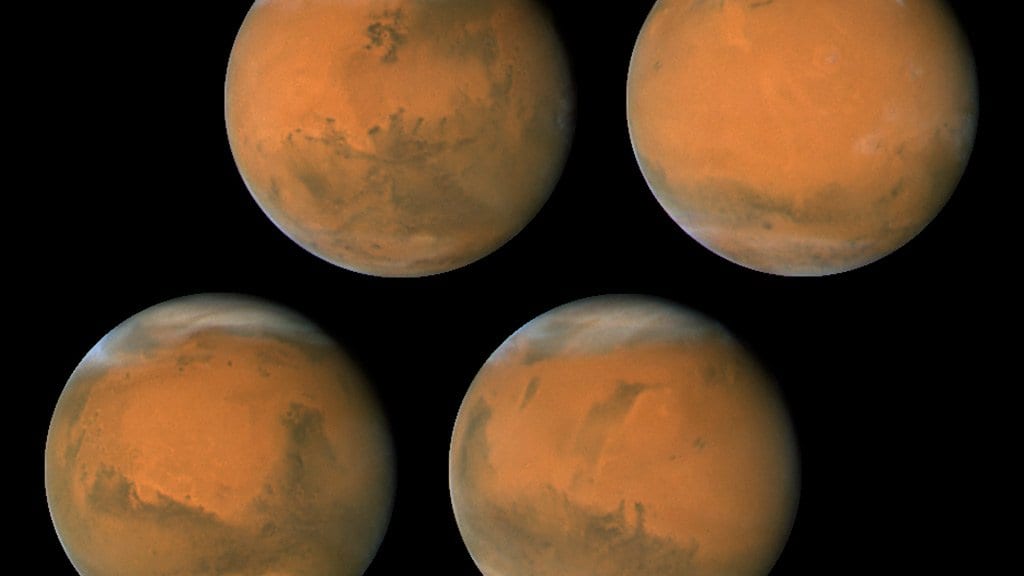
For decades the recipe for an aurora seemed to demand something Mars simply does not have: a planet-sized magnetic field. Earth's aurora is fed by one. So is Jupiter's, and Saturn's. Mars lost its global field roughly four billion years ago, when the churning core that generated it wound down and the solar wind began stripping the atmosphere away. And yet Mars glows. For years, researchers could see the light but could not fully explain the machinery behind some of it.
A study published July 23 in Nature Communications offers an answer that is both familiar and strange: Mars runs the same basic engine Earth does, only shrunk to a fraction of the size. Led by Shaosui Xu, an associate research physicist at the University of California, Berkeley's Space Sciences Laboratory, the team drew on years of measurements from NASA's MAVEN orbiter to trace how charged particles get energized in the thin Martian environment. What they found is a miniature analogue of what physicists call the Dungey cycle.
On Earth, the Dungey cycle is a grand, planet-wrapping process. Magnetic field lines carried by the solar wind meet Earth's global field on the dayside and reconnect with it. The joined field lines get dragged back over the night side, stretch, snap, and reconnect again, flinging energized electrons down into the upper atmosphere near the poles, where they crash into gas and make it glow. It is the reason auroras on Earth cluster around the magnetic poles rather than scattering across the whole sky.
Mars has no global field to anchor that cycle. What it has instead are freckles of magnetism. When ancient lava cooled around four billion years ago, it froze the imprint of the planet's then-active magnetic field into the crust. Those magnetized rocks survive today as scattered patches, each raising a small local magnetosphere above the surface. The MAVEN data show the same reconnect-stretch-snap sequence playing out over these crustal patches, accelerating electrons and lighting the sky above them. The NASA release describes it as a scaled-down version of Earth's process, confined to regions far smaller than the continent-spanning auroral ovals of home.
The distinction the authors draw matters. They call the mechanism Dungey-like, not identical. The physics rhymes with Earth's, but the setting is different in kind: many tiny magnetospheres rather than one enormous one, each running its own small circuit rather than a single global loop. It is less a copy of Earth's aurora than a demonstration that the underlying process does not require a big field to work. Give it any magnetic structure and a supply of charged particles, and it can turn.
"This is a remarkable result that changes how we think of Martian auroras," said Shannon Curry, MAVEN's principal investigator at the University of Colorado Boulder.
The finding also sharpens a picture that has been filling in for years. MAVEN has already shown that Mars hosts several aurora flavors that Earth lacks or barely shows, including a dayside proton aurora in which solar-wind protons steal electrons from the planet's hydrogen halo, slip past the usual magnetic barrier, and glow in ultraviolet across the whole daylit face. The Dungey-like cycle adds another entry: a localized, electron-driven aurora tied to those crustal magnetic islands. Together they make Mars a kind of natural laboratory for how aurora can happen without the Earth-style setup taken for granted.
That is where the result reaches beyond one planet. If the core process can run on magnetic scraps rather than a global field, then the list of places worth checking grows. Small magnetized bodies, worlds with localized magnetic regions and even moons with patchy fields become candidates for their own faint, miniature light shows. What once looked like a planet-scale phenomenon starts to look like something more portable.
The evidence here is solid. The work is peer-reviewed and appeared in Nature Communications, built on a long baseline of MAVEN observations rather than a single lucky pass. The mission itself has since ended; MAVEN lost contact on December 6, 2025, and NASA formally concluded operations on June 3, 2026. But the archive it left behind is deep, and results like this one are still being mined from it. A spacecraft that spent a decade watching Mars breathe under the solar wind is, even now, changing how we read the light in another planet's sky.