A 12Th-Century Supernova With No Surviving Suspect: The Case for Two Merging White Dwarfs

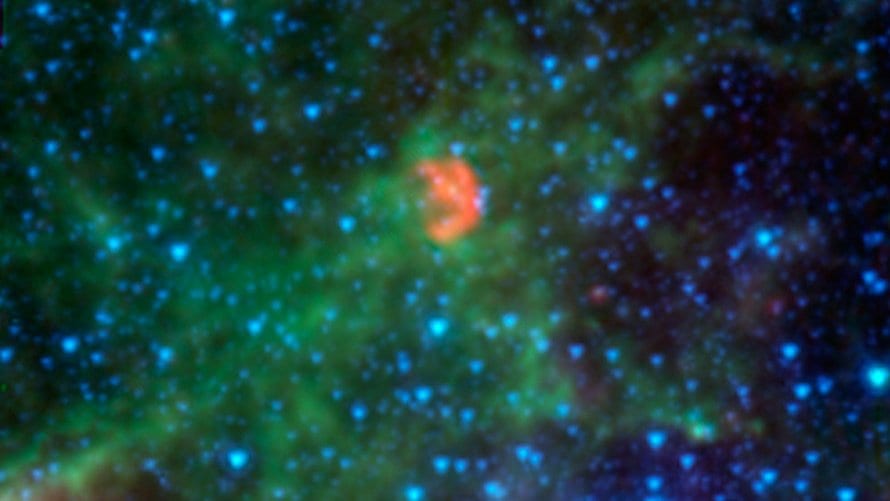
In the year 1181, astronomers in China and Japan noted a new star in the sky, a "guest star" that lingered for months before fading. Eight and a half centuries later, that entry in the historical record has an address: a faint, fast-expanding remnant known as Pa 30, with a strange, still-hot star sitting at its center. Because we know almost exactly when it exploded, SN 1181 is a rare thing: a supernova we can study forensically, tracing the wreckage back to the event that made it.
The question a team led by Kohki Uno set out to answer is the one that hangs over an entire class of stellar explosions: what set it off? In a preprint posted to arXiv, the authors treat SN 1181 as a test case for how Type Iax supernovae (a peculiar, generally faint cousin of the standard Type Ia) actually detonate. Two broad scenarios compete. In the single-degenerate channel, a white dwarf pulls material off a living companion star, often a helium-burning star, until it ignites. In the double-degenerate channel, there is no living companion at all: two white dwarfs spiral together and merge. The two paths leave a telltale difference. If a companion fed the explosion, it should still be there afterward, scarred but surviving, somewhere near the center of the remnant.
So the team went looking for that survivor. Using archival astrometry and photometry from Gaia and Pan-STARRS, they combed the region within about 30 arcseconds of the remnant (roughly a third of a light-year at the object's distance), checking every candidate star's motion and brightness. They found nothing that fit. Sources with measured distances and motions were ruled out as unrelated foreground or background stars. And the light of the remaining stars did not match what a surviving helium-star companion, or a hot subdwarf, should look like. Their binary-evolution models predicted that such a companion would shine at least as brightly as magnitude 6.5 in Gaia's green band; the data ruled out anything brighter than about magnitude 8, comfortably fainter than the floor a real survivor should have cleared.
No companion bright enough to survive, therefore, appears to be present. That absence, the authors argue, disfavors the single-degenerate picture for SN 1181 and points instead to two white dwarfs merging (a double-degenerate origin) for at least this member of the Type Iax family. If that holds, it strengthens the idea that these explosions do not all come from one kind of system; the same peculiar class may be reached by more than one road.
The reasoning is elegant, and it is worth being clear about its shape: this is evidence built on a non-detection. An argument from absence is only ever as strong as the search behind it, and non-detections carry their own caveats. A companion could, in principle, hide below the brightness limit, be reddened by dust, or vanish into the confusion of a crowded stellar field. The authors bound those possibilities with explicit limits, which is the right way to do it, but the conclusion remains an inference rather than a direct sighting of two merging stars. The work is also a single preprint, not yet peer-reviewed and not yet independently checked.
It is a compelling addition to a long-running debate over what lights up thermonuclear supernovae, and here the strongest clue is the star that isn't there. Whether the double-degenerate verdict for SN 1181 stands will depend on peer review.
Sources
- arXivPreprint