Hunting Ghost Particles From a Canyon Wall in the Andes

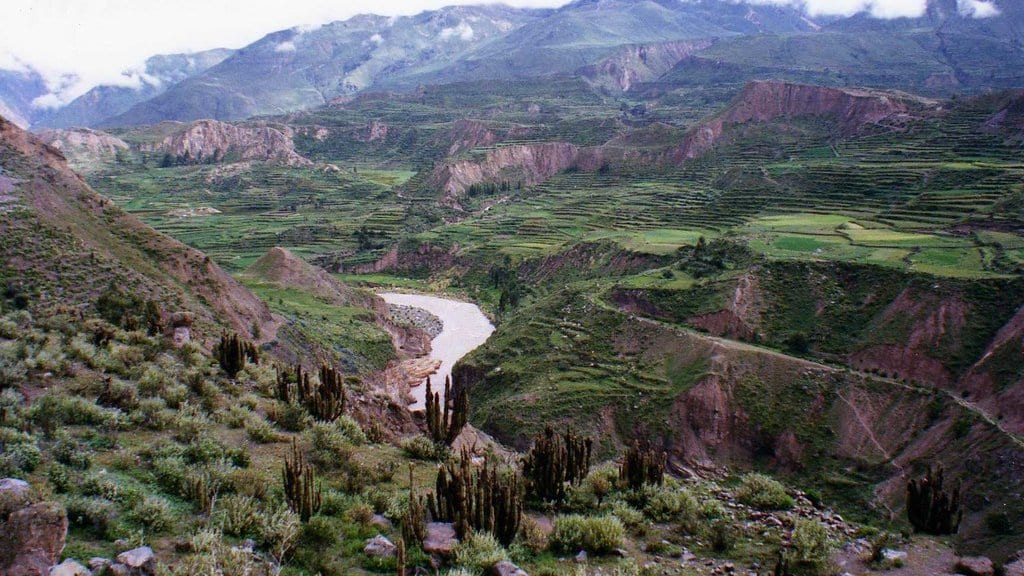
High in the Peruvian Andes, a deep gash splits the landscape: the Colca Canyon, one of the deepest on Earth. Physicists have been eyeing its two facing walls not for the scenery but for the geometry. The gap between the cliffs is, almost improbably, just the right width to serve as a trap for one of the universe's most elusive particles. That is the idea behind TAMBO, the Tau Air-shower Mountain-Based Observatory, a proposed detector that would turn a mountain into an instrument.
Neutrinos are the ghosts of particle physics, nearly massless, electrically neutral, and so reluctant to interact that trillions pass through your body every second without leaving a trace. That aloofness is exactly what makes them precious to astronomers. Unlike light, they stream out of the dense, violent cores of cosmic accelerators, black-hole jets, shredded stars, the debris of exploding suns, and travel to us in straight lines, unbent and unabsorbed, carrying information no photon can. The trouble is catching them at all.
They come in three flavours, and the tau neutrino is the hardest of the trio to pin down. Existing observatories such as IceCube, a cubic kilometre of instrumented Antarctic ice, detect all three but struggle to cleanly isolate tau events at the highest energies. TAMBO's design is built around solving precisely that problem, and it does so with a clever use of the canyon itself.
The scheme works like this. A tau neutrino arriving through the rock of one canyon wall can, on rare occasion, interact and produce a tau lepton, a heavier cousin of the electron. That particle bursts out of the far wall and, within a fraction of a millisecond, decays in the open air, triggering a cascade of secondary particles, an air shower. According to the public design papers, an array of water-filled Cherenkov tanks and plastic scintillators studded across the opposite slope would register that shower and reconstruct the neutrino that spawned it. The canyon's width is comparable to the distance a tau lepton travels before decaying, which is what makes the site so well suited to the task.
The scale envisioned is substantial. The collaboration's design studies describe an array of roughly 22,000 detector tanks and estimate that, so configured, TAMBO would offer an effective area for tau neutrinos about ten times larger than IceCube's, yielding a high-purity sample in the range of about 1 to 100 peta-electronvolts. That energy window is where astrophysical neutrinos are expected to carry the clearest fingerprints of the extreme objects that make them.
The occasion for revisiting the concept is a paper in Nature Astronomy that lays out how well an instrument of this kind could characterise the high-energy neutrino sky. The design details above draw on TAMBO’s openly available literature and collaboration talks. The Nature Astronomy paper provides the context for the renewed scientific interest, but it has not been examined in enough detail here to independently verify its specific figures and conclusions.
TAMBO remains a proposed observatory. It has yet to be built, is not collecting data and has detected no neutrinos. The new study strengthens the scientific case for what TAMBO could achieve if built, but the observatory remains a concept, and the results it might deliver are still hypothetical. Whether a mountain in the Andes ever becomes a telescope for ghost particles is, for now, a question for the future.
Sources
- Nature AstronomyPeer-reviewed