Skip to content
See the World Through ScienceA project of ALLATRA
Source: Peer-reviewedNature Chemistry1 source

Chemists Isolate Crystals of a Boron-Oxygen Triple Bond Stable at Room Temperature
Science

Republish this story

Our work is licensed under Creative Commons BY-NC 4.0. You may republish this piece for free — with credit to ALLATRA Media and a link to the original, unedited beyond length trims, and not for commercial use.

Read the full license

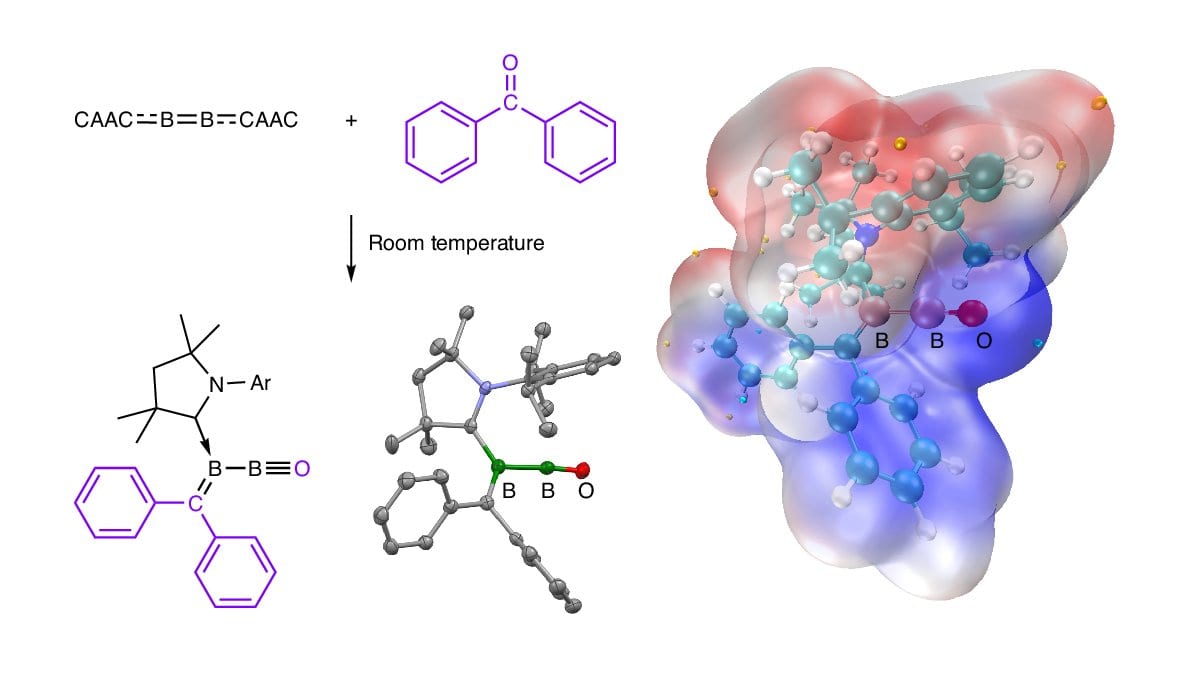
A figure in three parts: a drawn reaction of benzophenone with a two-boron molecule at room temperature, a ball-and-stick crystal structure of the oxoborane product at center, and a color-coded computed surface of the same molecule at right with its boron and oxygen atoms labeled.
At left, benzophenone and a two-boron reagent combine at room temperature to give one of the three oxoboranes. At center is that molecule's structure from X-ray crystallography, and at right a computed model of the same molecule with its two boron atoms and its oxygen marked.Figure from Lukas Lubczyk, Christian Markl, Mudit Jain, Sourav Kar, Thomas Kupfer, Rian D. Dewhurst, Ashwini K. Phukan, Holger Braunschweig (2026), "Synthesis and isolation of stable oxoboranes", Nature Chemistry. CC BY 4.0

Chemists at the University of Würzburg in Germany have made three oxoboranes, molecules built around a triple bond between a boron atom and an oxygen atom, and isolated them as crystals that are stable at room temperature. Their report appeared Oct. 27, 2026, in Nature Chemistry. The team writes that until now, no oxoborane free of stabilizing add-on groups had been isolated, or, to its knowledge, detected by spectroscopy at or near room temperature.

The authors note that boron's chemistry is dominated by its bonds to oxygen: boron-oxygen compounds are workhorses of organic synthesis and feature in a young boron-based drug chemistry, while the triple-bonded form had stayed out of synthetic reach. They write that oxoboranes that can be stored and handled open the way to exploring a chemistry that the difficulty of making them had kept closed.

The paper records documented attempts to pin these molecules down going back to at least the early 1960s. Those reached detection in the gas phase or trapping in a frozen solid, evidence that oxoboranes form briefly during reactions, and the isolation of relatives whose boron-oxygen bonds are weaker than a triple bond.
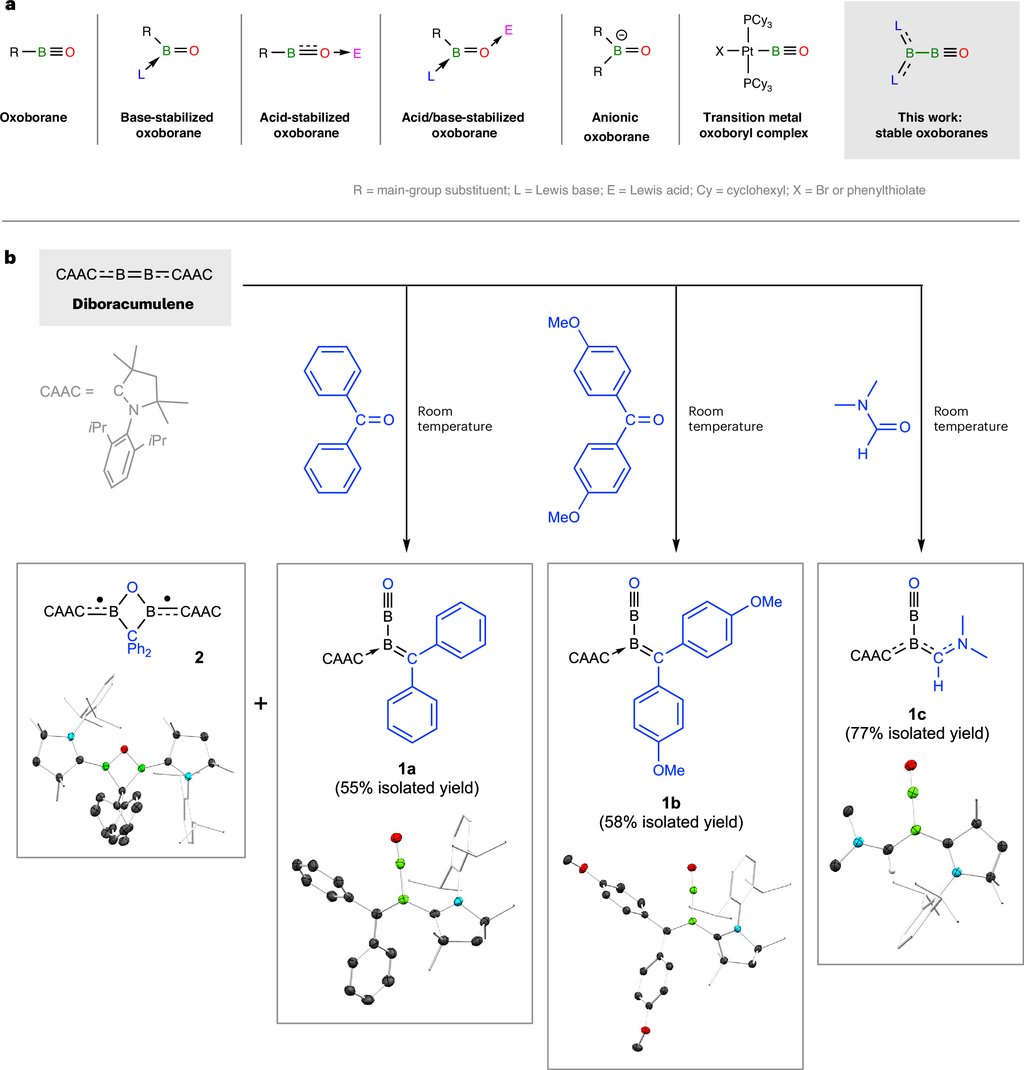
Two-part figure. The top row draws six previously known types of oxoborane with the new compound at right. The lower part shows three room-temperature reactions of the same two-boron compound with three carbonyl reagents, each product drawn beside its crystal structure and isolated yield.
Panel a sets the new compounds, at right, against earlier oxoboranes that each needed a stabilizing partner. Panel b gives the route: the same two-boron starting material with a different carbonyl reagent for each product, in isolated yields of 55, 58 and 77 percent. Fig. 1 from Lukas Lubczyk, Christian Markl, Mudit Jain, Sourav Kar, Thomas Kupfer, Rian D. Dewhurst, Ashwini K. Phukan, Holger Braunschweig (2026), "Synthesis and isolation of stable oxoboranes", Nature Chemistry. CC BY 4.0

The new route is one step. Lukas Lubczyk, Holger Braunschweig and colleagues stirred a highly reactive molecule carrying two boron atoms with reagents that hold a carbon-oxygen double bond, among them benzophenone, at room temperature. The authors report more than 50% isolated yield of an orange or yellow solid from each of the three reactions, and X-ray measurements that put the boron-oxygen bonds at 1.208 to 1.217 ångströms, which they describe as exceptionally short and strong.

They attribute the stability to the group bonded to the neighboring boron atom, which is rich in electrons and lowers the positive charge on the oxoborane's boron, leaving it less open to attack. Stable does not mean inert: in first tests, amines, a common family of nitrogen compounds, added across the triple bond.

Sources

By Olga SchmidtEditor-in-Chief, Writer

Spot an error?

Spot an error?

Report an error

Spotted a mistake on this page? Tell us what's wrong and our editors will take a look.

What kind of problem?

Only if you'd like us to be able to follow up. We won't use it for anything else.

We correct mistakes openly. Select any text to flag it. Fixes are logged under our Corrections Policy.

Report an error

Reporting on

Chemists Isolate Crystals of a Boron-Oxygen Triple Bond Stable at Room Temperature

What kind of problem?

Only if you'd like us to be able to follow up. We won't use it for anything else.

We read every report. Corrections are logged publicly.