A 10-Jupiter World at the Edge of the Mass-Ratio Desert

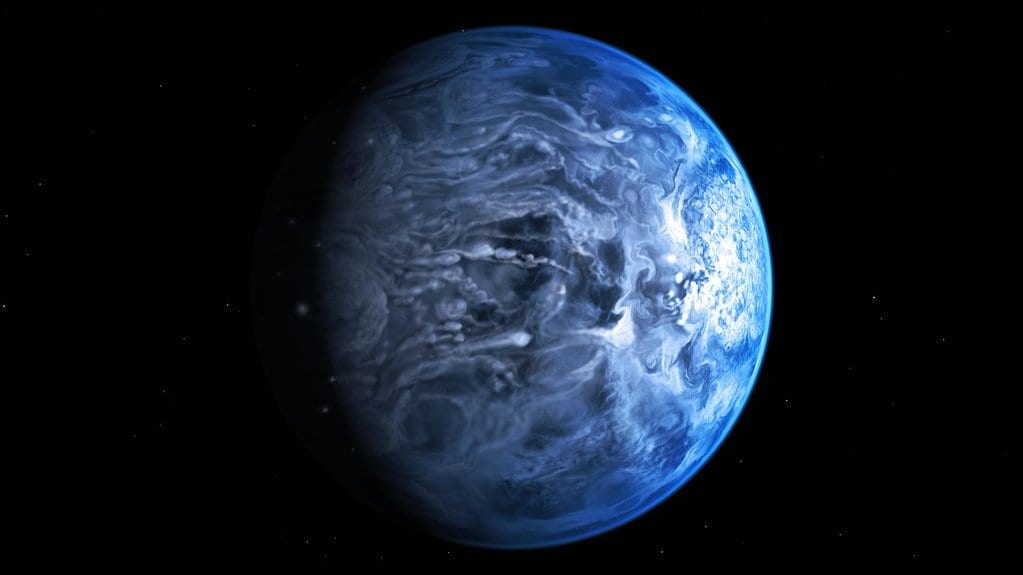
Somewhere toward the crowded heart of the Milky Way, a faint star drifted almost exactly in front of a more distant one. For a few weeks its gravity acted as a lens, bending and magnifying the background star's light. Then a smaller, sharper blip rode on top of that glow, the fingerprint of a second body orbiting the lens. From that brief distortion, a team led by Yuki K. Satoh and David P. Bennett reconstructed something they could never have seen directly: a world of about ten Jupiter masses, bound to a star only about six-tenths the mass of the Sun.
The event is named MOA-2020-BLG-108, after the Microlensing Observations in Astrophysics survey that caught it, and the analysis has been accepted for publication in the Publications of the Astronomical Society of Japan. The intriguing part is not that astronomers have found another distant companion, but where it is located.
Astronomers describe such systems by their mass ratio, the companion's mass divided by the host's. For MOA-2020-BLG-108 that ratio is roughly 0.02. That number places the object at the low boundary of a feature the authors call the mass-ratio desert, a range around 0.02 to 0.05 where companions turn up conspicuously less often. Below the desert lie ordinary planets, thought to build up grain by grain in a disk around a young star. Above it lie brown dwarfs and low-mass stellar companions, which more plausibly form the way stars do, from a gas cloud that fragments and collapses. The desert marks the awkward middle, where neither story is comfortable.
A ten-Jupiter object around a modest star is exactly the kind of thing that makes theorists uneasy. The leading model for building giant planets, core accretion, has a harder time around small stars: there is less raw material in the disk, and the clock for gathering it runs out before a massive gas giant can assemble. Finding a heavyweight companion beyond the snow line of a low-mass star, the frost line past which ices survive and planet cores can grow fatter, pushes against that expectation. It hints that whatever made this object may have leaned on a different route, or that giant-planet formation around small stars is simply more forgiving than the textbooks allow.
Microlensing provides a clear measurement of the mass ratio and projected separation, but determining the actual masses in solar and Jupiter units requires modelling the lens system, as is often the case with this technique, and MOA-2020-BLG-108 admits two geometric solutions, a wide configuration and a close one, that the data do not fully separate. The angular size of the lensing ring, about 0.7 milliarcseconds, and an estimated distance near 5 kiloparsecs anchor the physical scale.
These uncertainties do not diminish the finding’s significance: microlensing is uniquely suited to catching cold, wide-orbit companions around faint stars, the very population that transit and radial-velocity surveys tend to miss, and every clean detection near the desert's edge sharpens the boundary between planet and failed star. It is a single, carefully characterised data point on a map that fills in one object at a time. On that map, MOA-2020-BLG-108 marks a spot theorists would rather stayed empty.
Sources
- arXivPreprint