A Flaw in Zinc Oxide Joins the Shortlist of Possible Quantum Building Blocks

In quantum technology, sometimes the most valuable thing in a material is a flaw. The most famous example lives in diamond, where a missing carbon atom paired with a nitrogen atom creates a defect that can trap a single electron's spin and hold quantum information in it. That "nitrogen-vacancy center" has become a workhorse of quantum sensing. But diamond is finicky and hard to scale, so physicists have been hunting for the same magic in more manufacturable materials.
A new candidate has just been proposed, and it lives in zinc oxide, a cheap, common semiconductor already familiar to industry.
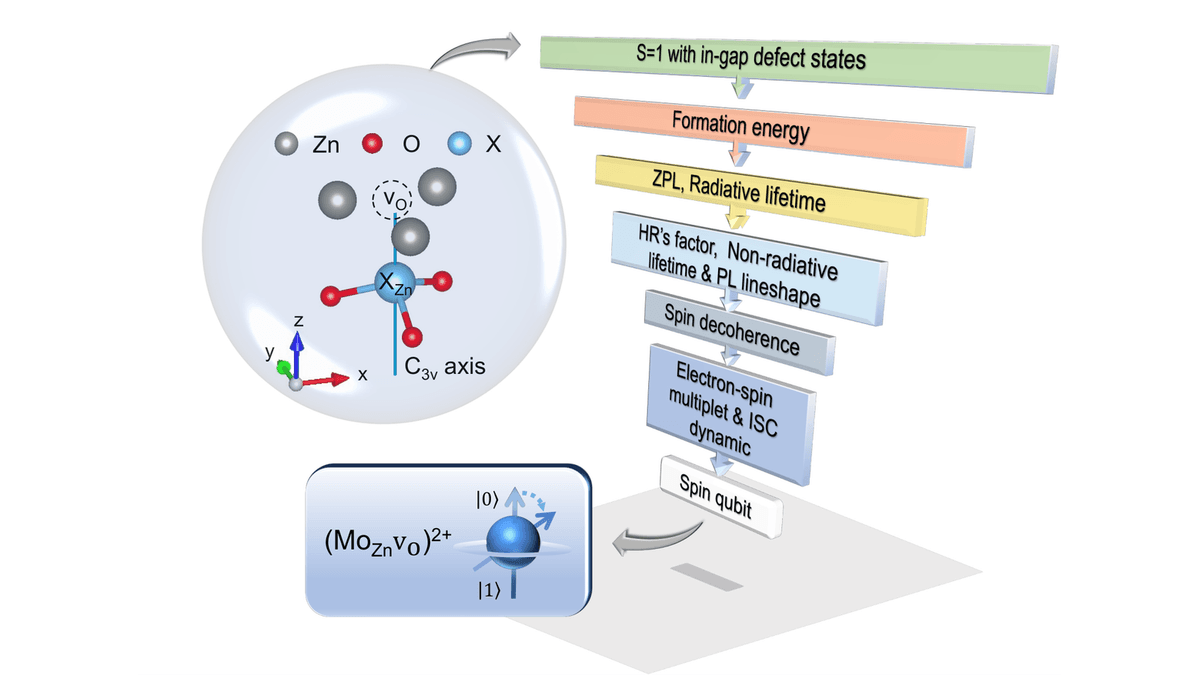
Reporting in PRX Quantum, a team led by Professor Hosung Seo at Sungkyunkwan University in South Korea, working with colleagues at the University of Wisconsin-Madison and the University of Washington, identified a particular atomic defect in zinc oxide that appears well suited to serve as a spin qubit. The defect is a small complex: a molybdenum atom sitting where a zinc atom should be, right next to a spot where an oxygen atom is missing. That arrangement, the researchers calculate, would trap electrons in a way that gives the defect a usable, controllable spin.
What makes it appealing is a combination of predicted properties. The team's simulations suggest the defect would emit bright, sharp light in the visible range, which matters because that light is how you would read out and manipulate the qubit's state. It also scores well on a technical measure called the Huang-Rhys factor, essentially, how cleanly it emits light rather than blurring the signal into lattice vibrations. And the calculations put its coherence time, roughly how long it could hold quantum information before the environment scrambles it, at around four milliseconds, a respectable figure for this kind of system.
Zinc oxide brings its own advantages as a host. It is already widely used in the semiconductor industry, can be grown as ultrahigh-purity crystals, and is "magnetically quiet," containing almost no nuclear spins of its own to jostle the qubit and shorten its memory. Those are exactly the traits that make a material easier to scale into real devices.
The essential caveat is that all of this is, so far, on paper. This is a first-principles study, meaning the defect and its properties were identified and characterized through large quantum simulations run on supercomputers, not built and measured in a lab. The coherence time, the emission, the whole promising profile: these are predictions from theory. No one has yet fabricated this defect in a crystal and shown it working as a qubit, and materials that look ideal in calculations often prove stubborn in practice.
Read that way, the result is a well-supported prediction rather than a breakthrough device, a signpost telling experimentalists where to dig next. The value of such work is in narrowing a very large search. Somewhere among the countless possible defects in countless possible materials may sit the qubit that finally scales, and this study adds a specific, credible entry to the shortlist worth trying to build.