A 'Winter Version' of the Biological Clock: One Spliced Gene Keeps Flies in Seasonal Standby

The biological clock most of us picture runs on a 24-hour loop: proteins build up through the day, break down overnight, and the cycle sets the rhythm of sleep, hunger and hormones. For decades, that loop has been studied almost entirely in one setting, which a Washington State University biologist now calls the summer version.
"For years, we've been studying what is essentially the summer version of the clock," said Sergio Hidalgo, an assistant professor in WSU's College of Veterinary Medicine and corresponding author of the new work. "This work shows that the clock can be remodeled in winter, creating a system that functions differently and helps animals maintain a winter program."
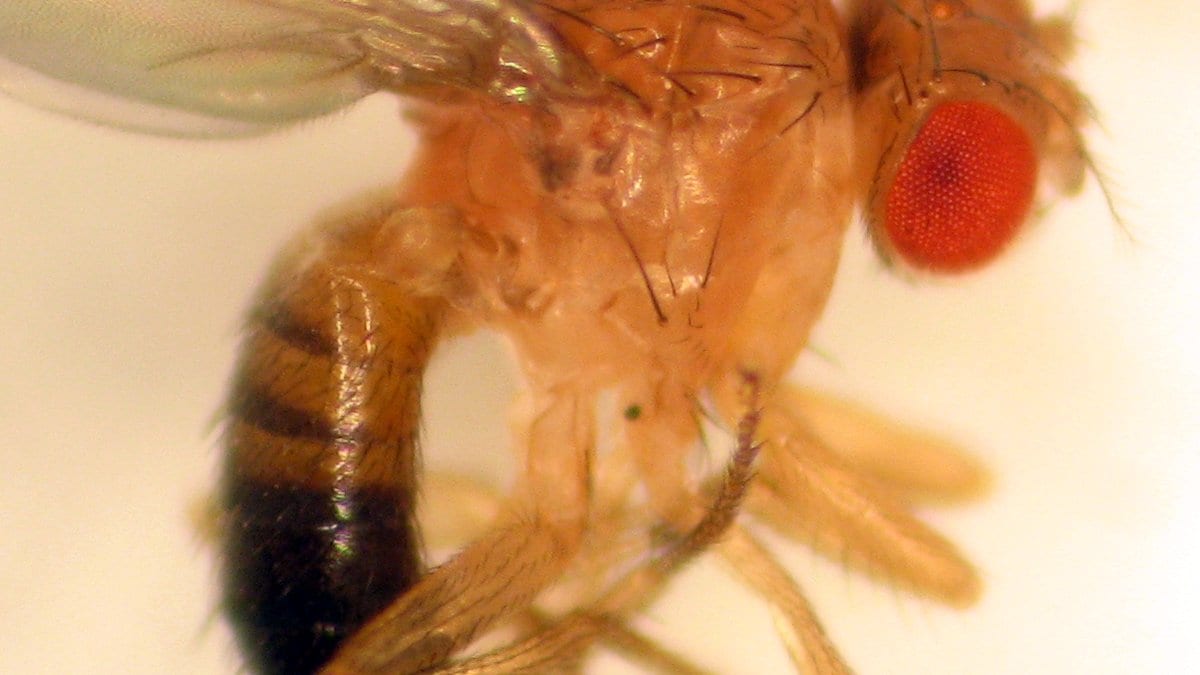
The study, published in Science Advances, looked at fruit flies and homed in on a gene at the heart of that daily loop: timeless. It is one of the core clock genes, part of the machinery that won its discoverers a Nobel Prize. What Hidalgo's team found is that timeless does not make just one protein. Through alternative splicing, a process by which a cell reads the same gene in more than one way to produce different proteins, the gene also yields a distinct winter-specific form.
That second protein does something the ordinary daily clock does not. It reconfigures the clock into a winter setting, a molecular arrangement the WSU announcement describes as a "winter lock." In that state, the flies shift their daily activity pattern and shut down reproduction, entering the kind of dormancy that carries cold-climate insects through the lean months. The lock holds until the environment signals that it is safe to switch back.
The mechanism at the center of the paper is what the authors call winter gating. Rather than the clock simply slowing or stopping in the cold, a specific spliced isoform of timeless actively gates the system into its winter configuration and keeps it there. It is less a battery running down than a switch being thrown and held.
Why does that distinction matter? Because it changes what the clock is understood to be doing. A clock that only tracks the day tells an animal when to be active within a single 24-hour cycle. A clock that can be remodeled by the season is doing something larger: integrating cues that unfold over weeks, such as shortening days and falling temperatures, and committing the animal to a months-long strategy.
"We've known for a long time that animals use environmental cues to prepare for seasonal changes," Hidalgo said, "but we haven't understood exactly how that information is integrated by the biological clock." The winter isoform of timeless offers one concrete answer: the same gene that helps run the daily cycle also carries a seasonal setting, written in an alternate splice.
The finding fits a broader idea the authors advance, that animals may not rely on a single clock at all but on several molecular versions of it, each tuned to a different environmental regime. Seen that way, "summer" and "winter" are not just labels for behavior. They are distinct configurations of the same underlying machinery.
The reach of a result like this is easy to overstate. The experiments were done in fruit flies, a workhorse of clock biology precisely because so much of that machinery is shared across animals, but a fly is not a mosquito and is certainly not a person. The paper is peer-reviewed and appears in Science Advances; an earlier version was posted as a preprint. The core claim, that a spliced winter isoform of timeless gates flies into a seasonal state, rests on the fly work itself.
The wider applications the researchers describe sit one step beyond that evidence. Hidalgo suspects that similar seasonal switches operate in agricultural pests and in disease vectors such as mosquitoes, and that learning how those insects keep time could "provide new ways to disrupt populations by interfering with the biological processes that help them survive changing seasons." That is a reasonable direction to look, given how conserved clock genes tend to be, but it is a hypothesis for future work, not something these experiments demonstrated.
The same caution applies to the human angle. The team notes that seasonal patterns show up in human health too, from seasonal affective disorder to certain neurological and psychiatric conditions whose timing tracks the calendar, and that a seasonally remodeled clock might eventually help explain some of them. That link is a prospect the fly result invites, not a finding it establishes. No human data enters this study.
What the work does establish, in a well-studied animal, is a mechanism that had gone unnoticed while researchers watched the summer clock: a single gene, read two ways, that can flip the whole timekeeping system into a seasonal standby and hold it there until the light and the cold say otherwise.