A Flower That Leans Left or Right, and Needs Gravity to Do It

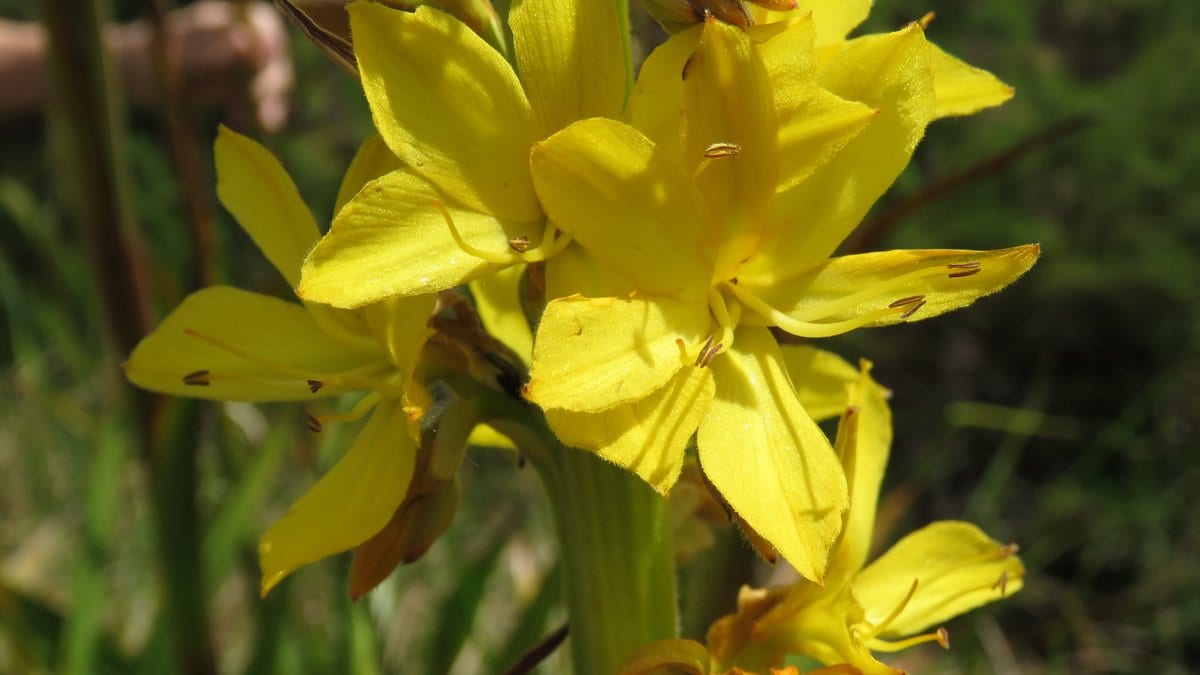
In the Botanical Garden of the University of Potsdam grows a South African plant called Wachendorfia thyrsiflora, the butterfly lily. Look into one of its yellow flowers and you find a small architectural decision already taken. The style, the female organ that receives pollen, leans off to one side; the pollen-bearing stamens lean the other way. Walk to the next plant and the whole arrangement may be reversed, like a right hand next to a left.
Botanists call the trait enantiostyly, and they have been arguing about how it is built for more than a century. A flower is not a body with a left and a right in the way an animal is; it is radially arranged, a wheel of parts around a stem. Something has to tell it which way is which. A team led by the University of Potsdam published an answer in Science on July 30, and it comes in two halves that only work together.
The first half is genetic. The second half is gravity. In the paper, Haoran Xue, Michael Lenhard and colleagues describe the organs as deflecting through "a combination of genetically controlled chirality and gravitropism, orienting left and right with respect to an external rather than internal reference axis." Strip the phrasing back and it says something odd: the plant does not measure left and right against itself. It measures them against the pull of the Earth.
That is unusual. Most handedness in biology is internal. Your heart sits left of center because a cascade of signals in the early embryo distinguishes one side of the body from the other, and the reference is the body itself. A butterfly lily instead pairs an intrinsic twist, written into how its cells grow, with gravitropism, the growth response every root and shoot uses to tell up from down. The twist supplies the handedness; gravity supplies the frame it is measured in.
How the flower gets there is a two-step performance, according to the Potsdam group. Inside the bud, the style rotates. Then, as the flower opens, growth carries it out to one side, and gravity is what tells that growth which side to take. Neither step alone produces the finished shape. The release describes both as necessary for the deflection that is actually seen.
One block of DNA, inherited whole
The genetic half is the supergene. A supergene is not a single gene but a stretch of chromosome in which several genes sit so close together, and recombine so rarely, that they are passed down as one unit. Break the block apart and a plant could end up with its style and its stamens leaning the same way, and the reciprocal geometry would be lost. Keeping the parts locked together is the point.
Plant biology already had a famous example. The pin and thrum forms of the primrose, the arrangement Darwin studied and wrote a book about, are set by a supergene at the S-locus, and that supergene is hemizygous: it is present in one of the two forms and simply absent in the other. The butterfly lily's supergene is hemizygous too. One morph carries it, the other does not, so there is no coin being flipped. There is a default flower, and there is a flower in which the supergene has reversed the default.
Inside the block the team points to two candidate causal loci, named MIR156-R and YUCCA-R, which the paper says are responsible for the orientation of the female and the male organs respectively. The word doing the work there is "candidate." The supergene is what the study establishes; which genes inside it actually do the turning is not yet settled, and the University of Potsdam's own announcement, which describes two tightly linked genes placing pollen on a pollinator's body, is a shade more confident than the paper it describes.
Both names are suggestive rather than random. MIR156 is a microRNA family that regulates developmental timing and organ patterning across flowering plants; YUCCA genes make auxin, the hormone that drives the differential growth behind every bend a plant performs, including its response to gravity. Finding those two families at a locus that bends floral organs is coherent rather than surprising. Coherent is not the same as demonstrated. Confirming that either locus is the cause means knocking it down, or moving it into a plant that lacks it, and this account cannot say whether that was done. The paper's full text is paywalled; the abstract, which is public, says candidate.
What the geometry is for
The reason any of this matters to the plant is pollination. A bee or a fly arriving at a left-leaning flower picks up pollen on one part of its body; at a right-leaning flower it picks up pollen somewhere slightly different. When it moves on, the pollen it is carrying is delivered preferentially to flowers of the opposite handedness. That is the mechanism the paper describes, and it is what keeps both forms in the population instead of one crowding the other out.
It is tempting to go one step further and call the arrangement a lock against self-pollination. The paper does not, and neither should anyone else. What it claims is that reciprocal placement promotes efficient cross-pollination and maintains the polymorphism. Species in this genus are not all self-incompatible, and a flower that leans is not a flower that cannot be fertilized by its own pollen. The geometry biases where pollen goes; it does not forbid anything.
A result with a paper trail
One more piece of context. This result has been readable in public since Aug. 29, 2025, when the same work went up as a preprint on bioRxiv under the same title. What changed on July 30 is that it cleared peer review and appeared in Science. That is a real step, and it is a different thing from a result arriving out of nowhere.
The plants themselves are undramatic: Wachendorfia thyrsiflora is a tall yellow-flowered perennial from the Cape, grown for this work in Potsdam's botanical garden, with fieldwork and molecular analysis at the University of Cape Town, biomechanical modeling at Wageningen University, and a contribution from the Max Planck Institute of Molecular Plant Physiology. What the team is left holding is a locus, a growth response and a geometry that fit together.
Sources
- SciencePeer-reviewed
- idw-online.de