The Taung Child Is Still the Only Sure Example of Its Own Species

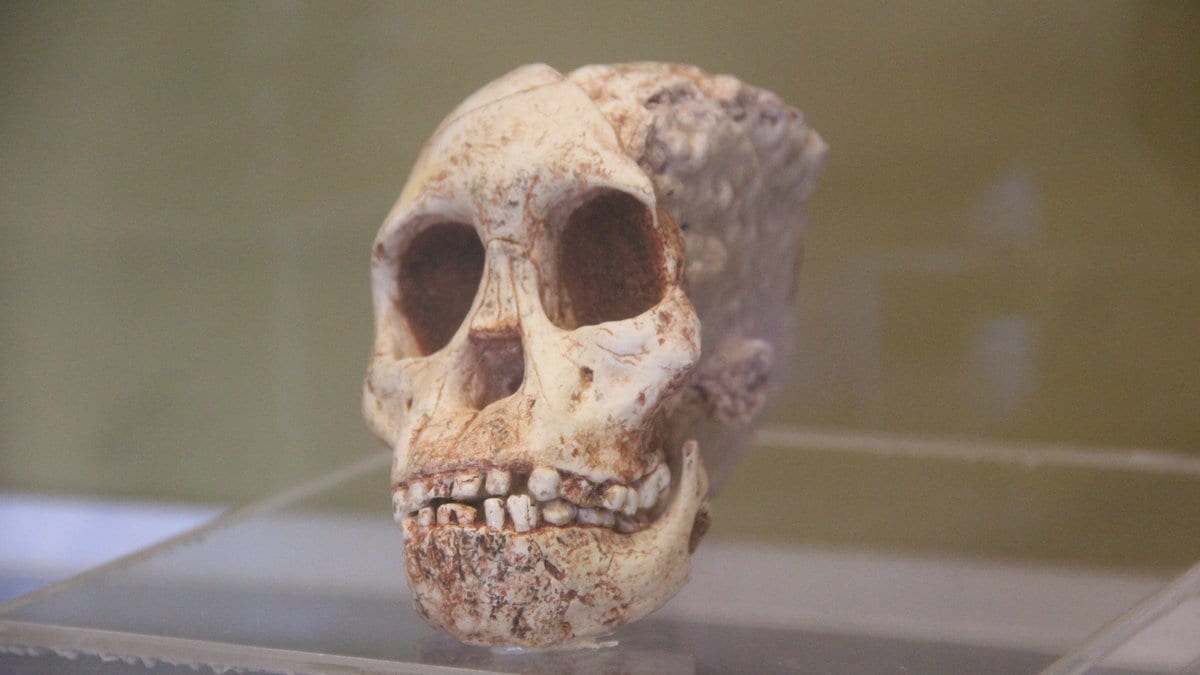
In 1924 a quarry at the Buxton limeworks, near the South African town of Taung, gave up the face and braincase of a small child set in cave rock. Dart named it Australopithecus africanus in Nature the following year and argued that the search for human ancestors belonged in Africa. He was right about the continent. The species is the part that never settled: a hundred years on, this one juvenile skull is still the only fossil that can be assigned to it without an argument.
That is the starting point of a paper published Nov. 5, 2026, in npj Palaeoecosystems by Gabriele A. Macho of Vrije Universiteit Brussel and seven colleagues, who went back over the Taung child's teeth, its brain growth and the inner shape of its molars. Their verb is careful. "These analyses confirm that A. africanus is a poorly defined taxon," they write, and the dispute they are confirming has run since the 1980s.
The confusion is nearly as old as the fossil. Broom put the Sterkfontein hominins in Plesianthropus transvaalensis and those from Kromdraai in Paranthropus; Dart gave the Makapansgat material a species of its own, Australopithecus prometheus. In 1954 Robinson folded Sterkfontein and Makapansgat into A. africanus as an act of "rationalisation," without naming a single shared derived feature to justify it. Nothing has replaced that act. The species is still, the authors write, "defined on the basis of a combination of vaguely defined qualitative features," among them "more molarized" and "less extreme," and Robinson's arrangement survives as "conventional palaeoanthropological wisdom." In 1988 Tobias put the Taung child closer to the robust australopiths than to its own species; A. prometheus was revived on the strength of a near-complete Sterkfontein skeleton and rejected again by Martin and colleagues in 2025.
Three names that may not fit
The sharpest new claim in the paper is a short list. The team measured hundreds of points on digital casts of the braincase interiors of Taung and five adult fossils filed under A. africanus, then set the result against growth series of wild chimpanzees and gorillas. Taung sits in the middle of the adult scatter, which is odd, because young apes at the same stage of tooth development do not overlap their own adults at all. Run forward under either ape model, the trajectory suggests Taung could have grown into something shaped like Sts 5 or Sts 60, and not like the other three. The set of fossils a species is built from is its hypodigm, and the authors remove three from this one: "Sts 71, MLD 37/38 and StW 505 are not part of this hypodigm."
The counterweight is in the same results section. Adult braincase volumes across those five fossils run from 391 to 568 ml, a spread that "is consistent with the hypothesis that these individuals are drawn from a single species" once the range inside living chimpanzees and gorillas is used as a yardstick. Volume points one way; shape and growth trajectory point the other, so the volumes are not what carries the argument for more than one species. The tooth work is thinner still, and the authors say so: "fossil hominin samples were often too small to produce meaningful results."
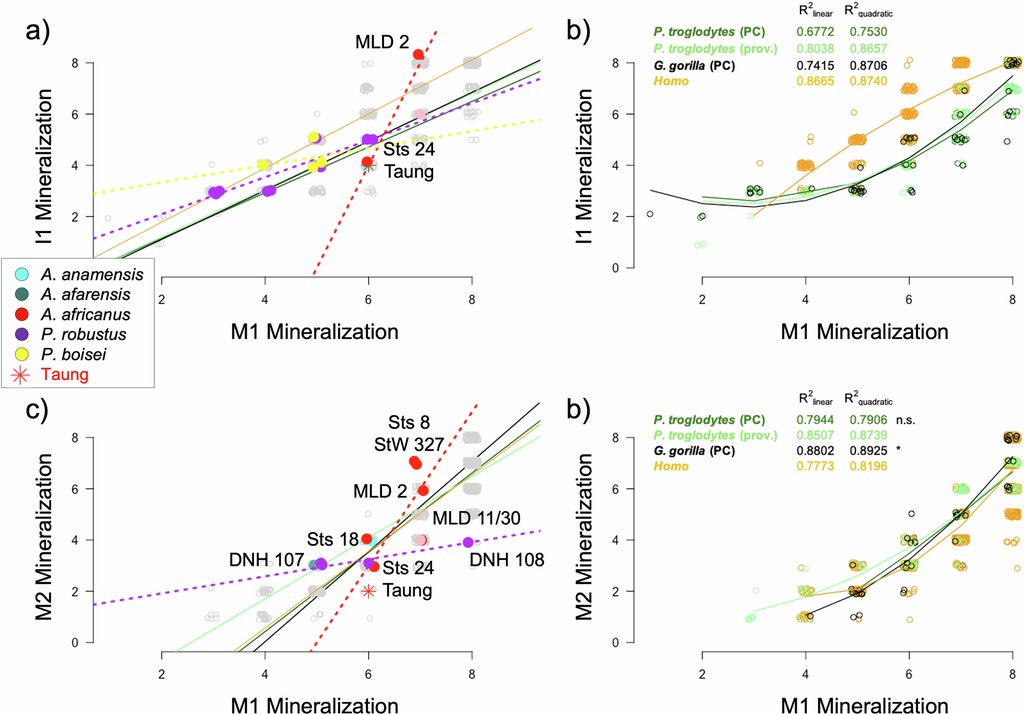
Which is why the least press-release sentence in the paper is its own summary. "Despite the comprehensive, although not exhaustive, analyses presented here, no clear picture emerges regarding the relationship of the Taung child with other hominins," the authors write, and they name three reasons: small samples, no second fossil that preserves everything Taung preserves, and a record scattered across time and space.
Why the rock above a fossil can be dated when the fossil cannot
A century of quarrying took the one thing a dating program would want. "The exact provenance of the Taung child has been lost during mining operations," the paper notes, so nobody can point to the layer the skull came out of. What can be dated is a sheet of flowstone, cave calcite laid down by dripping water, lying above the fossil-bearing deposit. Calcite traps uranium as it forms, and uranium decays to lead on a known schedule, so the sheet carries a clock that started when it grew. Because it grew on top of the deposit, its age is a floor under everything below, and never the age of the fossil.
Which uranium clock matters. The widely used version, lead-206 accumulating from uranium-238, needs a correction for the state of the uranium when the calcite formed, and beyond roughly 1.5 million years the uncertainty attached to that correction can be larger than the correction it is applying. A second clock in the same mineral, lead-207 from uranium-235, is largely free of the problem, and on the Taung flowstone it gives 2.962 ± 0.059 million years. That measurement is not this paper's own work. It belongs to Pieter Vermeesch, Philip Hopley, Nick M. W. Roberts and Randall Parrish, has been public since October 2025 as a preprint and is due as a chapter of a centenary volume on A. africanus; Vermeesch is a co-author here. This paper carries no uranium-lead methods and no data table, and its data statement reads "Raw data are culled from the published literature." What is new is that the figure has now appeared in a peer-reviewed journal and been put to work.
The paper gives a second reason for calling it a floor rather than an age. "Assuming uranium gain only, both ages are minimum estimates," the authors write, taking the older of two clocks as the lower limit. There is no radiometric ceiling at all: the 3.03-million-year figure quoted as the top of the range comes from paleomagnetic work by Herries and colleagues in 2013, and the search for a radiometric upper bound continues. What the isochron supports is a Pliocene floor under the Taung child, and nothing above it.
Rains that moved a boundary
The larger proposal is about geography rather than bones. The Limpopo valley, where the Makapansgat fossils come from, today marks the line between two biological regions, the Zambezian to the north and the Natal and Kalahari zone to the south. That line is sharp for backboned animals and blurrier for plants, the authors note, and it is set by how far south the tropical rain belt reaches. The belt has moved on orbital rhythms, which the team tracks in ocean and lake records, so the boundary moved with it. Their reading is that hominins were not long-distance travelers; the habitats moved, and populations expanded and contracted as whole biomes slid south and back again.
Boundaries are where things interbreed. Transition zones carry tangled species mixtures, as lions in the Limpopo area do today, and that is the mechanism the authors reach for: "we propose that complex population dynamics, including drift and hybridisation, probably underpin hominin morphological diversity in southern Africa during the Plio-Pleistocene." Both hedges are theirs. No ancient DNA or protein evidence exists for any of these fossils, so nothing here tests the idea; it is offered as a frame for the next round of work.
One strand of evidence for a wetter past is new and very small. A pilot study recovered pollen from two bulk samples of cave infill taken near the dated flowstone, neither sample dated and neither with a recorded position in the deposit, and counted about 30 grains in each. Among them was Podocarpus, a conifer whose forests now sit hundreds of kilometers to the east. Its presence at Taung, the paper says, "provides the first evidential support for the hypothesis of a more widespread distribution of Podocarpus forests across Africa" in the Pliocene. The paper adds a limit of its own: "Admittedly, the extent of forest cover is unclear."
None of this settles what the Taung child is, and the authors do not pretend otherwise. The skull, they write, "must stay at the heart of future investigations" of where our own genus came from. Dart was right about the continent. What remains unresolved is what the name he gave the child is supposed to cover, and which fossils it can honestly be made to hold.