Skip to content
See the World Through ScienceA project of ALLATRA
Source: Peer-reviewednpj Palaeoecosystems1 source

Taung Child Is at Least 2.962 Million Years Old, New Dating Finds
Science

Republish this story

Our work is licensed under Creative Commons BY-NC 4.0. You may republish this piece for free — with credit to ALLATRA Media and a link to the original, unedited beyond length trims, and not for commercial use.

Read the full license

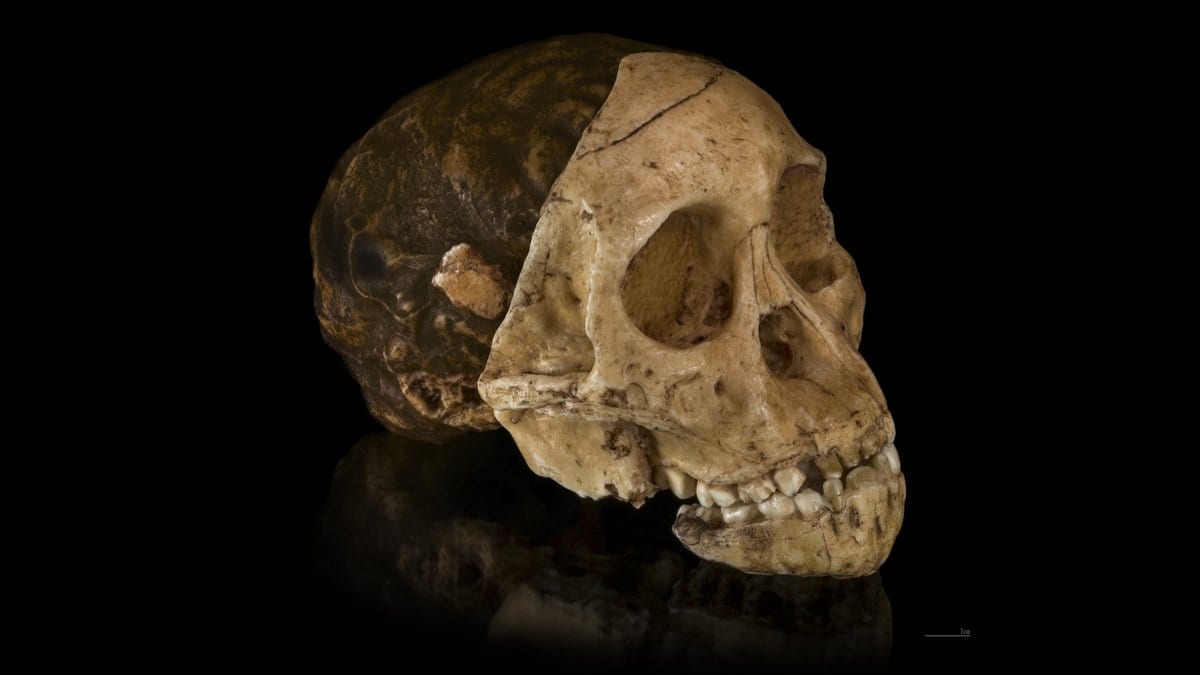
A cast of the Taung child skull photographed against a black background in three-quarter view, the juvenile face and teeth in front of a rounded stone endocast of the braincase.
The rounded brown mass at left is the natural stone endocast that filled the braincase, and the pale front is the juvenile face and teeth (shown as a cast). The new uranium-lead measurement was made on calcite lying above the fossil deposit at the Buxton Limeworks, South Africa, and makes the skull at least 2.962 million years old."Australopithecus africanus - Cast of taung child" by Didier Descouens, via Wikimedia Commons, CC BY-SA 4.0

Gabriele A. Macho of Vrije Universiteit Brussel and colleagues have put a minimum age of 2.962 million years on the Taung child, the fossil skull found in South Africa in 1924 that gave Australopithecus africanus its name. Their result, published Nov. 5, 2026, in npj Palaeoecosystems, is a floor rather than an age.

Southern Africa has none of the volcanic ash layers that date fossils in eastern Africa, and published estimates for the Taung child run from 942,000 years to 3.03 million. The authors say the floor places the skull firmly in the Pliocene. Combining it with a maximum age from earlier work on reversals of Earth's magnetic field narrows the fossil's age to between 2.96 million and 3.03 million years.

The age was measured not on the skull but on a flowstone, a sheet of calcite left by flowing water, above the deposit the skull came from. The clock is the decay of uranium-235, which the paper says avoids a correction that earlier flowstone dating needed. The authors write that both of their uranium dates are minimum estimates if the rock took up uranium after it formed, and that they adopt the older one as the best lower limit. A radiometric upper age constraint, the paper reports, "remains unavailable despite additional drilling and screening efforts".

The authors also re-examined the fossil's tooth and brain development and the shape of the boundary between enamel and dentine in its first molar, and their abstract concludes: "These analyses confirm that A. africanus is a poorly defined taxon." Taung is the only specimen they treat as unquestionably A. africanus, and they report that the fossils usually grouped with it do not cluster consistently.
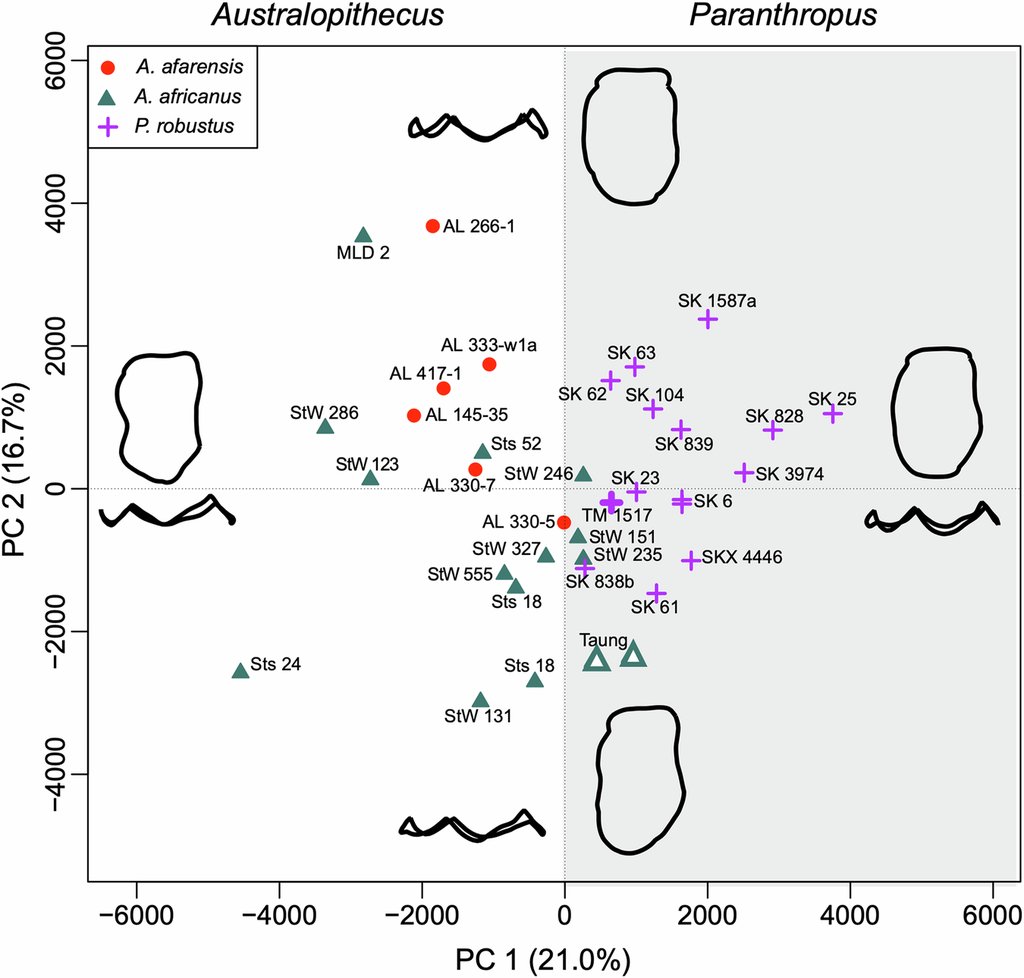
A scatter plot of two principal components of enamel-dentine junction shape, with labeled specimens of Australopithecus africanus, Australopithecus afarensis and Paranthropus robustus, and Taung marked among them.
Each symbol is one specimen, positioned by the shape of the junction between enamel and dentine in its lower first molar. The authors report that the fossils usually assigned to Australopithecus africanus do not cluster consistently. Fig. 3 from Gabriele A. Macho, Simon Neubauer, Clement Zanolli, Pieter Vermeesch, Kevin L. Kuykendall, Andreas Koutsodendris, Laurin S. Kolb, Thibaut Caley (2026), "The Taung child and the biogeographic and palaeoclimatic drivers of southern African hominin diversity", npj Palaeoecosystems — CC BY 4.0, resized

The authors go on to propose an explanation for the variety of early human relatives in southern Africa: populations that tracked shifting rainfall belts and interbred where they met, rather than one unusually variable species. The paper notes that the skull's exact position in the quarry was lost during mining, one reason dating it from nearby animal fossils has stayed insecure.

Sources

Spot an error?

Spot an error?

Report an error

Spotted a mistake on this page? Tell us what's wrong and our editors will take a look.

What kind of problem?

Only if you'd like us to be able to follow up. We won't use it for anything else.

We correct mistakes openly. Select any text to flag it. Fixes are logged under our Corrections Policy.

Report an error

Reporting on

Taung Child Is at Least 2.962 Million Years Old, New Dating Finds

What kind of problem?

Only if you'd like us to be able to follow up. We won't use it for anything else.

We read every report. Corrections are logged publicly.