Skip to content
See the World Through ScienceA project of ALLATRA
Source: Peer-reviewedNature1 source

Fossil Proteins Identify a Disputed Chinese Skull as Denisovan
Science

Republish this story

Our work is licensed under Creative Commons BY-NC 4.0. You may republish this piece for free — with credit to ALLATRA Media and a link to the original, unedited beyond length trims, and not for commercial use.

Read the full license

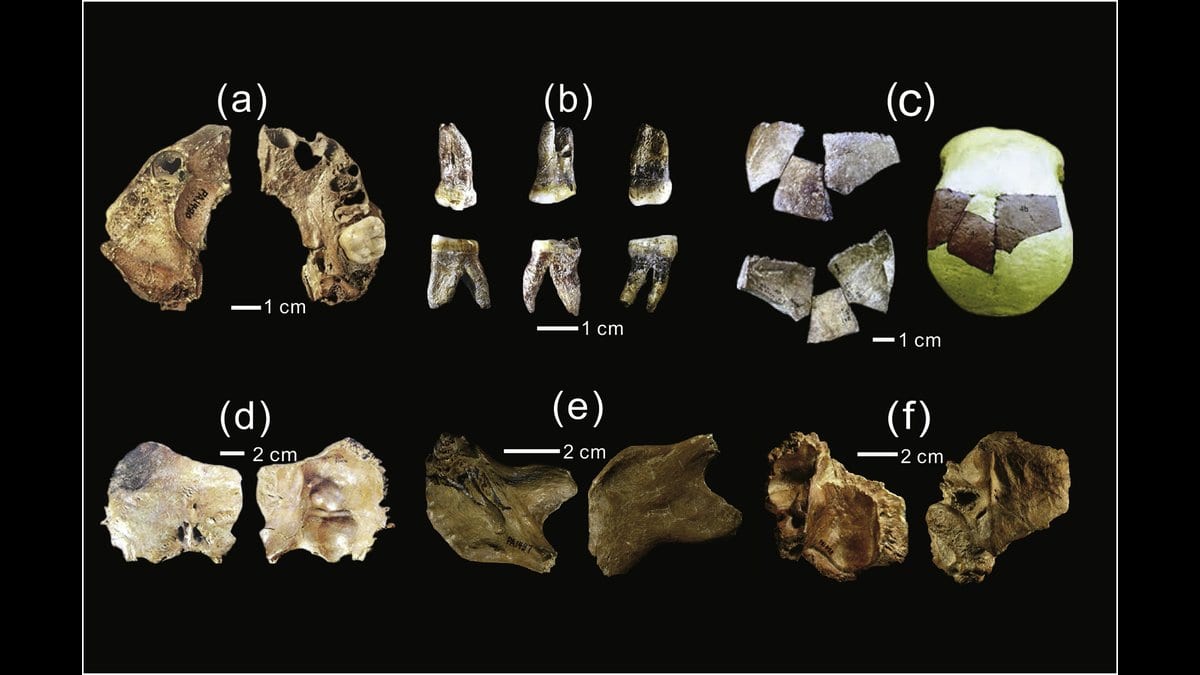
Six panels on a black background showing fossil skull fragments, teeth and jaw pieces from the Xujiayao site, each panel with a centimeter scale bar.
Fossils excavated at the Xujiayao site in northern China, shown with centimeter scales. Protein sequences from two of them, a parietal bone and part of a lower jaw, carry the marker the study reads as Denisovan."Xujiayao hominin" by Hong Ao, Chun-Ru Liu, Andrew P. Roberts, Peng Zhang, and Xinwen Xu, via Wikimedia Commons, CC BY-SA 4.0

Song Xing, Qiaomei Fu and colleagues at the Institute of Vertebrate Paleontology and Paleoanthropology in Beijing report that proteins from two fossils at Xujiayao, in northern China, carry a variant so far seen only in Denisovans. The paper appeared Oct. 21, 2026, in Nature and is open access.

Denisovans were defined by DNA from remains in Siberia, and which other Asian fossils belong with them has been disputed since. The new analysis turns on a single position in a collagen protein, COL1A2-996: the authors report that the Denisovan form there is present in every Denisovan so far identified by DNA or protein, while Neanderthals and modern humans carry a different amino acid. It can place a fossil that has yielded no genome.

The two specimens were a piece of skull and a jaw fragment. The authors report 18 proteins they judge ancient rather than modern contamination, the Denisovan marker in both bones, and a family tree built from the protein sequences that put the samples with known Denisovans every time.
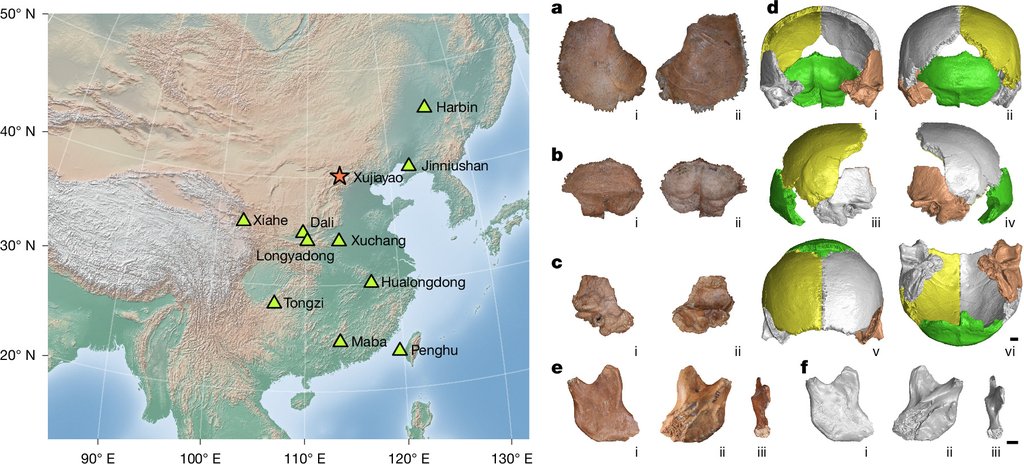
A relief map of eastern China with fossil sites labeled and Xujiayao starred, beside surface scans of a parietal bone, an occipital bone, a temporal bone and a jaw with colored virtual reconstructions.
Left, Xujiayao among the East Asian fossil sites in the comparison. Right, the parietal bone and the jaw fragment that were sampled, beside virtual reconstructions of the cranium and mandible. Fig. 1 from Song Xing, Zhongyou Wu, Qingfeng Shao, Junyi Ge, E. Andrew Bennett, Huiyun Rao, Sungui Lin, Yuhao Zhao, Feng Liu, Yichen Liu, Kai Zhou, Xiaotian Feng, Qigao Jiangzuo, Qiaomei Fu (2026), "The proteome of Middle Pleistocene Xujiayao and common Denisovan morphology", Nature — CC BY-NC-ND 4.0, resized

Xing and colleagues then compared Xujiayao with other East Asian fossils of the same period, among them Harbin, Jinniushan, Dali and Hualongdong, and set out traits they share: a low braincase with nearly parallel side walls, a heavy brow ridge, a flat cheek region and a face that barely juts forward. They describe this as indicating that all belong to the Denisovan lineage, an inference from shared anatomy and not a molecular result for each fossil.

The paper notes an earlier analysis that measured the Xujiayao 6 braincase at 1,700 ml, grounds for putting Xujiayao in a separate species, Homo juluensis. Xing and colleagues argue that the gap in brain size between the two groups falls inside the range recorded in living people, and counts as variation within one population.

The Xujiayao fossils come from the Nihewan Basin and are dated to roughly 199,000 to 138,000 years ago. The protein data are deposited in the public PRIDE repository.

Sources

Spot an error?

Spot an error?

Report an error

Spotted a mistake on this page? Tell us what's wrong and our editors will take a look.

What kind of problem?

Only if you'd like us to be able to follow up. We won't use it for anything else.

We correct mistakes openly. Select any text to flag it. Fixes are logged under our Corrections Policy.

Report an error

Reporting on

Fossil Proteins Identify a Disputed Chinese Skull as Denisovan

What kind of problem?

Only if you'd like us to be able to follow up. We won't use it for anything else.

We read every report. Corrections are logged publicly.