A Fossil Whale Built to Point Its Snout at the Seafloor

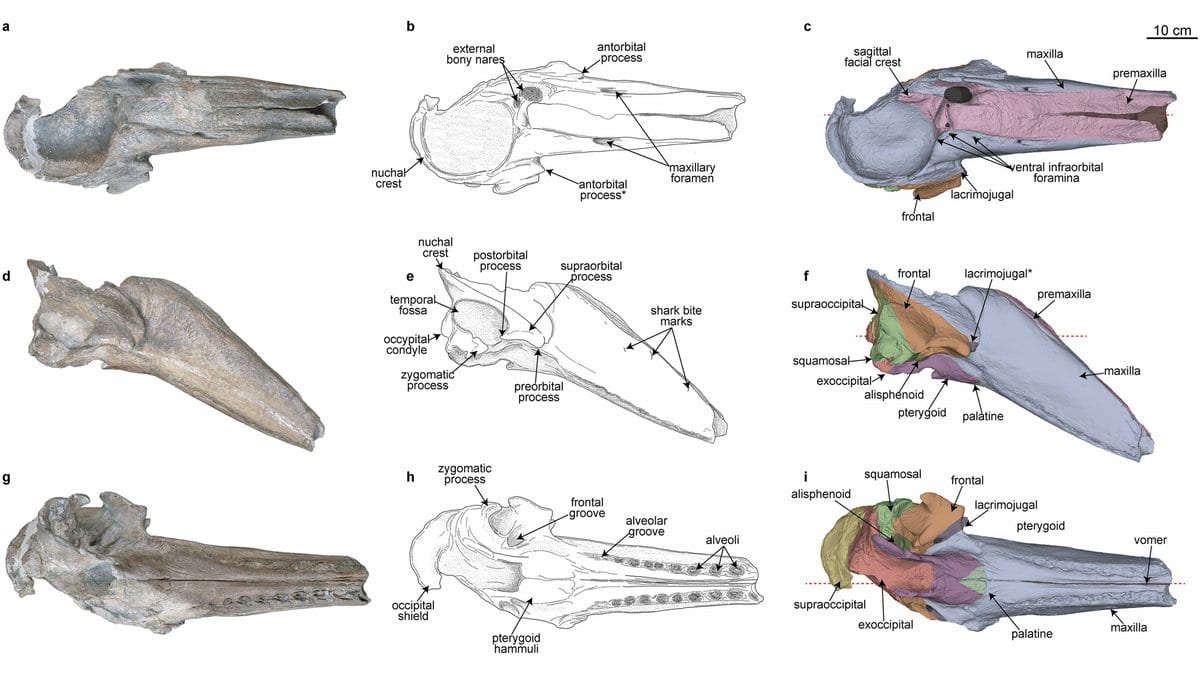
In a collection room at the Museo de Historia Natural in Lima sits a whale skull that looks stepped on. The whole face is shoved left of where a face should be, both nostril openings have crossed the midline, and the heavy tube of a snout bends toward the floor. With a skull this distorted, Aldo Benites-Palomino says, the first suspicion is always that the sediment did it, flattening and twisting bone over millions of years. He came across this one in 2015, as a bachelor's student. The sutures were fully closed, and nothing else on the skull was deformed. "This was genuine biology, not a result of poor preservation," he adds.
The paper describing it, by Benites-Palomino and colleagues, appeared Nov. 9, 2026, in Communications Biology. The animal is a pygmy sperm whale, a small relative of the living Kogia, and they named it Scaphokogia huachafo. The genus is not new; this is its third species. "In Peru, huachafo is an everyday word for anything that is flashy, over-the-top, bizarre, extravagant or difficult to categorize aesthetically," Benites-Palomino says in a University of Zurich release issued the same day. The whale, he adds, "broke every rule of symmetry and elegance seen in living cetaceans."
Lopsided skulls are normal in toothed whales. The bones of the right side of the face push leftward, making room for the fatty forehead organs that generate and aim the clicks these animals hunt by. In Scaphokogia huachafo the shift goes much further: both bony nostrils have crossed to the left of the midline, the left one considerably larger than the right, and the bones in front of the eye differ in build from one side to the other. The description rests on this single skull, an adult missing part of the left side of its braincase.
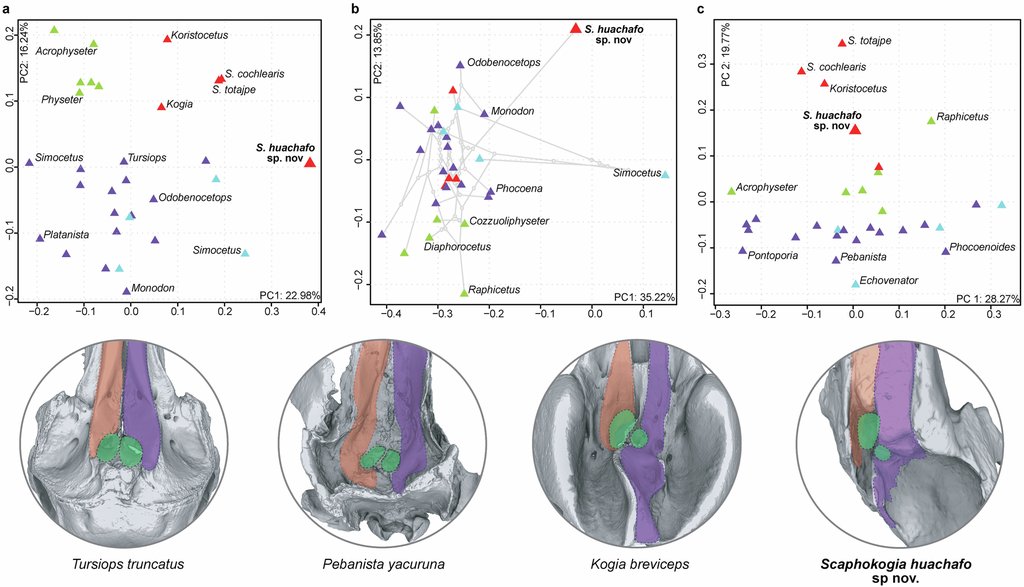
The team put numbers on the shape. The usual schemes for placing landmarks on a whale skull do not carry over to sperm whales, so the authors built one for the sperm whale face and ran it across 31 skulls. Against that sample, they write, the genus Scaphokogia "exhibits the most extreme facial asymmetry documented among cetaceans, and potentially among mammals."
The new species is not the extreme case within its own genus. In the analysis comparing the left and right bones of the upper face directly, the paper says, "Surprisingly, S. huachafo was not the most extreme taxon; instead, this position was occupied by S. totajpe, the smallest species within the genus." That one was described in 2020. What S. huachafo holds is the farthest-out position in the shape comparison among pygmy sperm whales, and an asymmetry the authors call unique among cetaceans. The record is a position on a chart of skull shape, not a tested result: the statistic behind the separation of the groups fell short of the usual threshold, which the paper itself calls marginal.
The snout is the other peculiarity. All three Scaphokogia species carry it tilted downward, and in the new one the angle between the snout and the main axis of the skull reaches 31 degrees, the steepest of the three. It is also unusually massive: thickened, extra-dense bone, with some of the cartilage inside it turned to bone, which, the authors expect, shifted its center of gravity forward. The whole whale was small, with an estimated body length of about 2.7 meters.
Then there is the joint where the skull meets the neck. The new skull came with no neck bones, so the team worked from MUSM 171, the only specimen of the genus that preserves the first vertebra, and reconstructed how far the head could swing. With the neck pulled as far up as it goes, the snout still sat 22 degrees below the body axis; at full downward flexion it reached 55 degrees. The travel is the difference between the two, not the 55 itself; in every posture the reconstruction allows, the snout points down. "The entire cranio-cervical complex is modified to point the snout directly toward the bottom," says Gabriel Aguirre-Fernández of the University of Zurich, a co-author.
From there the authors argue toward a way of feeding. Heavy, dense skull bone usually goes with active bottom feeding among marine mammals, they note, as in sea cows, walruses and some early whales, where the extra weight helps an animal hold position against the bottom. Add a permanently downturned snout and a neck that drops well below the body line, and the result is "consistent with a benthic foraging behaviour," in the paper's phrasing: a whale working the sediment of a shallow coast.
The diet itself is missing. There are no stomach contents and no chemical traces of food, and the tooth sockets in the upper jaw are filled with spongy bone, with teeth the authors suggest may have been present earlier in life and then lost. Other bottom-feeding marine mammals find prey with whiskers or with their eyes, and Scaphokogia appears to have had neither, so the team proposes, explicitly as a proposal, that it swept the sediment with its lopsided sonar instead.
The age belongs to the authors. They date the fossil-bearing layer at Aguada de Lomas, in the Sacaco basin of Arequipa, to between 6.3 and 5.6 million years ago, laid down as a shallow sea pushed in over the coast. The ages of these beds are argued over in the regional literature: the chronology the paper itself cites puts the classic fossil level at that locality about two million years older, so the window is the team's reading and not a settled date. It falls near the end of the Miocene either way, on a coast that carried several specialized bottom feeders, the walrus-like dolphin Odobenocetops among them. That company is the authors' closing argument: the job this whale did went vacant when the oceans reorganized into roughly their present form, and nothing alive has taken it back.
Sources
- Communications BiologyPeer-reviewed
- www.news.uzh.ch