Skip to content
See the World Through ScienceA project of ALLATRA
Source: Peer-reviewedRoyal Society Open Science1 source

A 400-Kilogram Dinosaur From South Africa Was Still Growing When It Died
Science

Republish this story

Our work is licensed under Creative Commons BY-NC 4.0. You may republish this piece for free — with credit to ALLATRA Media and a link to the original, unedited beyond length trims, and not for commercial use.

Read the full license

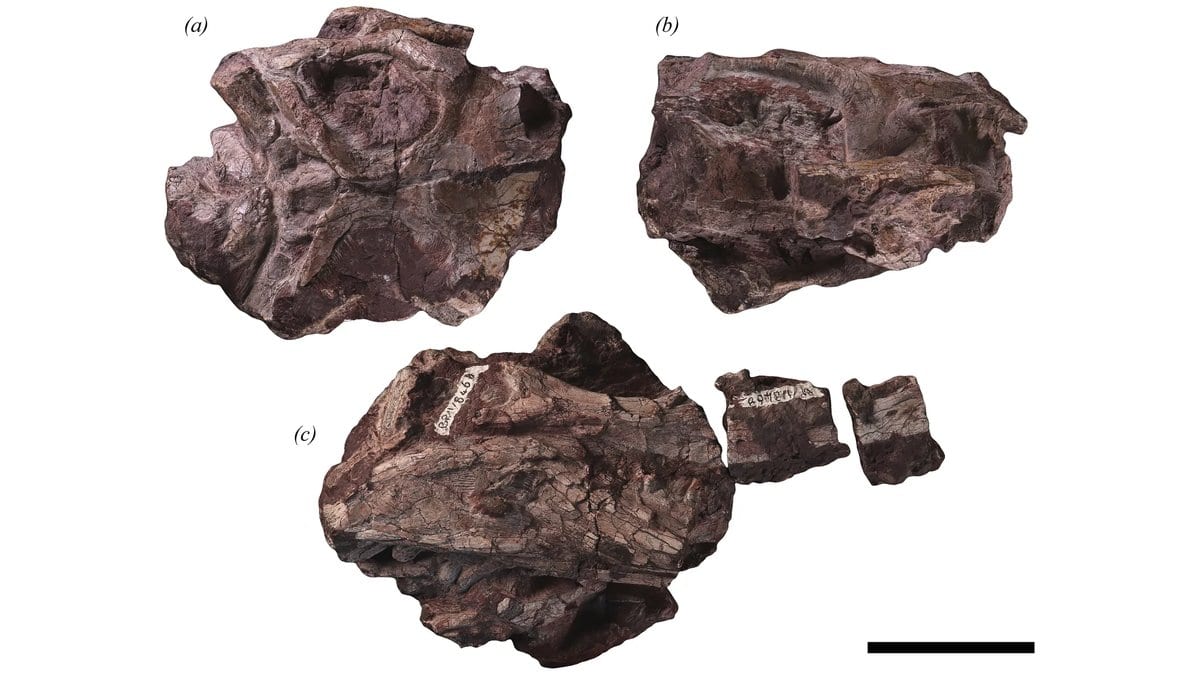
Three photographs of a brown fossil dinosaur skull on a white background, seen from above, from the left side and from below, with a black scale bar at lower right.
The skull photographed from above, from the left side and from below (panels a, b and c). The bar at lower right is a 5 cm scale.Figure 3 from Atashni Moopen, Jennifer Botha, Roger Benson, Kimberley E. J. Chapelle, Paul M. Barrett, Kathleen Dollman, Jonah N. Choiniere (2026), "Nyana rooiwalensis: South Africa's earliest near-complete sauropodomorph dinosaur skull from the Late Triassic of the Eastern Cape Province", Royal Society Open Science — CC BY 4.0, resized and padded

A new Triassic dinosaur from South Africa's Eastern Cape Province has been named Nyana rooiwalensis, described from what its authors call the first well-preserved, near-complete skull recovered from the lower Elliot Formation. The description was published Nov. 11, 2026, in Royal Society Open Science.

The paper reports that body-mass estimates put the animal at roughly 400 kg, while cut sections of its bone show at most two lines of arrested growth (the marks left where growth stalls) and a rippled outer bone surface. The authors take both as signs of an early stage of growth, and write that the combination supports the early evolution of rapid growth in sauropodomorphs, the lineage that went on to produce the long-necked giants.
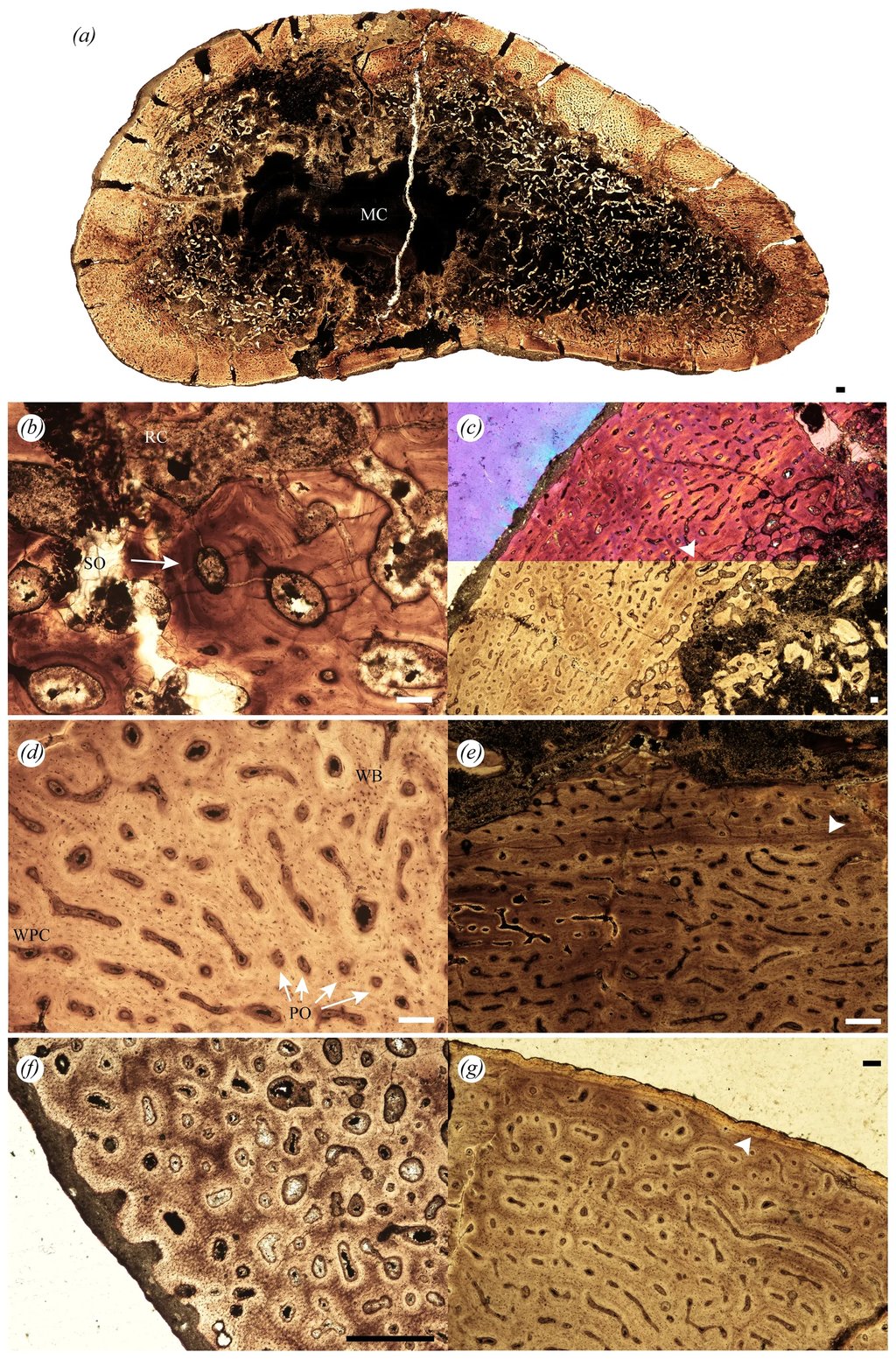
Amber-toned microscope views of a cross-sectioned fossil limb bone, showing a hollow center, dense networks of vascular canals, and a thin dark line near the outer edge.
Thin sections of the animal's ulna under the microscope. Arrowheads mark the lines of arrested growth, the rings left behind where bone growth paused. Figure 60 from Atashni Moopen, Jennifer Botha, Roger Benson, Kimberley E. J. Chapelle, Paul M. Barrett, Kathleen Dollman, Jonah N. Choiniere (2026), "Nyana rooiwalensis: South Africa's earliest near-complete sauropodomorph dinosaur skull from the Late Triassic of the Eastern Cape Province", Royal Society Open Science — CC BY 4.0, resized

Atashni Moopen, of the Evolutionary Studies Institute at the University of the Witwatersrand in Johannesburg, is the paper's first author, and the institute's Jonah N. Choiniere is its senior author. The specimen they describe preserves the braincase and the palate, the hyoid bones of the throat and the scleral rings that sat inside the eyes, together with bones from the rest of the skeleton.

The paper notes that Triassic skulls from this group are scarce, known mainly from Argentina, Brazil and Europe. In southern Africa, only two Late Triassic species, Mbiresaurus and Kholumolumo, had preserved any skull bone at all, both from limited material.

Where Nyana belongs on the family tree is not settled. The analyses recovered it as the closest relative of either Sarahsaurus, from North America, or Ngwevu, from South Africa. The paper is free to read under a Creative Commons license.

Sources

Spot an error?

Spot an error?

Report an error

Spotted a mistake on this page? Tell us what's wrong and our editors will take a look.

What kind of problem?

Only if you'd like us to be able to follow up. We won't use it for anything else.

We correct mistakes openly. Select any text to flag it. Fixes are logged under our Corrections Policy.

Report an error

Reporting on

A 400-Kilogram Dinosaur From South Africa Was Still Growing When It Died

What kind of problem?

Only if you'd like us to be able to follow up. We won't use it for anything else.

We read every report. Corrections are logged publicly.