A Cheap Perovskite Crystal Becomes a Polariton Laser That Runs on Plain Direct Current

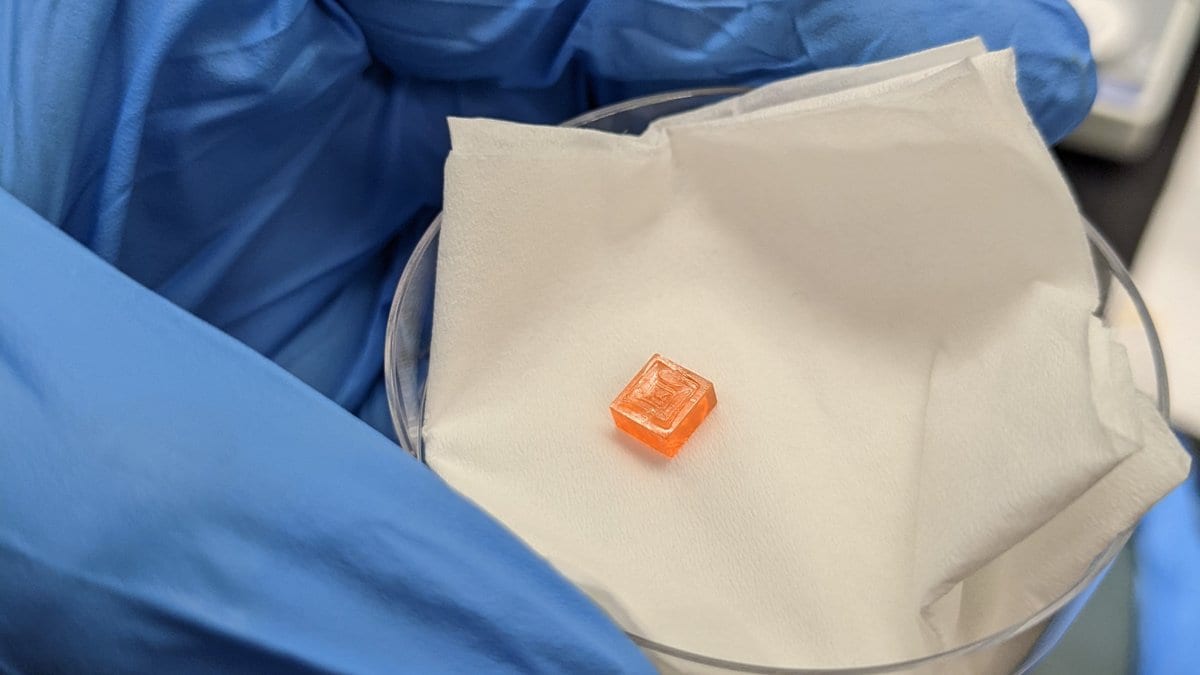
For years, the perovskite polariton laser has had an awkward secret: to make it shine, you had to shine another laser at it.
That is not a small caveat. A laser you can only switch on with a second, bulkier laser is a physics demonstration, not a device. No one is going to build a chip, a display, or a communication link around a light source that needs an external optical pump to come alive. The whole point of a practical laser is that you plug it in and current does the rest. Getting these exotic devices to run on ordinary electricity has been the wall the field kept hitting.
A team led by Anatoly Pushkarev and Pavlos Lagoudakis has now gone through it. Their device lases under nothing more exotic than direct current (a steady 65 microamps of it), making it, they report, the first perovskite polariton laser driven by direct electrical pumping rather than by an auxiliary beam of light. The work appears in Nature, with the underlying manuscript also posted to the arXiv preprint server.
Light that is also matter
To see why this is hard, it helps to know what a polariton is.
Trap light between two closely spaced mirrors (an optical microcavity) and pack a suitable crystal inside, and the photons can couple so tightly to the crystal's electronic excitations that the two stop being separable things. What you get is a polariton: a hybrid quasiparticle, part light and part matter, that inherits properties from both. Because polaritons can pile into a single shared quantum state, they can be coaxed into emitting coherent light, or lasing, at far lower power thresholds than a conventional laser, where you have to force a full population inversion. That efficiency is the whole attraction.
The catch has always been the pumping. Feeding energy into the system optically is straightforward. Feeding it in electrically (injecting electrons and holes cleanly into the crystal so they recombine and sustain the polaritons) is much fussier, and perovskites, for all their virtues, are chemically delicate. Standard metal electrodes tend to react with them or inject charge unevenly.
The team's answer was a careful piece of materials engineering. They grew the light-emitting element from a solution (a microplate of the perovskite CsPbBr3, cheap and made without an expensive high-vacuum furnace) and contacted it with electrodes made of single-walled carbon nanotubes, which are chemically inert and gentle on the crystal. Arranged inside the microcavity as a p-i-n diode, the structure injects charge evenly enough to hold a steady stream of polaritons and drive them into lasing on direct current alone.
Real, and not yet ready
The honest framing matters here, and the researchers supply it themselves. The device runs at 8 kelvin, colder than 265 degrees below zero Celsius, achievable only with serious cryogenic cooling. That makes this a proof of concept, not a product. No one is putting a liquid-helium cryostat behind a laser pointer, and room-temperature operation is a separate, formidable challenge still ahead.
What the result establishes is narrower and, in its way, more important: that the electrical hurdle itself can be cleared. The reason to care about perovskites in the first place is that they are cheap and easy to make, grown from solution rather than fabricated atom by atom. Marrying that low-cost chemistry to direct electrical drive is exactly the combination a usable technology would need. Warming it up comes next. Getting it to run on plain current at all is the step that had been missing.