Orangutan Mothers Seem to Travel Farther to Let Their Young Play

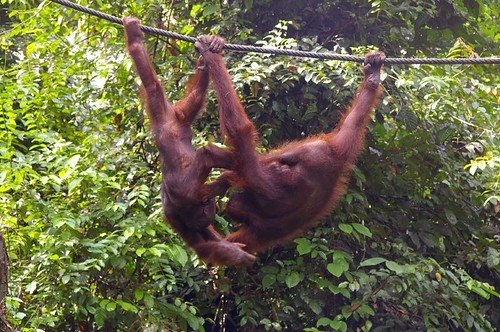
In the peat swamp forest at Tuanan, on the Indonesian side of Borneo, two infant orangutans catch sight of each other across a gap in the canopy and the day changes shape. They rush together, grapple, bite, and hang upside down from the branches while they wrestle. Their mothers, who as a rule keep a wary distance from other adults, settle in nearby and wait it out.
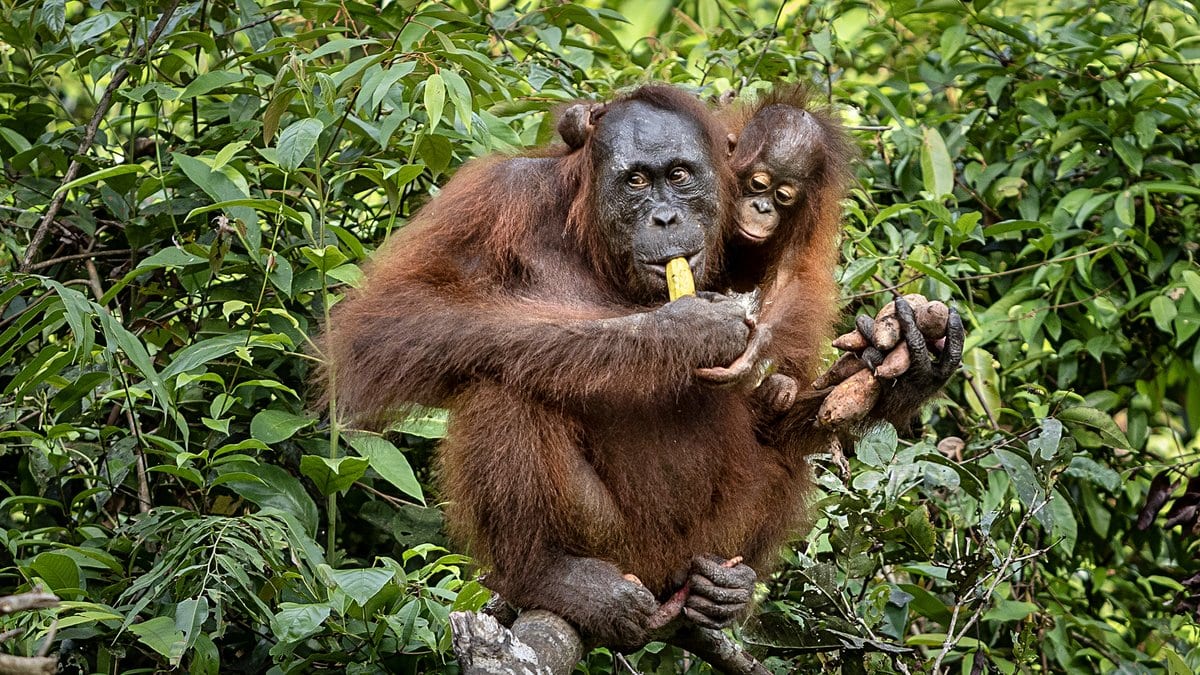
Scenes like that one are rare, and for a long time nobody could say whether they were accidents. Orangutans are the least sociable of the great apes. A mother spends most of her time alone with her youngest, who stays dependent on her for seven years or more, and meetings between adults are infrequent and careful. That leaves the young with a problem, because rough play with peers is how young primates build strength and social skill, and a mother who travels alone with one infant has no ready supply of them.
Whether mothers do anything about that, and what it costs them if they do, is the question behind a study published Oct. 6, 2026, in the Proceedings of the National Academy of Sciences. Odd T. Jacobson of the Max Planck Institute of Animal Behavior, Maria A. van Noordwijk of the University of Zurich and colleagues worked through about 32,600 hours of dawn-to-dusk observation of 31 mother and offspring pairs, gathered at the Tuanan research station in Central Kalimantan since 2003. They asked whether mothers arrange their daily travel in ways that put their infants near other infants.
Van Noordwijk noticed early on that the infants' meetings seemed to land on their mothers. "It just looked like a very long, exhausting day for them," she says in the Max Planck Society's announcement of the work, which is in German; the quotations here are translated. "I knew there was more behind these play days, but we needed more analysis to show it."
The authors report two patterns in the movement data. Neighboring mothers whose offspring were close in age showed unusually high overlap in where they ranged over a year, and that overlap held independently of how closely the mothers were related and of how much fruit was available. Both of those controls earn their place. Female orangutans settle near where they were born, so neighbors are often relatives, and two animals in the same patch of forest are frequently just sharing a fruiting tree. Play between neighboring offspring, in turn, was more frequent the closer in age they were.
Then there is the travel. On days when their offspring played with a peer, mothers covered more ground and spent less time feeding. Distances were up on the day before and the day after as well, and the direction is what gives the pattern its shape: before a play meeting the mothers' movement bent toward the patch of forest the other female uses most, and afterward it bent back toward their own. The paper's title calls this an energetic cost, and the quantities behind the phrase are travel distance and feeding time rather than any measurement of energy taken in or burned.
The authors write that the pattern "suggests these encounters are planned and actively pursued over multiple days rather than arising by chance." Nothing in this study was manipulated. It is observation of wild animals, so the case that mothers are seeking the meetings out rests on an association between where they ranged and when they moved, not on anything that could separate a deliberate detour from a habit.
The Max Planck Society puts the meetings at about 6% of days, roughly one in every 20, and says that when the young do play with a peer they spend around 20 minutes at it. That is the whole of it, at the end of a detour that takes three days to walk.
What none of this settles is whether the effort pays. "We still do not know whether the time and energy that mothers invest in organizing play dates gives their young an advantage later in life," says Sri Suci Utami Atmoko of Universitas Nasional in Jakarta, a co-author. She adds that only long-term studies such as this one can produce an answer, tying behavior to development, environment and demography across the whole life of a long-lived animal.
That is the shape of the finding, and also its edge. A cost has been measured; what the mothers are buying with it is an inference. What the record does show is that an ape known for being alone is not indifferent to its neighbors: who they are, and how old their young are, appears to register in where a mother chooses to spend her day. The authors call that an underappreciated form of maternal investment, and evidence that the social side of growing up can be provided for even at the solitary extreme of animal life.