What Do Bumblebees Learn From One Another?

Beneath a transparent plate lies a blue artificial flower holding a drop of sucrose solution. A bumblebee tries to reach the drop from above, but the plate blocks its path. A string attached to the flower extends beyond the edge of the plate. A simple pull would bring the flower closer. But how is the bumblebee supposed to figure that out?
Watching a neighbor
Sylvain Alem and Clint Perry of Queen Mary University of London gave buff-tailed bumblebees (Bombus terrestris) a chance to find the solution on their own. This test marked the start of a series of experiments that they described with Lars Chittka and other colleagues in PLOS Biology in 2016.
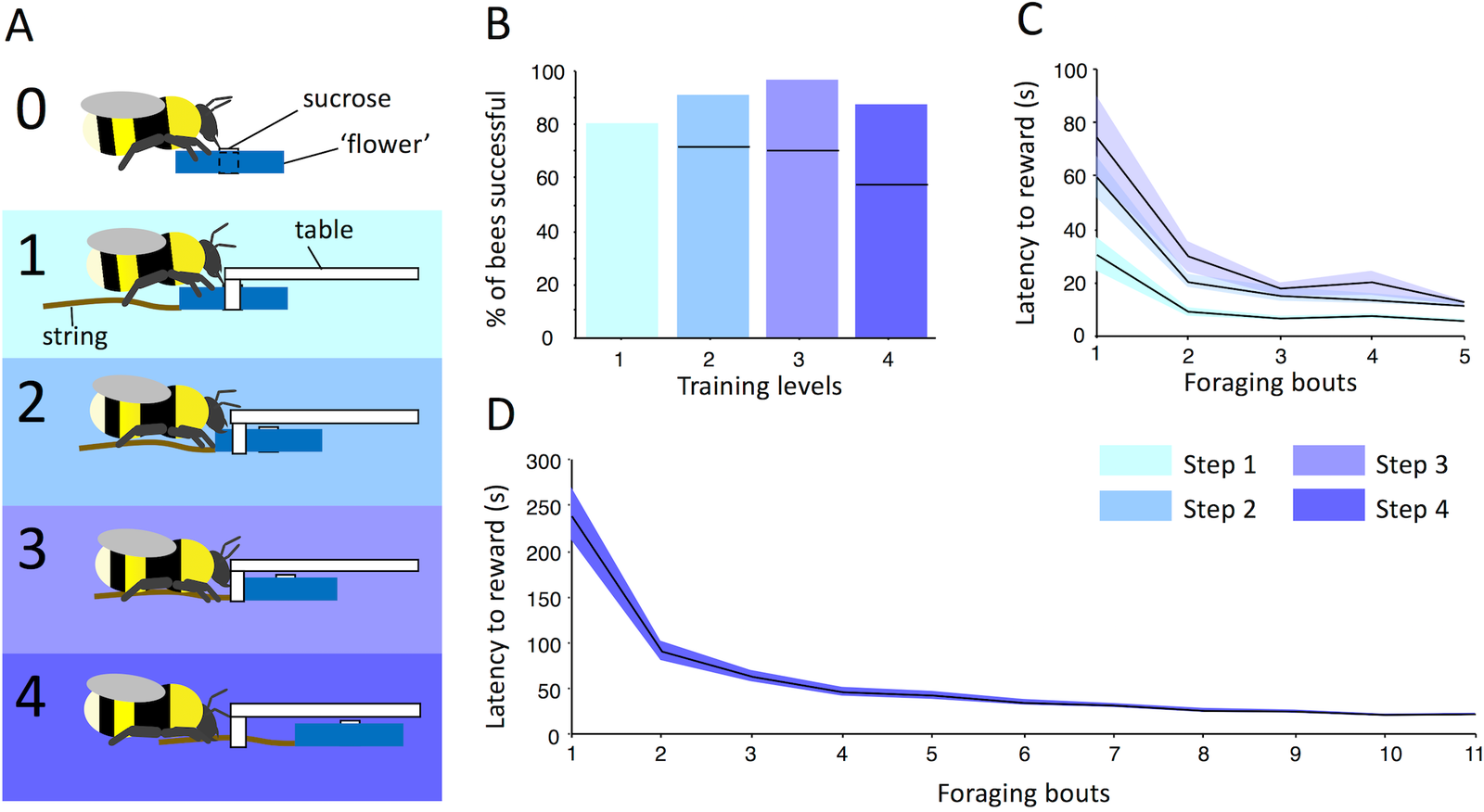
The bumblebees were released one at a time to approach the flowers beneath the plate, and each was given five minutes to reach the nectar. None of the 291 bees succeeded on the first attempt. When 25 bees were given a second five-minute attempt, two of them pulled a flower out by the string on their own.
The researchers trained another group of bumblebees to perform this task by gradually moving the flower farther beneath the plate. At first, half of the flower remained exposed, and a bee could reach it with its proboscis. When only a quarter of the flower extended beyond the plate’s edge, the bee had to pull it closer with its legs. Next, the flower was placed entirely beneath the plate, but still right at the edge, within the bee’s reach. In the final stage, it was moved so far underneath (2 cm from the edge) that the nectar could be reached only by pulling the string. Bees that had learned the technique grasped the string with their forelegs or mandibles and pulled the flower toward themselves. The authors suggested that the movement of the flower itself encouraged the bee to keep pulling it closer.
The researchers selected trained bees from the same colony to serve as demonstrators for untrained observers. Each observer was placed in a transparent chamber from which it could watch an experienced bee pull the flower out by the string. After ten such demonstrations, the observer was released from the chamber and given five minutes to reach the nectar on its own. Fifteen of the 25 bees succeeded.
In a separate experiment, the researchers tracked how the technique spread through a colony. They trained one bee in each of three colonies to pull the string, then began releasing bees to the flowers in pairs, in the order in which they left the nest. A bee that had learned the technique from an experienced member of its colony could then serve as a model for others on its next foraging trip.
After 150 such foraging trips in each of the three colonies, about half of the bumblebees had learned to pull the string. In three control colonies, where no bees had been trained beforehand, not a single bee learned to pull out the flower over the same number of trips.
A step without a reward
Each successful tug on the string brought the flower closer to the bee. Could another bee’s example help a bumblebee learn an action that is not followed by an immediate reward?
Biologists at Queen Mary University of London and the University of Sheffield designed a puzzle box that could be opened only by performing two actions in sequence.
In 2024, Alice Bridges, Lars Chittka and their colleagues described in Nature how bumblebees learned to open it. A drop of sugar solution lay beneath the box’s lid. To reach it, a bee had to perform two actions. First, it had to push aside a blue tab that blocked a red one. Then it had to push the red tab to rotate the lid. Only then could it obtain the reward.
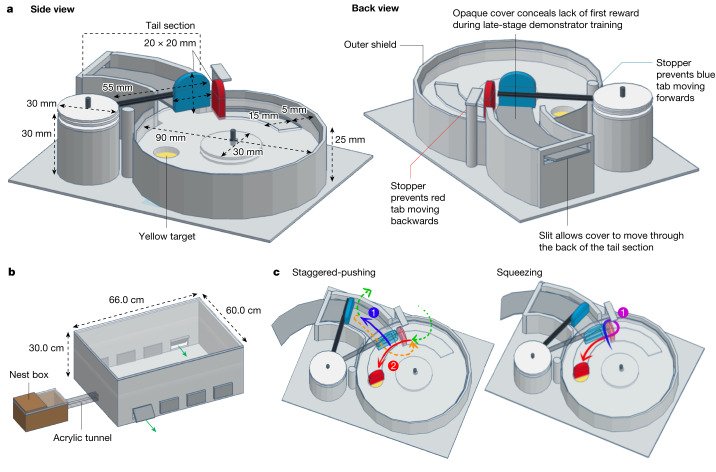
The bees that would serve as demonstrators proved difficult to train. They repeatedly tried to push the red tab but left the blue tab blocking its path untouched. The researchers therefore placed an extra drop of sugar solution beneath the blue tab so that the bees would receive a reward for the first step. As training progressed, this reward was gradually removed, while the amount of sugar solution provided for opening the lid was increased. By then, the bees had learned to perform both actions in sequence: first freeing the red tab, then opening the lid and only afterward receiving the treat.
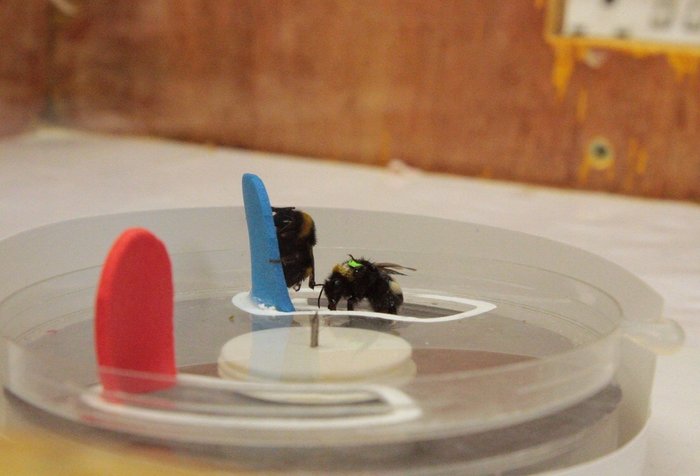
Once the demonstrators had mastered the task, the researchers began releasing them to three closed puzzle boxes together with untrained observers. A total of 15 untrained bumblebees took part in these trials, each paired with an experienced bee. While the experienced bee opened the lids and obtained the sugar solution, the observer could watch its actions and sometimes followed closely behind it across the surface of the box. After 30 joint sessions, the observer was left alone with a closed box containing no sugar solution and given 15 minutes to open it independently. If it failed, it was paired with the demonstrator again, and the test was repeated after the 35th and 40th joint sessions. In the end, five of the 15 observers learned to solve the two-step task: three passed the first test, and two more passed the third. Unlike the demonstrators, none of them had received a reward directly for moving the blue tab.
To find out whether bumblebees could learn to solve the two-step task on their own, the researchers conducted a separate experiment with three control colonies. Each day, the bees were first given half an hour with lidless boxes, from which they could freely obtain sugar solution, followed by three hours with closed boxes. These trials continued for 12 consecutive days in two colonies and for 24 days in the third. Across all these trials, a bee managed to move the blue tab all the way only once, and got no further: not a single box was opened. Although the researchers do not rule out the possibility of a bee solving the task independently in rare cases, the results show how difficult it was for the bees without the help of a trained member of their species.
In the string-pulling experiments, bees that learned the new technique became models for others, and the skill gradually spread through the colony. The two-step puzzle experiment revealed another possibility for social learning: bumblebees were able to learn from others how to solve a task that, under the experimental conditions, they had not managed to solve independently. This finding challenges the widespread view that only humans can learn from others complex skills that they cannot acquire on their own.
Sources
- Alem et al. (2016). Associative Mechanisms Allow for Social Learning and Cultural Transmission of String Pulling in an Insect. PLOS Biology 14(10), e1002564
- Bridges et al. (2024). Bumblebees socially learn behaviour too complex to innovate alone. Nature 627, 572–578
- Bridges et al. (2023). Bumblebees acquire alternative puzzle-box solutions via social learning. PLOS Biology 21(3), e3002019