Earth's Earliest Sign of Oxygen May Be a Sign of Bacteria That Made None

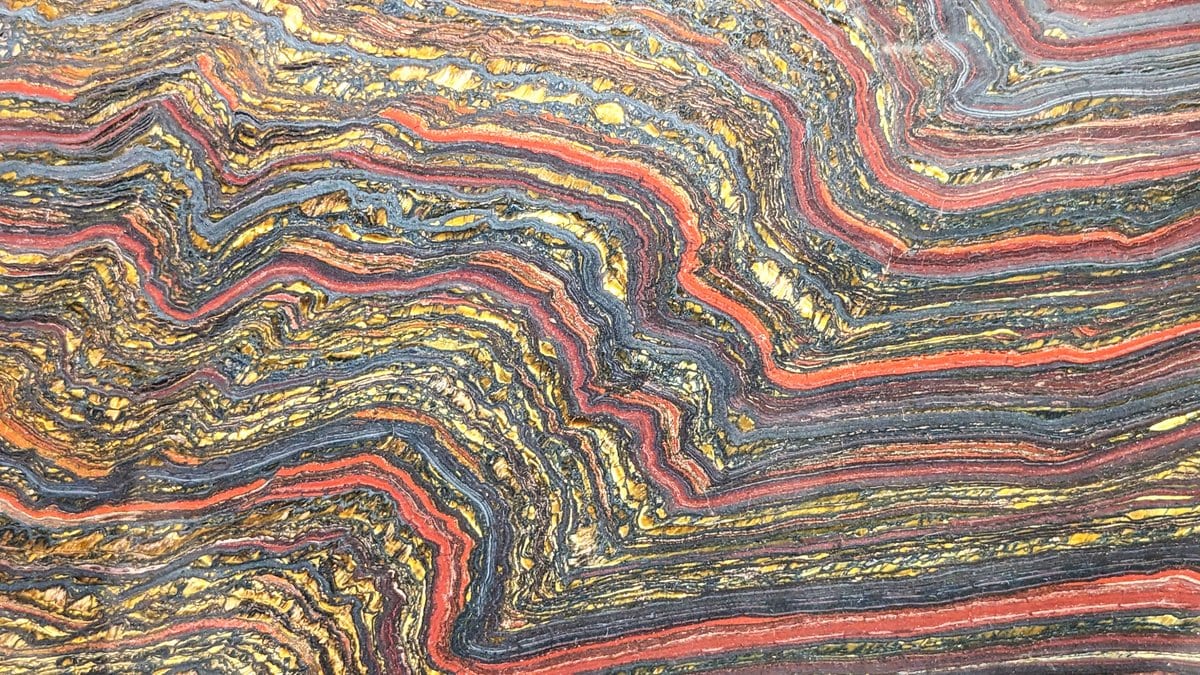
Iron does not rust on its own. Something has to take its electrons, and for most of Earth's history that something has been oxygen. So the striped rock geologists call banded iron formation, piled up on the seafloor between 2.57 and 2.51 billion years ago in layer after layer of iron oxide, has always carried an awkward question: what was doing the oxidizing on a planet whose air held almost none?
One of the sharpest answers has come from an element that is not iron at all. Molybdenum washes off the continents into the sea as a mixture of heavier and lighter atoms, and the minerals that pull it back out of the water take the light ones first. What is left behind is seawater weighted toward the heavy atoms, and that weighting gets locked into the sediment forming underneath. Read an unusually heavy molybdenum signature in ancient rock and you can argue that the minerals doing the pulling were the kind that only form where there is oxygen. In rocks from the run-up to the Great Oxidation Event, the stretch between 2.5 and 2.2 billion years ago when oxygen became a permanent part of the air, such readings have been taken as evidence that parts of the ocean surface were already oxygenated.
A study published Nov. 10, 2026, in the Proceedings of the National Academy of Sciences proposes a different reading. Changle Wang, at the Institute of Geology and Geophysics of the Chinese Academy of Sciences, is the paper's first author; co-authors work in China, Canada and the United Kingdom. The case they make is that the heavy signature arose in an ocean that was largely without oxygen, and that the chemistry behind it was run by bacteria rather than by air.
The alternative turns on a mineral that both readings share. Ferrihydrite, a rust-like iron mineral, forms as fine particles that sink through the water column, with dissolved molybdenum sticking to them on the way down. In the traditional account it forms in oxygenated water, alongside manganese oxides, which need oxygen too. The authors propose that ferrihydrite settling through iron-rich seawater did nearly all of the work of stripping out the light molybdenum. Their new mass-balance model, a bookkeeping of where the ocean's molybdenum went, indicates that only a minor manganese-oxide sink was required to leave the rest of the water as heavy as the rocks record.
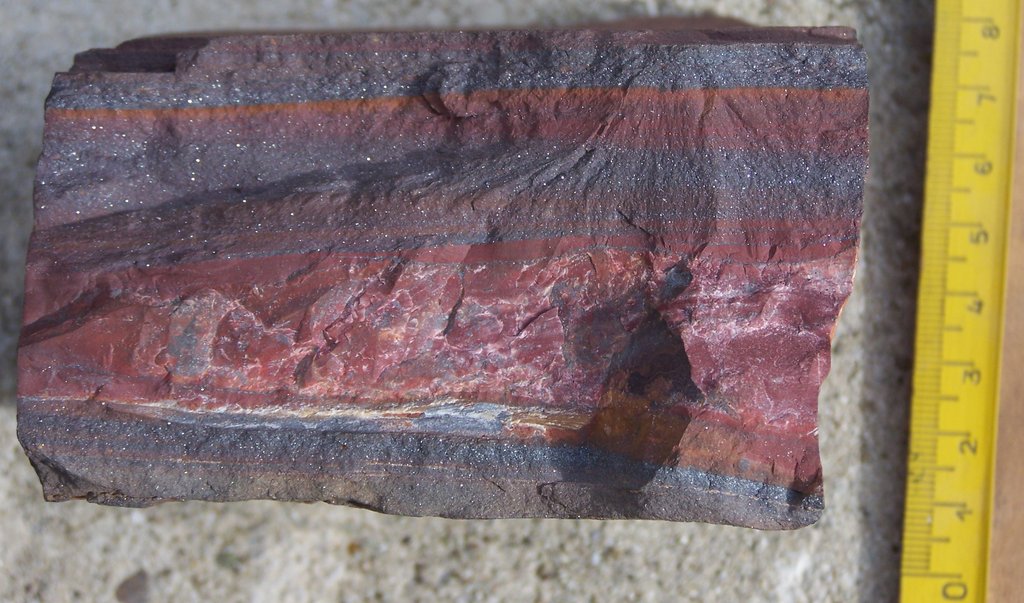
A second step explains why the values in the rocks scatter so widely. After the particles settled, the molybdenum they carried was taken up into iron and molybdenum sulfide minerals as the sediment aged. The broad range of values, on their account, is best explained by the two effects combined rather than by either alone.
Correcting for how much the sticking step shifts the balance, the team estimates that seawater at the time held a relatively stable composition of 1.5 to 1.6 parts per thousand on the scale geologists use for molybdenum. That is a figure for the water, worked back from the rocks, not a value measured in them.
That leaves the question the rock started with. If oxygen was not rusting the iron, what was? Given the lack of indicators for oxygen-producing photosynthesis, the authors posit photoferrotrophs, bacteria that photosynthesize without making oxygen. These take electrons from dissolved iron where plants take them from water, and the oxidized iron drops out as ferrihydrite. That step is an inference from what is missing rather than from what was measured, and the paper puts it no more strongly than that. Photoferrotrophy is a long-standing candidate for how banded iron formations formed, not something this paper discovered; what is new is the molybdenum case for it.
The authors write that, taken together, the findings imply the molybdenum record in these rocks reflects iron being oxidized by life without oxygen, rather than widespread oxygen in the surface ocean before the Great Oxidation Event. The paper is peer-reviewed, and what it offers is a proposal set against an interpretation built from years of published work on the same kind of rock: one side of a live argument rather than the end of it.
What hangs on this is more than the bookkeeping of one element. The timing of oxygen's first appearance in the ocean is how geologists date the arrival of the organisms that made it, and heavy molybdenum has been among the firmer signs that oxygen-producing life was already at work before the air changed. If the same signature can be produced by bacteria that make no oxygen, that sign gets quieter, and the question of when oxygen-producing life began falls back on the other clues.
Sources
- Proceedings of the National Academy of SciencesPeer-reviewed