Fossil Teeth Put Mammals High in Eastern Tibet's Mountains 39 Million Years Ago

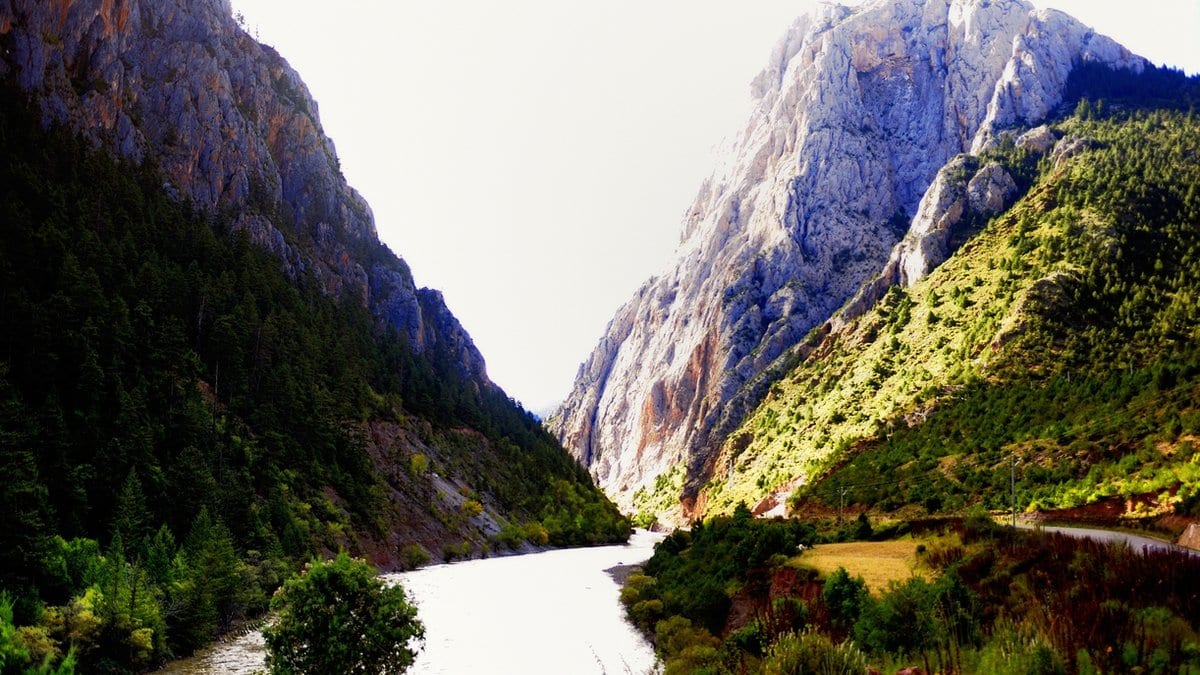
The Hengduan Mountains run north to south along the eastern edge of Tibet, a corrugation of steep ridges and deep river gorges that packs alpine meadow, conifer forest and subtropical valley within a few dozen kilometers of one another. It is one of the temperate world's great concentrations of species, many of which live nowhere else. The usual explanation for that abundance points at the terrain itself: mountains make many climates out of one, and populations separated by a ridge stop interbreeding. What the explanation has lacked is a date.
When that concentration got started is the question a team led from the Institute of Tibetan Plateau Research at the Chinese Academy of Sciences took to the Relu Basin, a fossil-bearing pocket of eastern Tibet. Songlin He, of the institute and of the Senckenberg Biodiversity and Climate Research Centre in Frankfurt, is the paper's first author. Lin Ding, in Beijing, is its corresponding author. Writing in Communications Earth & Environment on August 29, they and their colleagues report that the mammals buried at Relu went into the ground between 39.2 and 38.1 million years ago, and that the plant-eaters among them were living close to modern mountain elevations when they did.
The date rests on a mineral that grew inside the fossils themselves. After an animal is buried, groundwater moving through the sediment deposits calcite in the empty spaces of its bones. That calcite takes up a trace of uranium, which decays to lead at a known rate, so measuring the pair gives an age for the crystal. The team dated calcite from the bone cavities and, separately, carbonate nodules from the ancient soil that encloses the bone bed. They are two materials formed by different processes, bracketing the same burial.
That is why the authors bound their claim as tightly as they do: this is the oldest directly dated Cenozoic mammal fauna reported from the Tibetan Plateau. Older mammal faunas are known from the plateau and around its margins. Their ages, though, usually come from magnetostratigraphy, which reads the record of the Earth's magnetic reversals through a stack of sediment and matches that barcode against the global timescale. It is a powerful method and often the only one available, but the age arrives from the match rather than from a clock ticking inside the fossil bed. Directly dated is a narrower claim than oldest, and a harder one to earn.
The elevation comes from the teeth. Air pushed up over a mountain range sheds its heavier water first, so rain and snow falling high up carry a different mix of oxygen isotopes from the water reaching the lowlands. Animals drink it, and the enamel they grow keeps the ratio. Read that way, the enamel of the Relu plant-eaters points to a habitat elevation of about 3,463 meters, with an uncertainty of plus 819 and minus 869 meters, or roughly 2,600 to 4,300 meters. That is an inference about where the animals lived and fed. It is not a surveyed height for the burial site, and not a claim about the Tibetan Plateau as a whole, which rose in different places at different times.
The bars are wide for a reason. Reading an ancient elevation out of isotopes is contested for Tibet at this depth of time: Botsyun and colleagues argued in Science in 2019 that isotope-derived elevations for the plateau at that time come out systematically too high once the ancient climate is modeled in detail. The uranium-lead date is not what that argument is about. The height is. So the firm half of this result is the age, and the elevation is a carefully bounded estimate whose lower end sits nearly a kilometer below the headline figure.
A third strand comes from wood. Fossil wood dated to 41.5 million years ago, older than the mammals by a few million years, carries what the team describes as Mediterranean-type false rings: a growth boundary that forms inside a single year, where the tree stopped and then resumed. Trees do that when something interrupts the growing season, usually a dry spell in the middle of it. Read together with climate-model simulations, the authors take the rings to be consistent with a strongly seasonal climate that delivered its rain in two peaks a year, a regime in place before the Asian monsoon that waters the region today. Neither the rings nor the models carry that conclusion alone; it rests on the two together.
Put the three together and what emerges is a chronology rather than a mechanism. By roughly 39 million years ago there were mountains in eastern Tibet high enough to put plant-eating mammals near modern elevations, forests diversifying at those heights, and a seasonal rainfall pattern that owed nothing to the monsoon. The authors' own verbs stay inside those limits: uplift "contributing to" the rainfall regime, which "provided environmental conditions favourable for" early high-elevation diversification, implying that a montane biodiversity hotspot had emerged by then. What the paper offers is a coincidence in time, carefully dated.
Sources
- Communications Earth & EnvironmentPeer-reviewed