The Deep-Sea Vents Said to Have Cradled Life May Have Lacked the Chemistry to Do It

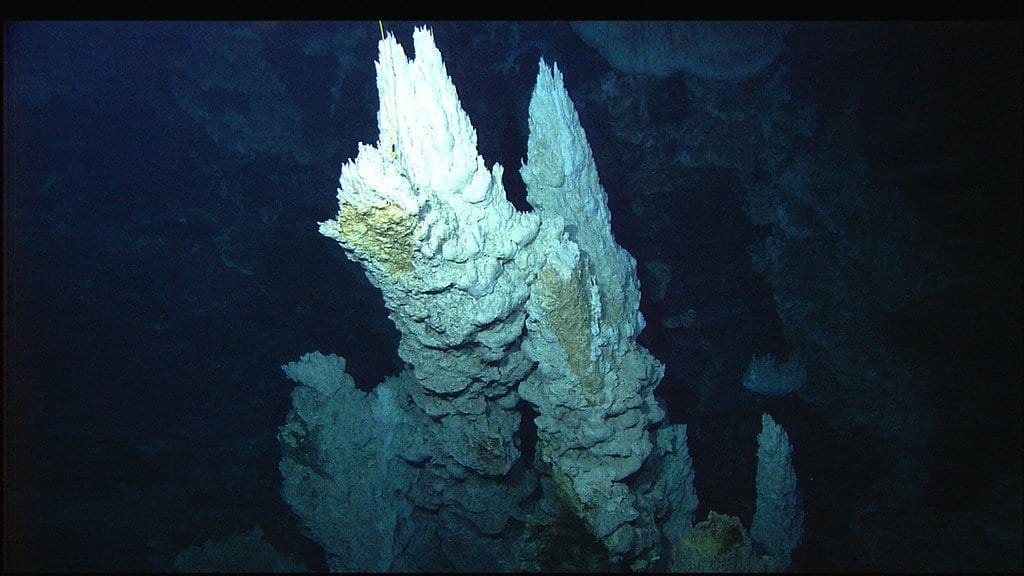
The chimneys at Lost City are the wrong color. Where the black smokers strung along the mid-ocean ridges build dark spires out of metal sulfide, this field on a bald dome of mantle rock in the mid-Atlantic grows pale carbonate towers, and leaks fluid that is warm rather than scalding and strongly alkaline. Since it was described a quarter of a century ago, that combination has carried a lot of theoretical weight: one of the leading accounts of where life began treats Lost City as a living model of the nursery. Benjamin Tutolo, a geochemist at the University of Calgary, argues in a paper published on August 28 that the model does not survive contact with what is now known about the ancient seafloor.
A fuller account followed in Science in 2005, from Deborah Kelley of the University of Washington and colleagues. They recorded fluids no hotter than about 90 degrees Celsius, alkaline enough to reach pH 11, and carbonate chimneys up to 60 meters tall. Nothing volcanic drives it. Seawater works its way into mantle rock and reacts with it, a process called serpentinization that generates its own heat and floods the fluid with hydrogen.
The account built on that chemistry is specific, which is what makes it testable. Alkaline vent hypotheses hold that hydrogen-rich fluid seeped up through a maze of micropores whose thin walls were made of iron and nickel sulfide minerals, and met an ocean that was acidic and rich in carbon dioxide. Across each thin wall sat a difference in pH, and a pH difference is a proton gradient of the kind every living cell still uses to make its energy. In the idea's fullest modern statement, published in Astrobiology in 2016 by Victor Sojo, Nick Lane and colleagues at University College London, that natural gradient has "equivalent magnitude and polarity to the proton-motive force required for carbon fixation" in modern bacteria and archaea. A protocell sitting in one of those pores would have found a battery already installed.
Tutolo's reappraisal goes at the gradient first. The extreme alkalinity that made the idea plausible, he argues, is a property of Lost City fluid after it has cooled at the seafloor, not of the same fluid where it is reacting with rock underground. Measured at hydrothermal temperature, the steep contrast with seawater is not there. "Neither modern nor ancient serpentinizing systems are characterized by strong pH gradients at hydrothermal temperatures," the paper states.
He is not the first to doubt that leg of the argument. In 2016, J. Baz Jackson, a biochemist at the University of Birmingham, reviewed the same claim from the other end. He was looking at the machinery rather than the geology. There was "as yet no evidence" for thin inorganic membranes holding sharp pH gradients at Lost City, he wrote, and a molecular motor of a few hundred atoms could not have worked inside the micrometer-thick membranes the models describe.
The second objection removes the wall itself. Sulfide has to come from somewhere. On the early Earth, Tutolo argues, it was not there to be had. The ancient oceans were poor in sulfate and sulfide, and serpentinizing systems including Lost City hold little sulfur themselves. Sulfide would have been "virtually absent" from ancient vents of this kind. Lost City itself makes the point. Its towers are carbonate, not the sulfide chimneys of a black smoker, which is part of what made the field worth reporting in Nature in 2001.
The third objection is about time. A protocell needs more than a power supply. It needs membranes and metabolites, which means complex hydrocarbons. Drawing on work done at Lost City and in the laboratory, Tutolo argues that making them would have been frustrated by reaction kinetics at the temperatures and over the timescales available. The chemistry is not forbidden, only slow, and a warm vent does not run hot enough to hurry it.
The fourth objection has nothing to do with chemistry. Lost City is a modern system and an unusual one. It sits well off the ridge axis where new ocean crust is made, on old crust that has had time to cool and crack. The ancient seafloor had a different geology, and Tutolo argues that serpentinizing systems on it would have circulated water at shallower depth. Their venting would have been shorter-lived and less focused than at the field being used as their stand-in.
What the paper is matters as much as what it says. It is a single-author evaluation and it reports no new measurement. Tutolo has assembled published field and laboratory results, 64 references worth, and argued from them. It is peer-reviewed, it appeared this week, and the researchers who built the alkaline vent case have not yet answered it. Its conclusion is that these considerations challenge "currently formulated alkaline vent hypotheses," which is a claim about the version now on the table rather than a verdict on vents.
Alkaline vent hypotheses have "driven speculation for life on ancient Mars, icy moons, and exoplanets," the paper notes. The evaluation therefore "demands a reappraisal of the potential for life beyond Earth," Tutolo writes. That is a claim about a mechanism rather than about those worlds. Similar geology covers large stretches of old ocean crust, and serpentinization still makes hydrogen there. What is in question is whether the machine the field has been importing from Lost City was ever available, even at Lost City. Answering that is now the work of the researchers who built the hypothesis.