The Compass Inside a Bacterium Is Messier Than the Textbook Drawing

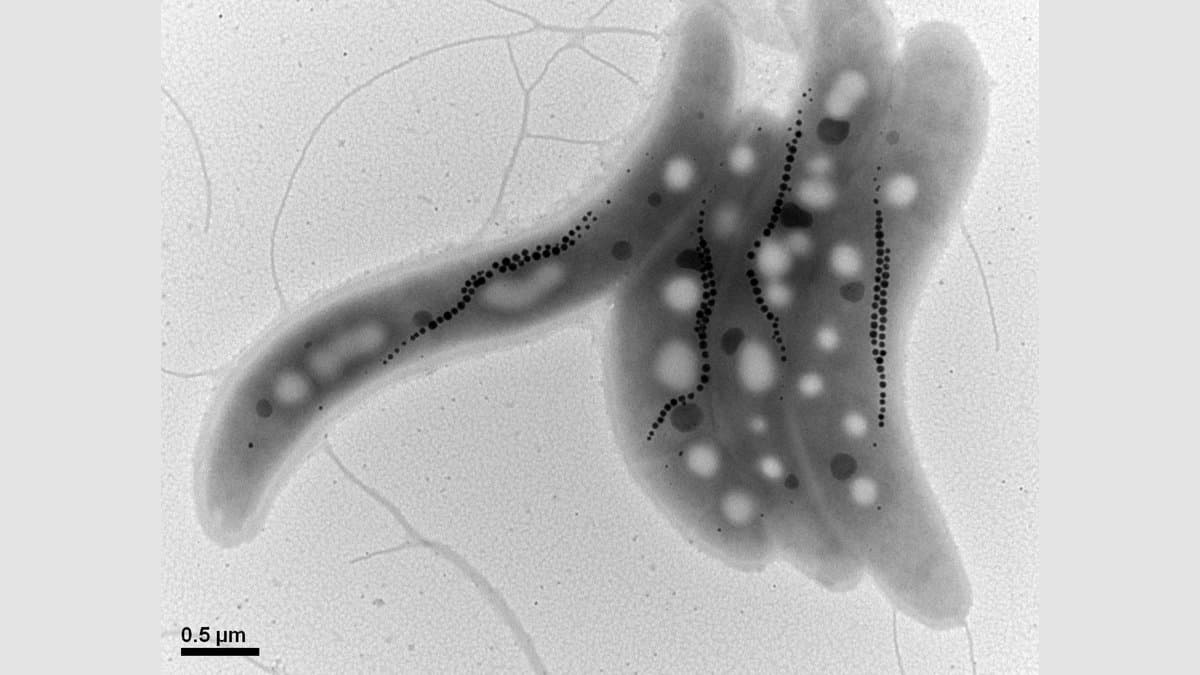
Ask a biologist to sketch the bacteria that swim along magnetic field lines and you will get much the same drawing every time: a cell with a neat row of tiny bar magnets inside it, lined up nose to tail like a compass needle assembled one crystal at a time. The cartoon has earned its place. These microbes, the magnetotactic bacteria, grow chains of iron oxide crystals, the mineral magnetite, each wrapped in its own membrane pouch. The chain gives the cell a steady magnetic pull that keeps it oriented as it swims.
A paper published Sept. 29 in the Proceedings of the National Academy of Sciences says the individual magnets in that row are not nearly so tidy. Jinhua Li of the Institute of Geology and Geophysics at the Chinese Academy of Sciences, Yongxin Pan, and their colleagues report a bacterium from freshwater sediment called strain WYHV-1. It builds unusually large prism-shaped crystals with a dimple at each end, and packs them into one tightly fitted chain.
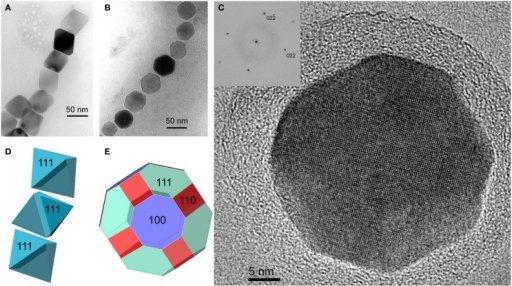
To see what each crystal was doing magnetically, the team turned to off-axis electron holography, which maps magnetic fields at the scale of the crystals themselves. The textbook expectation is a single domain: the whole crystal magnetized one way, north at one end and south at the other. What the maps commonly showed instead was a vortex, the magnetism curling around a center rather than pointing along the crystal. That is the one thing the imaging establishes, and it is worth holding separate from what follows.
A swirl looks like an awkward building block for a compass, and that is where the paper starts: whether crystals with unconventional shapes and untidy magnetic states can still deliver dependable magnetism at the level of the whole chain.
The answer in the paper comes from micromagnetic simulations, computer models that track the magnetism inside each crystal and between neighbors. Those models indicate that the crystals sit close enough for each to impose order on the next, suppressing the individual swirls, so the chain as a whole behaves much like the textbook needle and holds a strong pull along its length. They also indicate that whether a dimple-ended crystal settles into a swirl or a single domain depends on its size. Both of those are modeled rather than measured: the field maps show the state of individual particles, not the behavior of the chain.
Further simulations take the idea outside the cell. The chain's stray field is concentrated at its two ends, and the models indicate that one cell's chain could attract another there strongly enough to promote head-to-tail linking across distances shorter than a cell. The authors keep the condition attached: they claim that kind of cell-to-cell magnetic organization under field-aligned experimental conditions, which means with an external field applied.
There is an observation waiting for that explanation. In hanging-drop experiments, where cells are watched in a droplet of water under a microscope, magnetotactic cells have been seen gathering into clusters that look like a single multicelled organism, with the field determining whether they do. The simulated attraction at the chain ends would account for those clusters, and accounting for them is what the paper claims, not catching the mechanism in the act.
Magnetic company is not in itself a new idea. Some magnetotactic microbes live as consortia: a host cell carries magnetic bacteria on its surface, and their moments add up to steer the whole assembly. A 2023 paper in the same journal mapped how the arrangement of those partners tunes that collective steering. What would be new in WYHV-1 is single cells, each with a chain of its own, linking to one another through the field spilling from the chain ends.
WYHV-1 itself is not a laboratory organism. Nobody has grown it in culture. It is on record as an uncultured clone from freshwater sediment, identified by its 16S ribosomal RNA gene sequence and filed in GenBank, so following the work up means going back to the sediment rather than ordering a strain.
The conclusion the paper ends on is the one worth keeping. In this bacterium, magnetic performance is set by how the chain is organized, not by the magnetic state an idealized isolated crystal would hold. That has an audience outside microbiology, because crystals like these outlast the cells that made them and settle into sediment, where their magnetism becomes part of the record of Earth's past field. The author list shows who is listening: it runs from the electron microscopy center at Forschungszentrum Jülich in Germany to earth science groups in Canberra and Edinburgh.