The LHC Finds the Early Universe's Plasma in Its Smallest Collisions Yet

For a few millionths of a second after the Big Bang, the universe was too hot for ordinary matter to exist. Protons and neutrons had not formed; instead, their constituents, quarks and gluons, sloshed around freely in a searingly hot, dense soup. Physicists call it quark-gluon plasma, and for years the only way to make it on Earth has been to slam large, heavy nuclei, lead or gold, together at nearly the speed of light.
The interesting new question is how small you can go. Late in 2025, the Large Hadron Collider ran a program smashing much lighter nuclei, oxygen and neon, together, and the first physics results are now in.
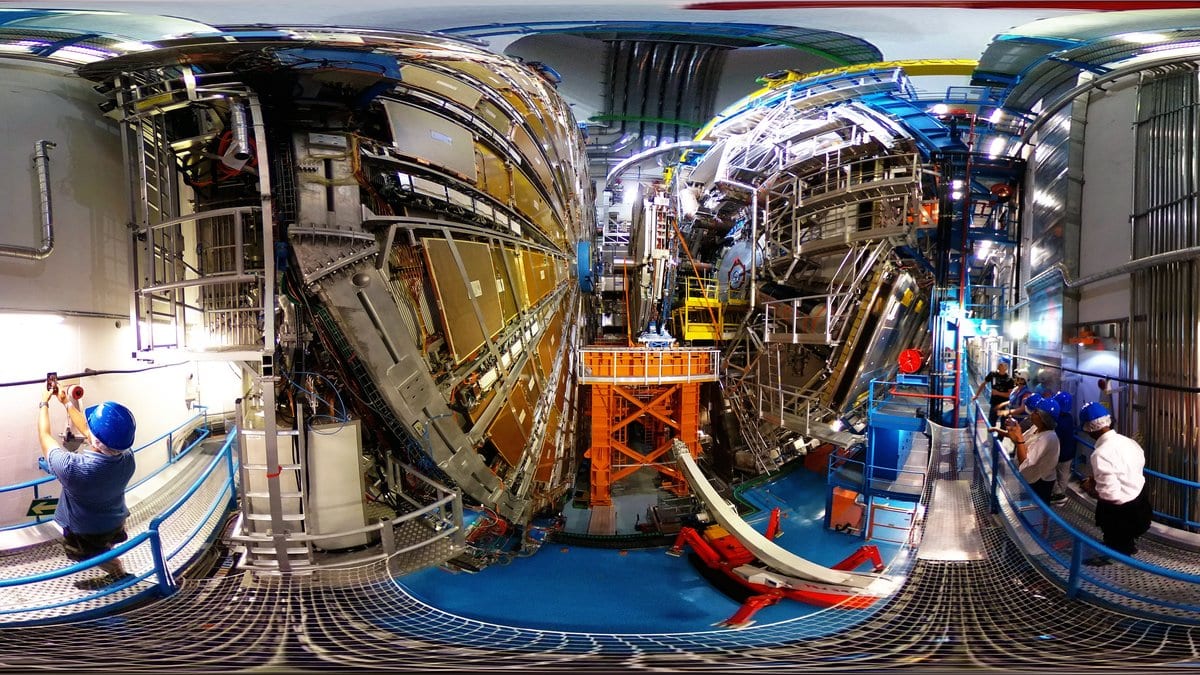
The standout comes from ATLAS, one of the collider's main experiments, which reports observing jet quenching in both oxygen-oxygen and neon-neon collisions. Jet quenching is one of the clearest fingerprints of quark-gluon plasma. When two nuclei collide, they can spray out narrow "jets" of particles, and in ordinary collisions those jets emerge in balanced pairs, each carrying comparable energy. But if a jet has to plow through a blob of plasma on its way out, it loses energy to that dense medium. The pair comes out lopsided. Measure enough collisions, tally the imbalance, and the plasma announces itself.
That is what ATLAS says it saw. Using a measure of how evenly paired jets share their momentum, the team found that head-on collisions of these light nuclei deviated significantly from what plain proton collisions would produce, at a statistical strength exceeding five standard deviations, the conventional threshold for a firm particle-physics result. Crucially, oxygen and neon are far smaller than the lead nuclei usually used, which makes these, in the collaboration's words, the smallest systems in which jet quenching has been observed at the LHC.
Why does the size matter? Because it probes a boundary. Quark-gluon plasma was assumed to need a lot of matter to form; finding its signature in collisions of such small nuclei tells physicists that even a tiny droplet of the stuff can be dense enough to slow a jet. That, in turn, sharpens models of how the plasma behaves and how it emerged as the early universe cooled. The picture is broader than one experiment, too: other LHC collaborations have reported complementary signs of plasma-like behavior in the same light-ion run, though the specific jet-quenching hallmark here belongs to ATLAS.
What ATLAS has done, in effect, is recreate a sliver of the universe's first microseconds using less raw material than anyone had managed before, and catch the plasma in the act of tugging on a passing jet.