Two Laser-Tracked Satellites Pin Down Earth Dragging Spacetime Around With It

Set a bowling ball spinning in the middle of a trampoline and, in Einstein's universe, it does more than sag the surface — it twists it, winding the fabric around like a spoon in honey. General relativity says a rotating mass literally drags spacetime along with its spin. Physicists call it frame-dragging, or the Lense-Thirring effect, and near an object as slowly turning as Earth it is almost absurdly faint: an extra twist that nudges a satellite's orbit by a few metres a year.
Faint does not mean unmeasurable. In a paper in Nature, a research team reports the most precise measurement of Earth's frame-dragging yet, pinning it to roughly one part in a thousand, about an order of magnitude sharper than previous determinations of the effect anywhere in the Solar System (Nature, 10.1038/s41586-026-10715-0). At that level the measurement agrees with Einstein's prediction and squeezes the room left for rival theories of gravity that would have the twist come out even slightly different.
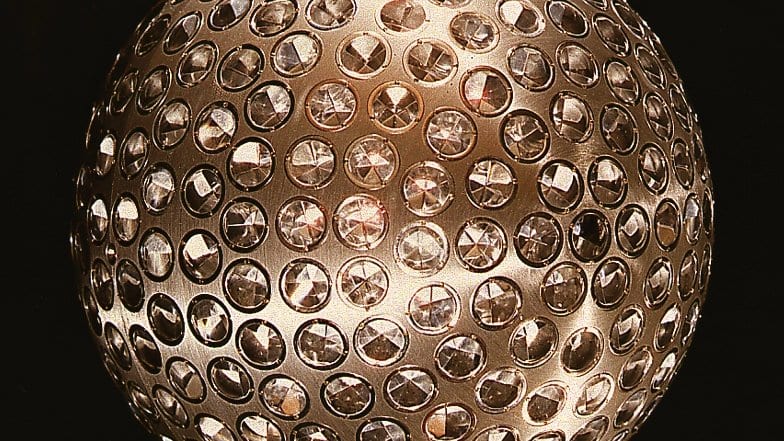
The measurement rests on a beautifully simple idea executed with painful precision. LARES-2, a satellite launched for exactly this purpose, is a dense metal sphere studded with mirror-like reflectors. Ground stations fire laser pulses at it and time the round trip, fixing its position to within millimetres, a method called satellite laser ranging. As Earth's dragged spacetime slowly swivels the orientation of the satellite's orbit, that swivel shows up in the laser data. LARES-2 is tracked together with the two older LAGEOS satellites, and the trio's orbits are combined so that the tiny relativistic twist can be teased apart from far larger, non-relativistic wobbles.
The largest of those nuisance effects comes from Earth itself not being a perfect sphere. Our planet bulges at the equator, and that bulge tugs on satellite orbits far more strongly than frame-dragging does. To subtract it, the team leans on precise maps of Earth's gravity field from NASA's GRACE mission. The satellites' inclinations are also chosen to be near-complementary, so that much of the bulge's influence cancels between them while the relativistic signal survives.
That subtraction is exactly where the result becomes contested. In a series of papers, including a 2025 arXiv analysis, physicist Lorenzo Iorio and colleagues argue that the systematic-error budget behind these frame-dragging measurements may be underestimated. Their concern centers on how the uncertainty in Earth's equatorial bulge propagates through the calculation: not just directly, they argue, but indirectly through errors in other orbital parameters, in a way that does not cancel as cleanly as the cancellation scheme assumes. If they are right, the true uncertainty could be larger than one part in a thousand. The debate is a genuine, long-running methodological disagreement, not a fringe objection. It is why the precision figure should be presented as the team's claim, carefully caveated, rather than an uncontested fact.
None of this puts the central physics in doubt. That Earth drags spacetime is well established; earlier missions, including the dedicated Gravity Probe B, measured the effect and confirmed its existence. What is at stake in the new work is how sharply the effect can be pinned down, and that is precisely the kind of number a careful reader should treat as provisional while the error-budget dispute plays out.
Why chase a few metres of orbital twist at all? Because frame-dragging is one of the harder-to-fake predictions of general relativity, and around Earth it can be measured in a controlled, repeatable way rather than inferred from distant black holes. Every tightening of the number is a tighter noose around alternative theories of gravity, the ones invoked to explain dark matter or dark energy without new particles. This peer-reviewed result, dispute and all, is another turn of that screw: Einstein's spinning-Earth twist, measured more finely than ever, still stubbornly matching the prediction he could only work out on paper.
Sources
- NaturePeer-reviewed