A Deep-Sea Microbe Turns Nitrogen Into Ammonia Near the Boiling Point

In volcanic country on the deep seafloor, where fluid leaving the rock can be hotter than boiling water, a single-celled organism called Methanocaldococcus infernus does something almost nothing else alive can do. It takes nitrogen gas straight out of the water around it and turns it into ammonia, the form that living things can actually use.
The gas does not give itself up easily. The two atoms in N₂ are held together by a triple bond, one of the strongest in ordinary chemistry. A single family of enzymes called the nitrogenases is the only thing in nature that breaks it at everyday pressure and temperature. The structure of the enzyme this microbe uses appeared Sept. 8, 2026, in Nature Communications, open access. It comes from Nevena Maslać, Tristan Wagner and colleagues at the Max Planck Institute for Marine Microbiology in Bremen and the Institut de Biologie Structurale.
The heat barely registers. The isolated enzyme comes apart at an estimated 92.3 °C, against 60.1 °C for the equivalent from Azotobacter vinelandii, the bacterium most nitrogenase research has been built on. The microbe itself grew on nitrogen gas up to 91.7 °C, although the cultures the team purified protein from were kept at 75 °C.
The heat resistance sits in a few small places
Proteins from hot organisms usually buy their stability in bulk, with extra salt bridges, more internal hydrogen bonds and fewer of the flexible amino acid glycine. The team found only some of that. What it proposes instead is that the enzyme is braced at a handful of hot spots, local rearrangements of contacts, most of them near the surface and well away from the metal cluster where nitrogen is reduced. That working part looks much as it does in the bacterial enzyme, which suggests it was already stable enough, or that it has to stay loose to work at all.
Rigidity has a price. At room temperature the whole system makes no detectable ammonia at all; the bracing that keeps it intact in the heat seems to deny it the small movements a reaction needs. The activity test ran only up to 50 °C, the ceiling of the chemistry that feeds the enzyme its energy. The rest is extrapolation. If the rate keeps climbing with temperature in the usual way, the archaeal enzyme would work several times faster than the bacterial one at the temperatures the microbe actually lives at. That last figure is a calculation, not a measurement made hot.
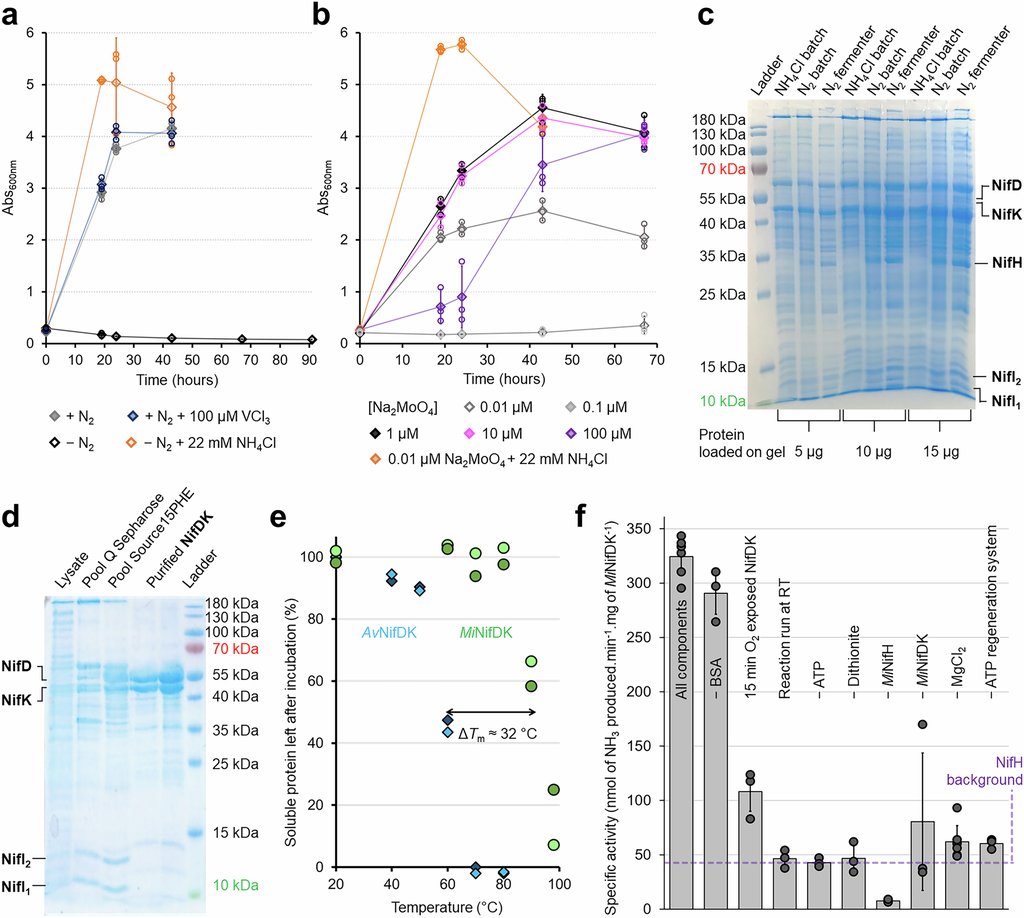
The microbe is also fussy about metals in a way that fits its address. It fixes nitrogen only when molybdenum is present. It also shrugs off tungsten, a chemical look-alike its cells have to keep out of the enzyme's metal core, at up to a thousand times the levels related microbes tolerate.
It is also the simplest one anyone has described
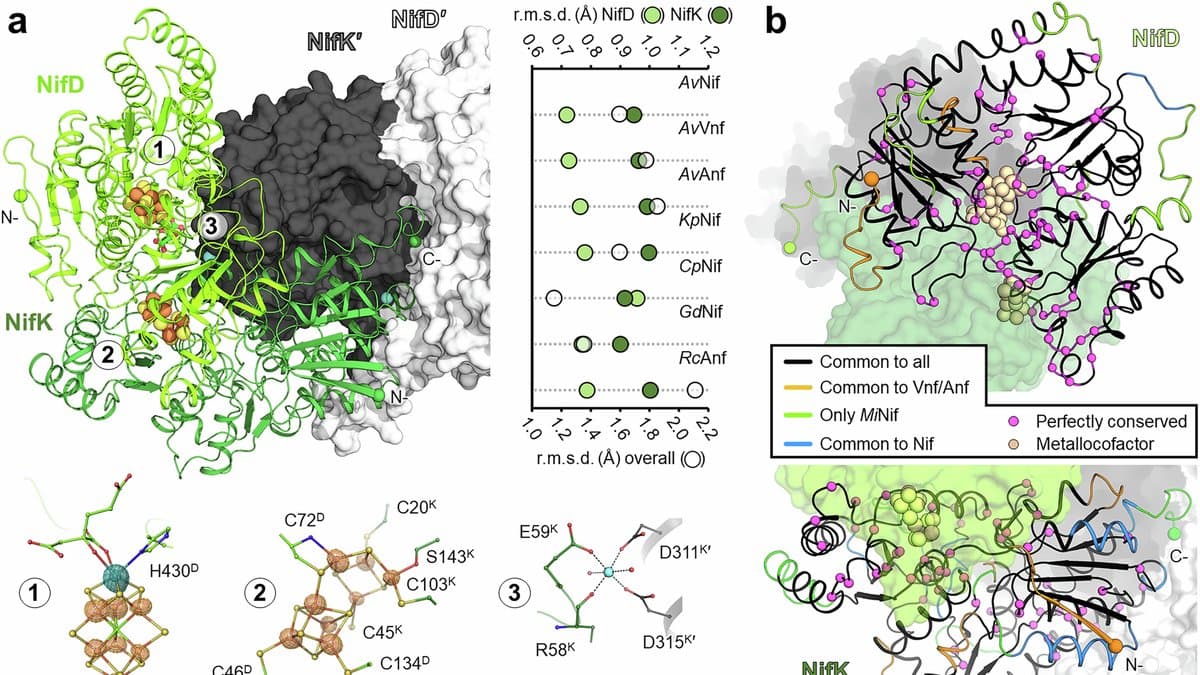
The structure's other surprise is how little of it there is. M. infernus carries a minimal set of nitrogen-fixing genes, and the protein those genes build is smaller than its bacterial counterparts without having shed the loops and exposed surfaces that normally make a protein fragile. Two crystal forms, refined to 1.21 angstroms in the sharper case, show a scaffold stripped back further than in any nitrogenase solved before. Both are public in the Protein Data Bank, the sharper one as entry 9SQ3.
There are three known kinds of nitrogenase, told apart by the metal at their core: molybdenum, vanadium or iron alone. X-ray measurements tuned to each metal's signature confirmed molybdenum in this one. Its shape, though, does not sort cleanly into any of the three. Parts of it match the vanadium and iron-only enzymes, parts match the molybdenum ones, and parts belong to nobody else. Earlier family-tree work had already placed these deep-sea methane-makers close to the hypothetical ancestor of all nitrogenases, and the authors argue the structure reinforces that proposal rather than settling it.
The crystals caught the catalyst partway through its cycle
The two crystal forms also froze the enzyme in different electrical states, and that is where the paper's mechanistic interest lies. One holds the cluster that relays electrons in a briefly emptied form that is hard to trap without chemical intervention. The other shows the molybdenum site as an even mixture of its resting shape and a rearranged one, with a sulfur atom moved out of position and an unidentified atom bridging two irons. Crystallographers call that the turnover state, and it had been seen only in the vanadium and iron-only enzymes. Even at this resolution the team could not say which atom is doing the bridging, and it notes that whether the arrangement is genuinely a step in the reaction is still argued over.
The reason this matters outside crystallography is sitting in a field somewhere. Biological nitrogen fixation supplies about half the nitrogen in living things, and it runs at ordinary pressure and temperature. The ammonia in the world's fertilizer is made a different way, by the Haber-Bosch process at 200 bar and around 400 °C. That process accounts for 1% to 2% of global carbon dioxide emissions. Chemists would like to know how an enzyme manages the same conversion without any of that, and they still do not.
An enzyme this rigid may be the way in. Wagner's group suggests it could be chilled and held while the reaction crawls, letting each intermediate be photographed in turn, which is not possible with a protein that falls apart far cooler. Decades of work on the bacterial version have not settled how the bond is broken. A heat-proof one gives the question a new handle.
Sources
- NaturePeer-reviewed