An Unfinished Virus Shell Is Nearly the Same Size and Shape as a Microbe's Chemical Container

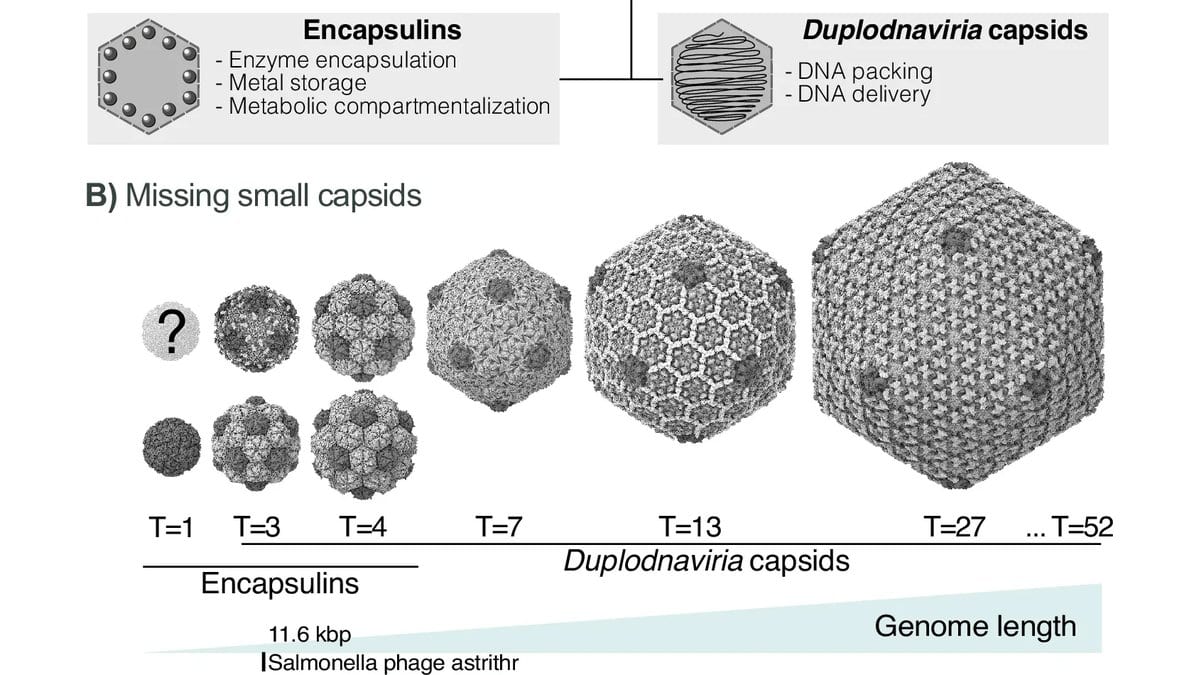
A virus is, in large part, a box with instructions inside it. An encapsulin is a box with chemistry inside it: bacteria and archaea build these containers to keep a reaction and its ingredients apart from the rest of the cell. Both boxes are made from the same protein shape, the HK97 fold, among the most common protein shapes on Earth. The prevailing account of why has been that the cellular containers are descended from viruses, shells that stopped carrying genomes and took up chemistry instead.
Abelardo Aguilar, a doctoral student in biology at the University of Miami, and Antoni Luque, the study's senior author, thought that account had an awkward step in it. Viral shells are the more elaborate of the two. Building one takes scaffolding proteins to shape the shell as it assembles, a portal to thread DNA through, and a motor to push the genome in. Most encapsulins are 60 copies of a single protein wrapped around a cargo enzyme. Deriving the simple thing from the complicated one asks the complicated one to come first. Their search for an alternative was published in Nature Communications on Oct. 14, 2026.
Compartments are not a side issue in arguments about how life began. Something had to concentrate reactions, shelter fragile molecules, and later keep a heritable set of instructions in one place. HK97-fold shells do both of those jobs today.
So the team went looking for the simpler viruses the standard story needs, in the one place such viruses could have gone unnoticed: public databases of DNA read straight out of soil, seawater, wastewater and the human gut. The smallest genome of any virus in this group that anyone has ever grown in a laboratory is about 11,600 base pairs long. Everything shorter the authors call the twilight zone. Sifting more than 14 billion sequence fragments, they found 523 complete-looking genomes down there that encode an HK97-fold shell protein. In 93 of them, the shell protein carried the sequence signatures used to identify encapsulins.
Where the genomes get smallest, the encapsulin signature gets common
That concentration is the firmest result in the paper. Among shell proteins from genomes in the upper part of the twilight zone, nearly 19% carried an encapsulin domain, against 2.5% in the control genomes just above the threshold, and rarer still in the reference catalogue of cultured viruses. In more than half of those cases, an encapsulin profile was the only recognisable match anywhere in the shell protein. The gap is large, and the paper reports it with effect sizes and corrected p-values.
Most of the encapsulin-enriched set falls into one group, drawn from human gut samples, and their gene maps look alike: an integrase (which lets a genome insert itself into a host chromosome), a shell protein, and a scaffold protein. There is no portal, no tail and no packaging machinery at all. Every known virus of this group threads its DNA in through a portal, so the authors are careful about what they have. They treat these as viral shell proteins carrying encapsulin-like domains while allowing that some may be misclassified, and they offer an alternative reading: the genomes could be satellites riding on other viruses' machinery.
The crossing point they propose is a shell that is not finished yet
A virus shell is not born at full size. It assembles first as a procapsid, an empty, rounder draft of itself, and only expands and stiffens once DNA is pumped in and the scaffolding is released. When the team set a bacterial encapsulin beside a procapsid from a mobile genetic element of Staphylococcus aureus, the two were close to the same shape and size. The encapsulin's inner diameter was about 322 angstroms, or ten-billionths of a metre, and the procapsid's about 330. The space they enclosed was comparable, while the mature shell of that virus is roughly 60% larger inside. The two proteins' sequences agree on about 14% of the aligned positions, which is to say barely at all.
That is the hinge in the argument. If the two containers resemble each other most while the viral one is still unfinished, then the procapsid is the state in which a shell could change jobs. The proteins sitting inside them point the same way: an encapsulin's cargo enzyme and a bacterial virus's scaffolding protein share a hairpin of two helices, despite almost nothing in common at the sequence level. Swap what is inside, the authors suggest, and the role of the shell follows. An enzyme makes it a reactor. A scaffold that can recruit a portal makes it a container for a genome.
Three methods each turn up groups that mix viruses with containers
The evolutionary half of the paper is softer, and the authors say so. A network showing which shell domains occur together, a tree built from predicted protein structures, and a conventional tree built from sequences each turn up groups containing both viruses and encapsulins. Both trees recover three such groups, which the paper reads as at least three crossings between the two roles. Two of the three are strongly supported and the third only moderately. Some of the structures in the tree come from AlphaFold2, a structure-prediction program, and were kept at a permissive confidence cut. Because no suitable distant relative exists to orient the tree, it is rooted at its midpoint for display. None of it has been tested experimentally.
What the trees cannot do is say which role came first. The paper is direct about that: with no way to root them and weak support on the deep branches, the analyses cannot tell a virus-like ancestor from an encapsulin-like one, which, in the authors' words, "precludes strong claims of directionality based on the phylogenetic analyses." They speculate that HK97-fold shells began as small, lopsided cages too cramped to hold even the smallest known viral genome but roomy enough for chemistry, and that only as they grew could they carry instructions at all. The paper's own word is "speculate," and it calls the scenario "speculative yet parsimonious."
The paper adds that the sampling in hand cannot settle whether packaging or chemistry came first, and that repeated switching may have worn away the earliest traces.
What the work hands other laboratories is a list. The 93 shell proteins carrying encapsulin signatures are a defined set that can be synthesised, assembled and looked at directly. So is the question of how a genome gets into a shell with no portal: the authors suggest a copying mechanism borrowed from plasmids, which, they write, is untested and will need experimental confirmation. The analysis code is archived on Zenodo and the data in Figshare, so another group can start from the same files.
"The majority of viruses cannot be grown in the lab. But now through sequencing, we have access to information on viruses for which we don't know the host, that we can't culture in the lab, but that are everywhere," Luque said in the University of Miami's announcement of the study. Aguilar, the paper's first author, points to the shells we already know: "One implication of this research is the possibility that viral capsids could also facilitate biochemical reactions, which would open up the potential roles that capsids have in environments as a whole."
Sources
- Nature CommunicationsPeer-reviewed
- news.miami.edu