A Newly Found Bacterial Immune System Builds Repeating DNA the Way Telomerase Does
Researchers at Columbia University and the University of Copenhagen have found a bacterial immune system that fights off viruses by building long stretches of repeated DNA, the same job telomerase does at the ends of chromosomes in plants, animals and fungi.
The system, named DRT10, is described in a paper published Oct. 12, 2026, in Nature by Stephen Tang, Samuel H. Sternberg and colleagues at Columbia, with co-authors in the Section of Microbiology at the University of Copenhagen. The group also built a family tree of these enzymes across the domains of life that puts telomerase on a single branch with the DRT family of bacterial defenses. That placement, the authors suggest, points to a shared origin for the way the two build DNA.
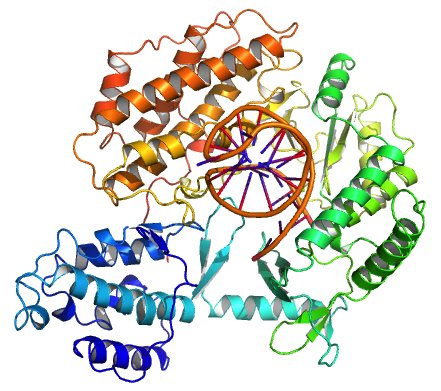
DRT10 works together with a strand of RNA that carries the template for the repeat. Images of the frozen enzyme-RNA complex show an arrangement the paper calls unanticipated: two copies of the enzyme bound to opposite sides of the RNA. Each copy reads the template on its own side, but only one produces the long repeating product, and the length of that product is set by the distance between two folded loops in the RNA that mark the boundaries of the copied stretch. The experiments were done in bacteria and with purified enzymes.
DRT10 joins DRT2, DRT3 and DRT9, three bacterial virus defenses described in earlier work. All of them, the authors conclude, run on the same underlying logic, an RNA template read over and over to add DNA repeats, even though the enzymes themselves are built along very different lines.
Sources
- NaturePeer-reviewed