Skip to content
See the World Through ScienceA project of ALLATRA
Source: Peer-reviewedCell1 source

Researchers Name 33 Possible Drug Targets Inside Parasite Mitochondria
Science

Republish this story

Our work is licensed under Creative Commons BY-NC 4.0. You may republish this piece for free — with credit to ALLATRA Media and a link to the original, unedited beyond length trims, and not for commercial use.

Read the full license

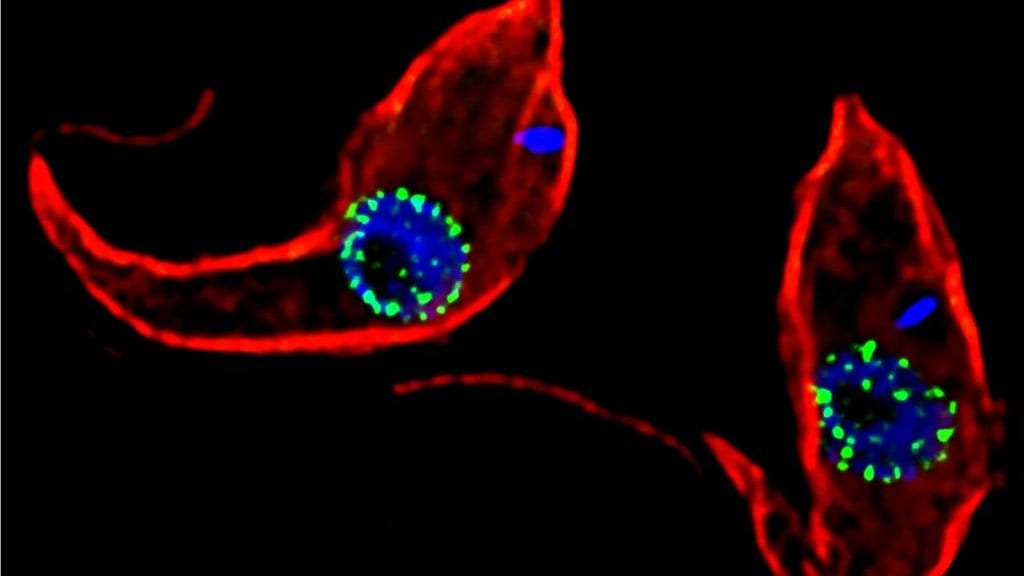
Fluorescence micrograph of two Trypanosoma brucei parasites, their cell bodies glowing red and their nuclei blue.
Two parasites of this species, imaged by fluorescence microscopy. Disease-causing single-celled eukaryotes are where the survey found 33 mitochondrial protein families that humans lack (illustrative)."Trypanosoma brucei, the cause of sleeping sickness" by National Institutes of Health (NIH), via Flickr, CC BY-NC

The MitoCarta Tree of Life Consortium has compared the proteins found inside mitochondria, the compartments that supply most of a cell's energy, in eight organisms drawn from across the tree of life. In a paper published on Oct. 1, 2026, the group reports 8,619 distinct mitochondrial proteins, grouped into 3,199 families of related proteins.
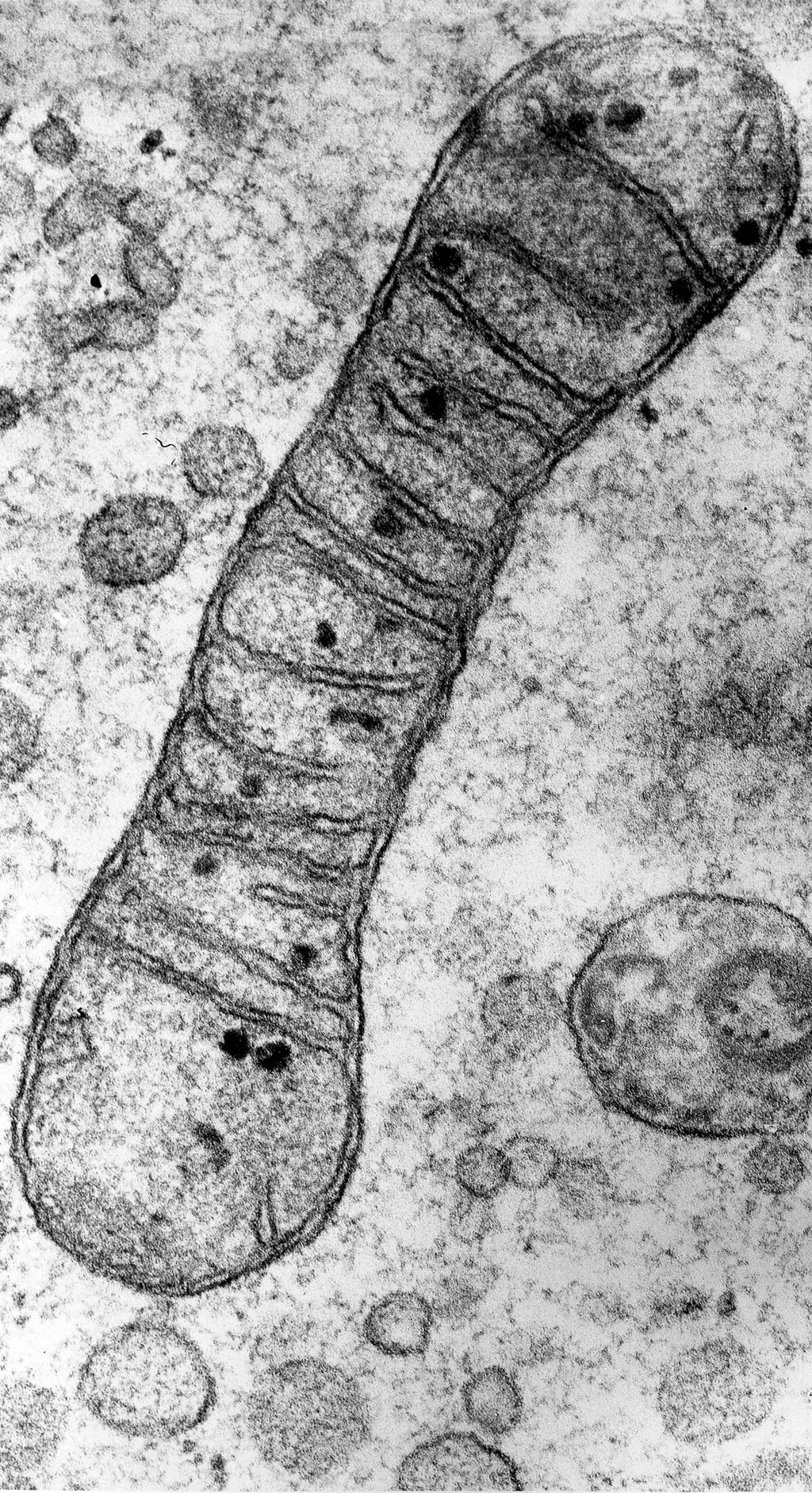
Transmission electron micrograph of a single elongated mitochondrion showing stacked internal membrane folds.
Inside the organelle, the inner membrane folds into the ridges where most of a cell's energy is converted. The proteins that do that work differ sharply from one branch of life to another. "TEM of a mitochondrion" (author not named on the source record), via Wellcome Collection, CC BY 4.0

The paper reports 33 of those families as conserved in disease-causing eukaryotes, organisms whose cells have a nucleus, yet absent in humans, and calls them promising candidate targets for protozoan infectious diseases, which single-celled parasites cause. They are presented as candidates for drug development rather than as a tested treatment.

To reach organisms the project had not measured in the laboratory, the consortium retrained a classifier built on a protein language model, an AI system trained on protein sequences, and used it to predict the mitochondrial proteins of about 200 eukaryotes.

The authors trace the origin of mitochondria to the moment a bacterium took up residence inside an archaeal host cell about 2 billion years ago. From the expanded set they reconstruct the mitochondrial proteins of the last common ancestor of all eukaryotes, the lineage that gave rise to animals, plants and fungi, and report that it already carried a complex mitochondrion able to work with or without oxygen.

The predicted set also runs in the other direction: some lineages expanded particular protein families, while in others the set of mitochondrial proteins shrank so far that the paper describes them as apparently heading toward complete loss of the organelle.

Sources

Spot an error?

Spot an error?

Report an error

Spotted a mistake on this page? Tell us what's wrong and our editors will take a look.

What kind of problem?

Only if you'd like us to be able to follow up. We won't use it for anything else.

We correct mistakes openly. Select any text to flag it. Fixes are logged under our Corrections Policy.

Report an error

Reporting on

Researchers Name 33 Possible Drug Targets Inside Parasite Mitochondria

What kind of problem?

Only if you'd like us to be able to follow up. We won't use it for anything else.

We read every report. Corrections are logged publicly.