The Human Heel Makes Walking Cheaper and the Landing Harder

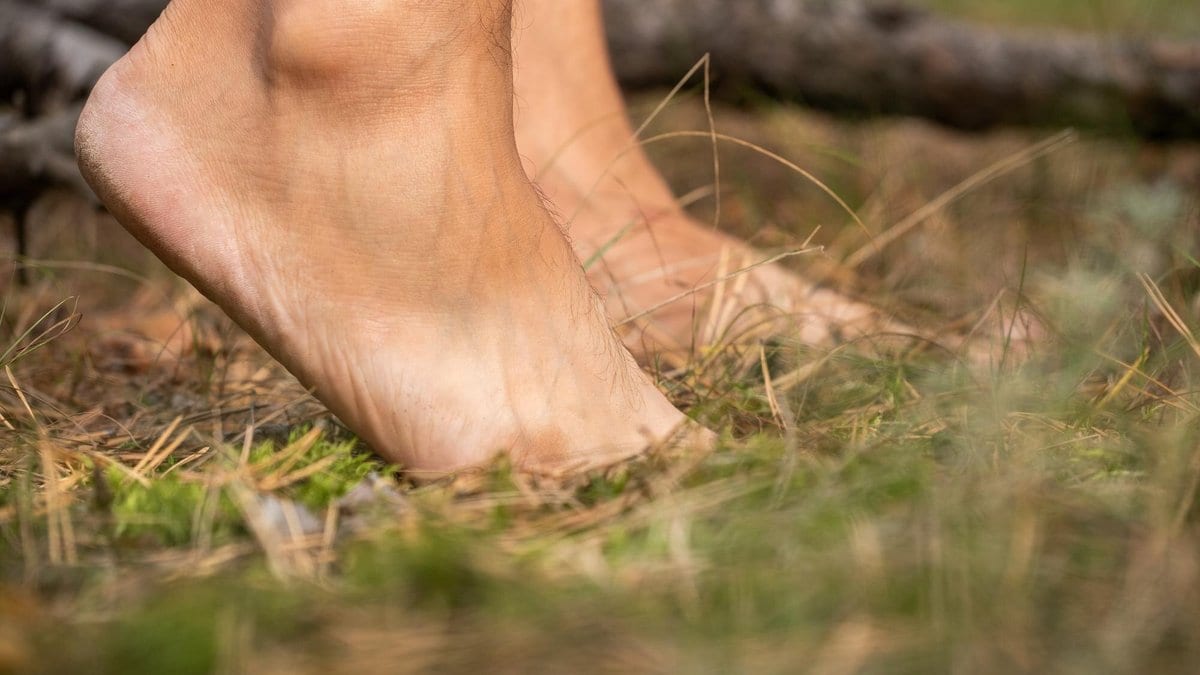
You took a few thousand steps today, and almost every one of them started the same way. The back of the heel touched down first, slightly ahead of the rest of the foot, and the load rolled forward from there. The habit is so fixed that it is easy to assume it is simply what a foot does. Chimpanzees, walking across the same equipment, turn out not to do it with anything like the same regularity.
Descriptions of what makes human walking distinctive usually start higher up: the straight back, the long extended legs. The landing has drawn less attention, in part because the African apes, our closest living relatives, are among the few other animals also thought to land heel-first. That similarity has been used for decades in arguments about how upright walking began. A study published on September 8 in the Proceedings of the National Academy of Sciences reports that the measurements underneath those arguments were too thin to settle them either way.
"What we're saying in this article is that landing on our heel is a unique aspect of human walking that's maybe been underappreciated," said Nicholas Holowka, the Penn State anthropologist who led the work, in the announcement his university published with the paper.
Holowka and colleagues tracked markers on the feet of walking people and walking chimpanzees in three dimensions, and recorded the force each footfall drove into the ground. The chimpanzees did it twice over, once upright on two legs and once on all fours. The people walked on two legs only.
The chimpanzees used ranges of foot-strike angle 2.4 to 8.6 times wider than the humans, and often did not land on the heel at all. Human feet came down one way. Chimpanzee feet came down many ways, and the heel was only one of them.
The team's statistical models offer what the paper carefully calls a possible explanation. In both chimpanzees and humans, landing heel-first is associated with a high peak force at impact and with a steep loading rate, meaning the force arrives fast rather than building. The models tie the landing to the force; they do not show one producing the other.
"Imagine you are trying to sneak across a creaky wooden floor. You tend to walk on the balls of your feet, because this reduces the rate of loading on the floor and creates less creaking. It's a softer way to walk," said Nathan Thompson of the New York Institute of Technology, a co-author, in the same announcement. "It seems that when walking on two legs, chimpanzees prefer the 'softer' way to land on their feet."
That raises the question of why people take the harder landing every step, all day. The alternative is expensive. When the human volunteers put the front of the foot down before the heel, the forefoot or the midfoot touching first rather than anything as extreme as walking on tiptoe, they spent 26 to 41% more metabolic energy. That figure is a human one; what the chimpanzees contribute here is angles and forces.
Together the two results describe a trade the authors call an important adaptive one. Heel-striking lowers the energy cost of walking upright, and it raises impact loading rates that are potentially damaging.
From there the paper reaches back several million years, and this is where measurement ends and inference begins. Nobody has put a fossil on a force plate. The argument runs from living people and living chimpanzees to extinct hominins: early hominins with more primitive legs and feet, the authors suggest, faced a choice between hard impacts and walking that cost too much, and either would have limited how far they could travel in a day. The later evolution of larger heels and bigger lower-limb joints, they argue, is what made heel-striking both cheap and safe, and with it the long daily distances that hunting and gathering demand.
"It seems like humans needed to evolve anatomical adaptations, thicker heel bones and bigger knee and ankle joints, to cope with these high forces," Holowka said.
Earlier laboratory work on foot posture pointed the same way on the human energy cost, but the chimpanzee comparison and the trade-off itself rest on this paper alone.
It is also, throughout, about walking. The long argument over whether runners should land on the heel or the forefoot is a different gait and a different question, and nothing here settles it.
Nor is any of this a reason to change how you walk. "We humans have evolved to use this high-impact walking style in a way that is safe and natural for us," Holowka said.