A Model of Young Earth Finds the First Ground That Stayed Cool for Good

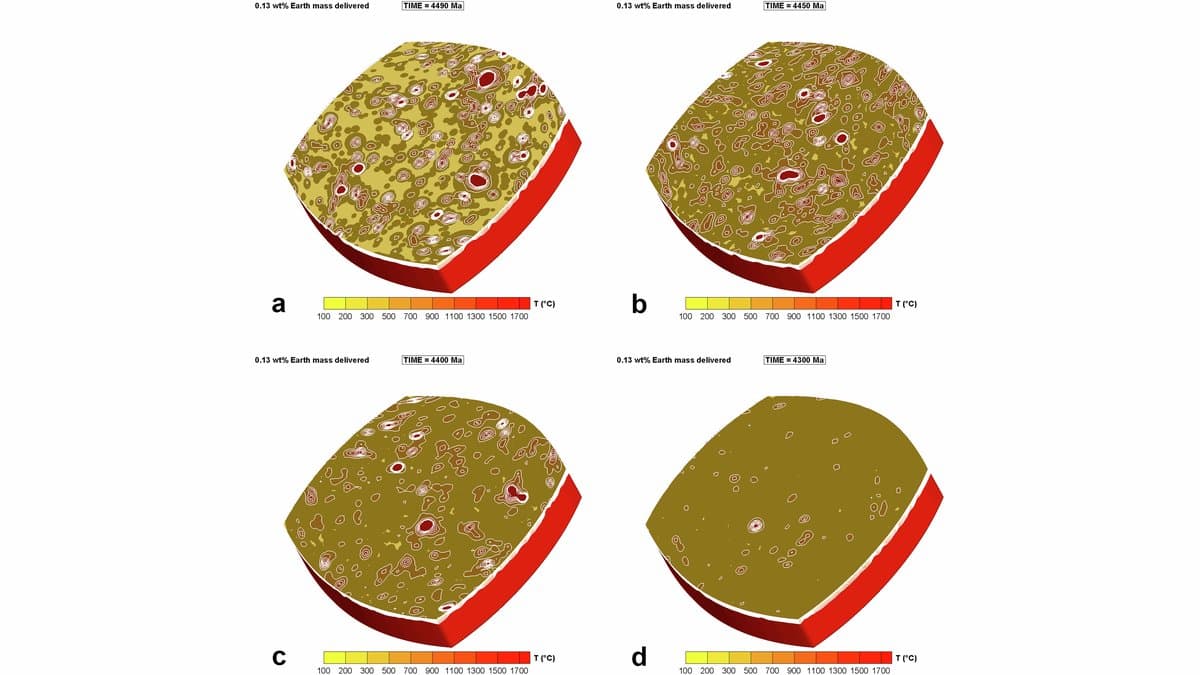
A patch of ground on the young Earth could have had everything going for it. Warm rock, liquid water, a supply of the right molecules, a few million years of quiet. Then another body tens of kilometers across would arrive, the heat would run down into the crust, and the patch would be cooked back to sterility. Whatever chemistry had been developing there started over.
Oleg Abramov, who did this work at the Bavarian Geoinstitute in Bayreuth, and three colleagues spent a simulated billion years watching that happen. Their study, published on September 22 in Nature Communications, runs a global three-dimensional model of how asteroid and comet impacts heated Earth's crust through the planet's first billion years. It then asks a question usually put to chemistry or to genetics: when did the hammering ease off enough that a cool patch could stay cool?
Their answer is around 4.33 billion years ago, and it is worth being precise about what kind of number that is. The team modeled temperature, and from temperature inferred whether the molecules of life's chemistry could have held together. The paper's word for the condition is biocompatible, defined as biomolecules staying available and stable long enough for the chemistry that precedes life to proceed, "whether life actually arises or not." It talks throughout about "postulated RNA organisms" and "a hypothetic RNA lifeform." The RNA World, a proposed stage before DNA took over the keeping of genetic information, stays a hypothesis here, and nothing in the work is a trace of anything that lived.
The clock that kept resetting
The sharpest quantity in the model is what the team calls never-sterilized volume: the share of the shallow crust that, once cool, never climbs back above the threshold. Before about 4.4 billion years ago that share is zero. Every cool patch the simulation makes is re-heated eventually. After that point it becomes non-zero for the first time, then grows, passing half the modeled crustal volume by 4.25 billion years ago.
"Prebiotic chemistry needs continuously stable temperatures, not just a brief cool interval between impacts," Abramov said in a statement from the Planetary Science Institute, where he is a senior scientist. "Once never-sterilized volumes appear, parts of the shallow crust stay below the temperature threshold from that time forward."
The impacts were building the good places too
On its own, that would argue for as late as possible. The reason the paper settles on a moment rather than on a trend is that the impacts were doing two things at once. Hot, fractured rock with water moving through it makes a hydrothermal system, a warm circulation that carries chemical energy. Settings like that have long been proposed as the crucible for life's first reactions. The team counted them by finding ground below 110 °C that sits above a steep temperature gradient, then grouping the connected pockets with a standard clustering algorithm. The number of separate clusters peaks at 4.3 billion years ago and falls away afterward.
So the two curves cross. Impacts big enough to vaporize the oceans become rare after 4.4 billion years ago, just as the plumbing they leave behind is at its most abundant. Averaging their criteria across that overlap, the authors arrive back at 4.33 billion, and the phrase they use for it is their own: a temporal "sweet spot," in their own scare quotes, in the paper's closing sentence.
The second decimal is softer than it looks, and the paper says so. That figure comes from a baseline run assuming the heaviest bombardment the authors consider plausible. Rerun with the lightest case, the sweet spot shifts earlier, to roughly 4.4 billion. Double the heavy case and it slides the other way, to about 4.30 billion. What holds across the whole range is the looser statement: lasting near-surface niches suitable for an RNA World got established sometime after about 4.4 billion years ago.
The model's reach stops where the chemistry starts. It does not simulate water actually circulating through the rock, so its count of hydrothermal ground is a conservative first pass rather than a map of habitats. It leaves out the heat carried far from an impact by blankets of ejected rock and by rock vapor raining back down, which would have made the early picture hotter still. And it says nothing about ingredients: building RNA needs a supply of reduced nitrogen, which is hard to come by in the early atmosphere as it is usually reconstructed. The authors say they are deliberately agnostic about where on the planet life's chemistry would have run.
Two clocks, and the order between them
The comparison the paper leans on comes from a different discipline. Molecular clock work on the genomes of living things, most recently by Moody and colleagues in 2024, puts the last universal common ancestor of everything alive today, LUCA, at about 4.2 billion years ago, inside a window running from 4.09 to 4.33 billion. The top of that window and the model's sweet spot are the same number, which makes it very easy to write that two independent clocks agree on a date. They do not, and neither does the paper. What it claims is an ordering: the good conditions come first, the common ancestor later.
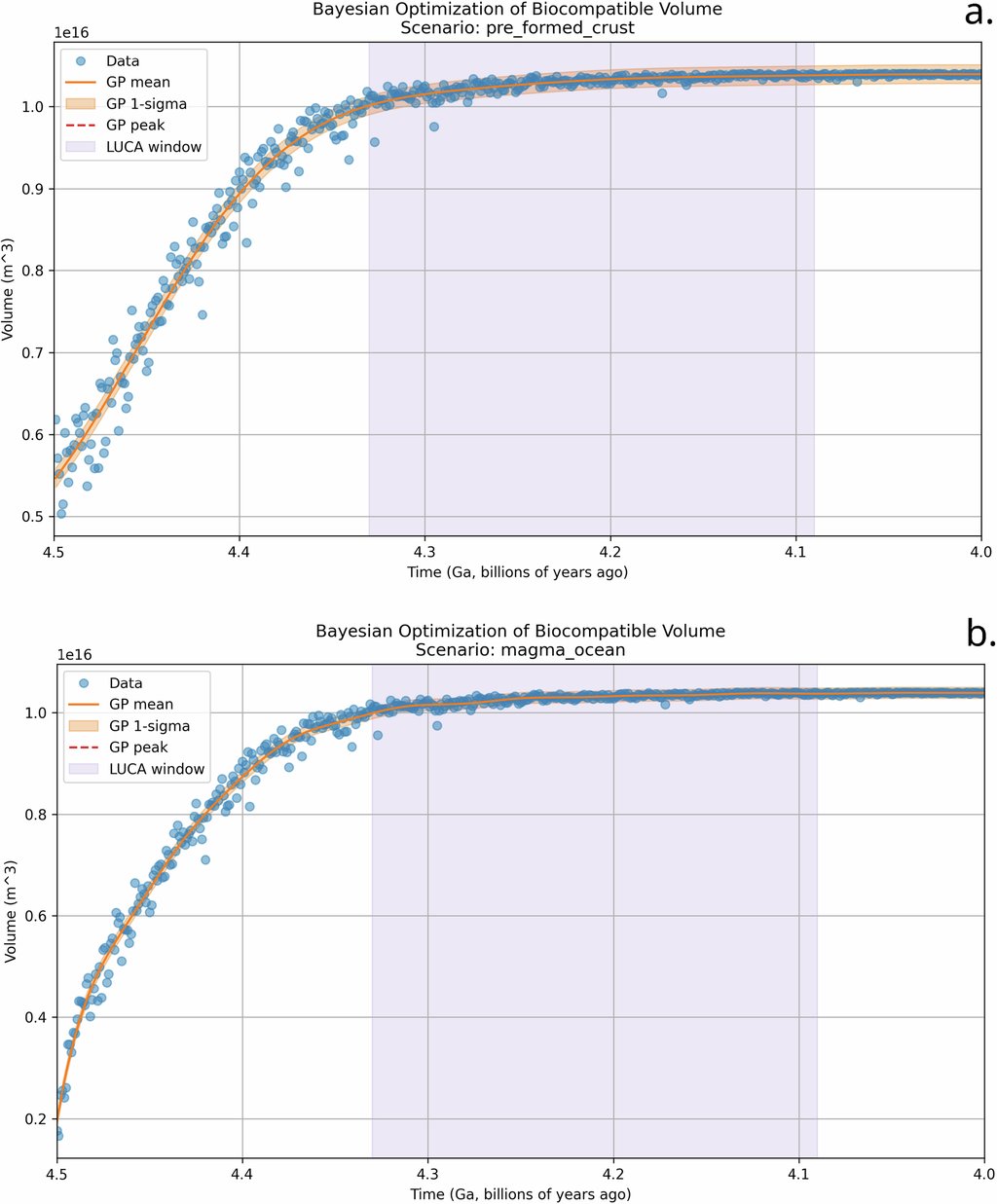
"Our study also suggests that life may have developed comparatively quickly once environmental conditions allowed it," said Stephen J. Mojzsis of the Bavarian Geoinstitute, who led the project, speaking in German in the University of Bayreuth's announcement. "The window we identify lies only about 130 million years before the estimated time of the last universal common ancestor of all life today." The authors supply the hedge themselves: LUCA is the last common ancestor, not the first organism, so a long stretch of evolution could sit between the two.
One result in the paper points away from its own headline. To check the temperature fields, the team turned them into the ages that zircon crystals would record, and compared those with the real zircons from the Jack Hills in Western Australia, the oldest pieces of Earth anyone has in hand. Even under the most violent bombardment tested, the model's impact-only ages come out markedly older than the measured ones. The implication is that impacts were not the main thing setting the ages of the planet's oldest surviving fragments. Something else, most likely the ordinary melting and remaking of crust, was doing that while the sky was still falling.