Skip to content
See the World Through ScienceA project of ALLATRA
Source: Peer-reviewedScience1 source

Kīlauea's Swelling Summit Shows When Its Next Lava Fountain Will Begin
Science

Republish this story

Our work is licensed under Creative Commons BY-NC 4.0. You may republish this piece for free — with credit to ALLATRA Media and a link to the original, unedited beyond length trims, and not for commercial use.

Read the full license

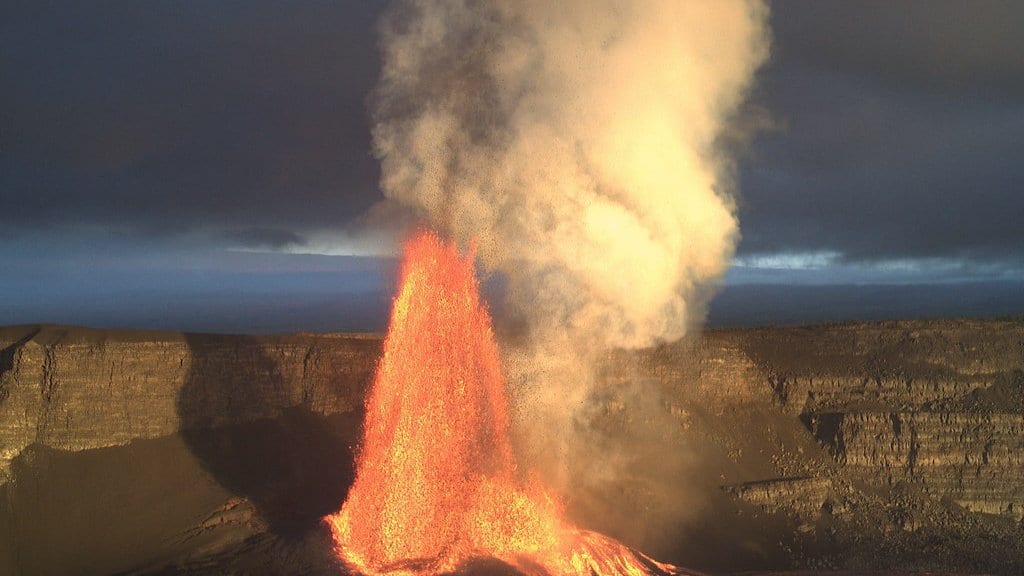
A tall orange lava fountain erupting from a vent on the floor of Kīlauea's summit crater, throwing a gas and ash plume above the layered crater walls.
Lava fountains from a vent on the floor of Halemaʻumaʻu, Kīlauea's summit crater, where episodes have recurred since December 2024. How much the summit swells between them is what the U.S. Geological Survey used to forecast when the next one would begin."Halemaumau Crater (22 April 2025) (Kilauea Volcano, Hawaii) 17" by James St. John, via Flickr, PDM

The U.S. Geological Survey's Hawaiian Volcano Observatory reported on Oct. 8, 2026, in Science that the amount Kīlauea's summit swells between bursts of lava tracks when the next burst begins, a correlation the team used to forecast the start of individual episodes.

The paper presents a monitoring record of the eruption that combines chemical, geophysical and geologic measurements. Several mechanisms have been proposed for episodic fountaining, and the authors report that basic questions remain about what sets off each episode, among them the pressure in the magma reservoir under the crater and the gas separating out of the molten rock.

Inside the summit crater Halemaʻumaʻu, the eruption began in December 2024 and had produced 54 fountaining episodes by the time the paper appeared, each typically lasting hours and separated by gaps of days to weeks. Episodes of this kind are rare worldwide, with only three at Kīlauea since 1823.
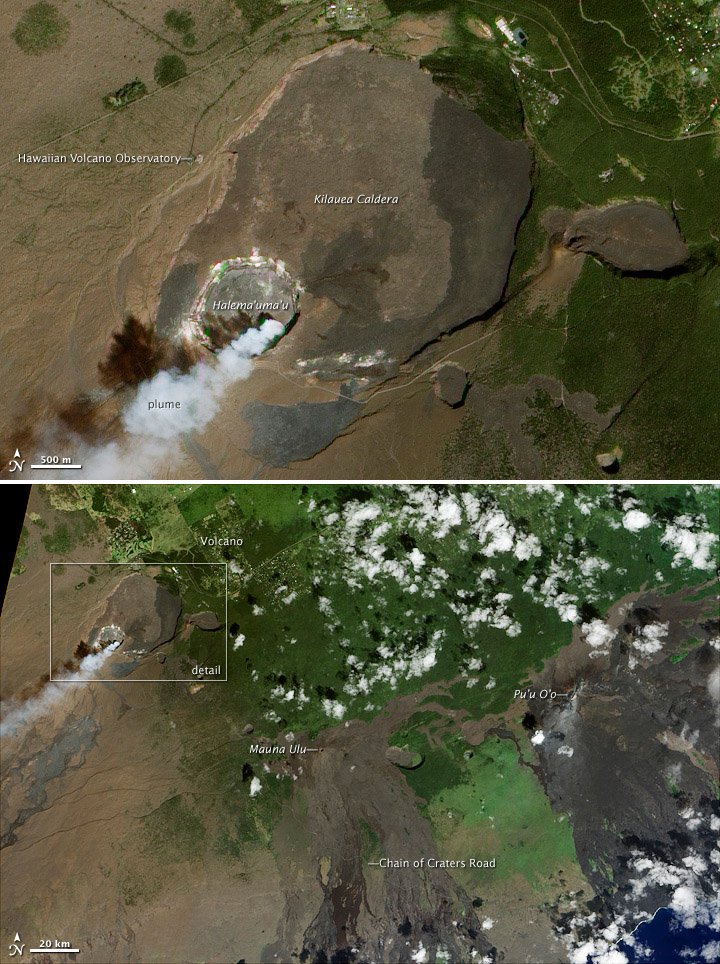
Two stacked annotated satellite images of Kīlauea: a close view labeling the caldera, Halemaʻumaʻu, a plume and the Hawaiian Volcano Observatory, and a wider view labeling Mauna Ulu, Puʻu ʻŌʻō and Chain of Craters Road.
A satellite view of the summit, with Halemaʻumaʻu, the caldera and the observatory labeled, and the volcano's east rift zone in the wider frame below (illustrative). "100 Years at Kilauea - NASA Earth Observatory" by NASA's Earth Observatory, via Wikimedia, CC BY 2.0

A. F. Flinders of the Hawaiian Volcano Observatory is the first author, and co-authors are based at the USGS Cascades and California Volcano Observatories, the University of Hawaiʻi at Hilo and at Mānoa, Earth Sciences New Zealand and the University of Oregon.

The team says the ongoing eruption will provide new constraints on the timing, evolution and processes behind episodic fountaining worldwide, and describes Kīlauea as a natural laboratory for studying how volcanoes work.

Sources

Spot an error?

Spot an error?

Report an error

Spotted a mistake on this page? Tell us what's wrong and our editors will take a look.

What kind of problem?

Only if you'd like us to be able to follow up. We won't use it for anything else.

We correct mistakes openly. Select any text to flag it. Fixes are logged under our Corrections Policy.

Report an error

Reporting on

Kīlauea's Swelling Summit Shows When Its Next Lava Fountain Will Begin

What kind of problem?

Only if you'd like us to be able to follow up. We won't use it for anything else.

We read every report. Corrections are logged publicly.