A Simple Liquid, Stretched Hard Enough, Snaps Like a Solid

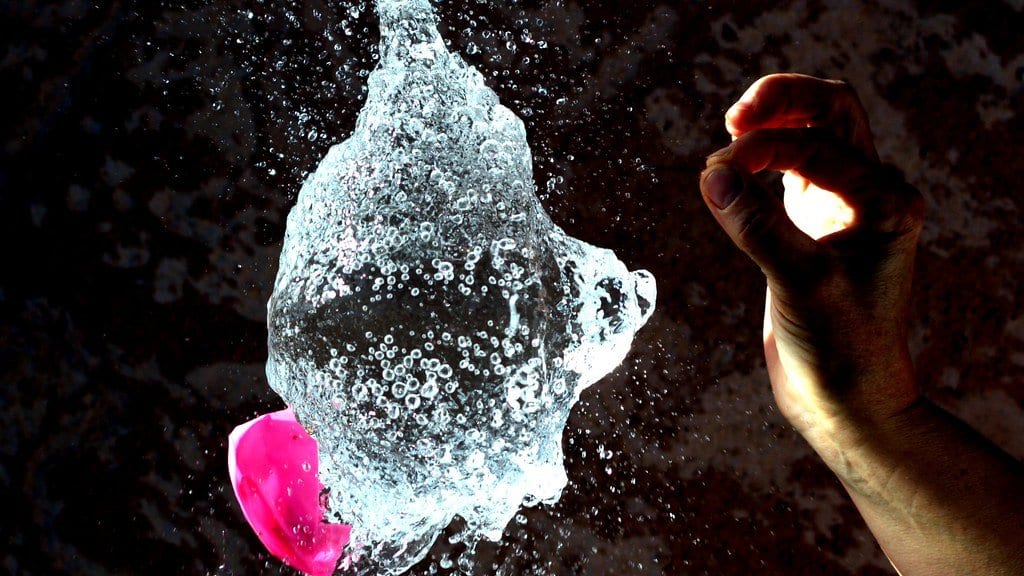
Stretch a rubber band and it eventually snaps. Pour honey and it just keeps flowing, however hard you pull. That contrast is one of the first things anyone learns about matter: solids can fracture, liquids only flow. For decades, the exceptions physicists knew about seemed to prove the rule. Some complex fluids, the ones stiffened with long, tangled polymer molecules, can be made to crack, but researchers chalked that up to elasticity, the same springiness that lets a solid store stress until it fails. A truly simple liquid, with no such internal scaffolding, was not supposed to be capable of the trick.
Thamires Lima and Nicolas Alvarez, chemical engineers at Drexel University, have now watched a simple liquid do exactly that. In work published in Physical Review Letters in March 2026, under the pointed title "Unexpected Solidlike Fracture in Simple Liquids," they report that an ordinary hydrocarbon blend, a fluid made only of hydrogen and carbon with none of the tangled polymers that confer elasticity, fractured under fast enough stretching. It broke with a crack, not a slow thinning-out. The study was carried out with collaborators at ExxonMobil, a disclosed industry partnership on a peer-reviewed physics result; the co-authors' affiliations are stated in the paper, and the finding stands on its measurements.
The setup that caught it is deceptively plain. The team used extensional rheology, essentially stretching a small bridge of liquid between two metal plates and pulling them apart at controlled speeds. Ramp the speed slowly and the liquid does what liquids do: it necks, thins and eventually drips apart. Push the speed up and the behaviour changes character. At a pull rate around 100 millimetres per second the fluid still stretched. At 300 millimetres per second it broke. As the Quanta Magazine explainer describes it, both the simple fluid and the complex, polymer-laden ones gave way at nearly the same threshold, a critical stress of about 2 megapascals, whether or not they had any elasticity to speak of.
That equivalence is the crux. If elasticity were the cause, the springy fluid and the plain one should behave very differently. They did not. To pin the culprit down, Lima and Alvarez leaned on temperature, which changes a liquid's viscosity without adding any polymer architecture. Warming or cooling the same fluid shifted where it fractured, and only the least viscous liquid they tested escaped breaking altogether. The critical stress tracked the viscosity multiplied by the strain rate, not any elastic modulus. As a clincher, a low-molecular-weight styrene oligomer matched to the same viscosity fractured in essentially the same way, isolating viscosity as the controlling property and ruling elasticity out.
"Nobody expected that this would be possible in this kind of simple fluid," Alvarez said, "because viscosity usually just rearranges the molecules." That is the received picture: viscosity is friction between molecules sliding past one another, a property that governs how fast a liquid flows, not whether it can shatter. The Drexel result suggests that when you pull hard and fast enough, that internal friction can build stress faster than the molecules can relax it away, and the liquid answers the only way a stressed material can when it cannot flow quickly enough: it cracks.
The cracks themselves are startlingly fast. In the simple fluids, the fracture front tore through the liquid at 500 to 1,500 metres per second, comparable to the crack speeds in brittle solids. Compare that with a complex fluid such as melted polystyrene, where the researchers clocked a crawling 0.07 metres per second. A simple liquid, in other words, does not merely fracture; it fractures explosively, more like glass than like taffy.
None of this means your morning coffee is about to shatter. The stresses involved are enormous by everyday standards, reached only under rapid, forceful extension of the kind these instruments are built to deliver. But the same physics is quietly at work wherever liquids are pushed hard and fast, in spraying and atomising fuel, coating surfaces at speed, jetting ink or adhesives, and processing lubricants and oils, which is part of why an industrial partner had a stake in the answer. Knowing that a plain liquid can fracture, and knowing the single property that decides when, gives engineers a cleaner rule for predicting it.
The evidence here is solid: a peer-reviewed paper in one of physics' most selective journals, with the surprising claim corroborated by an independent explanatory account. What it revises is not some obscure corner of fluid dynamics but a distinction most people carry around without thinking, the neat idea that flowing and breaking belong to different kinds of matter. Pull hard enough, and the line between them turns out to be thinner than the textbooks let on.
Sources
- Physical Review LettersPeer-reviewed
- www.quantamagazine.org