Why Almost Every Fly Flies the Same Way, and the Mosquito Refuses

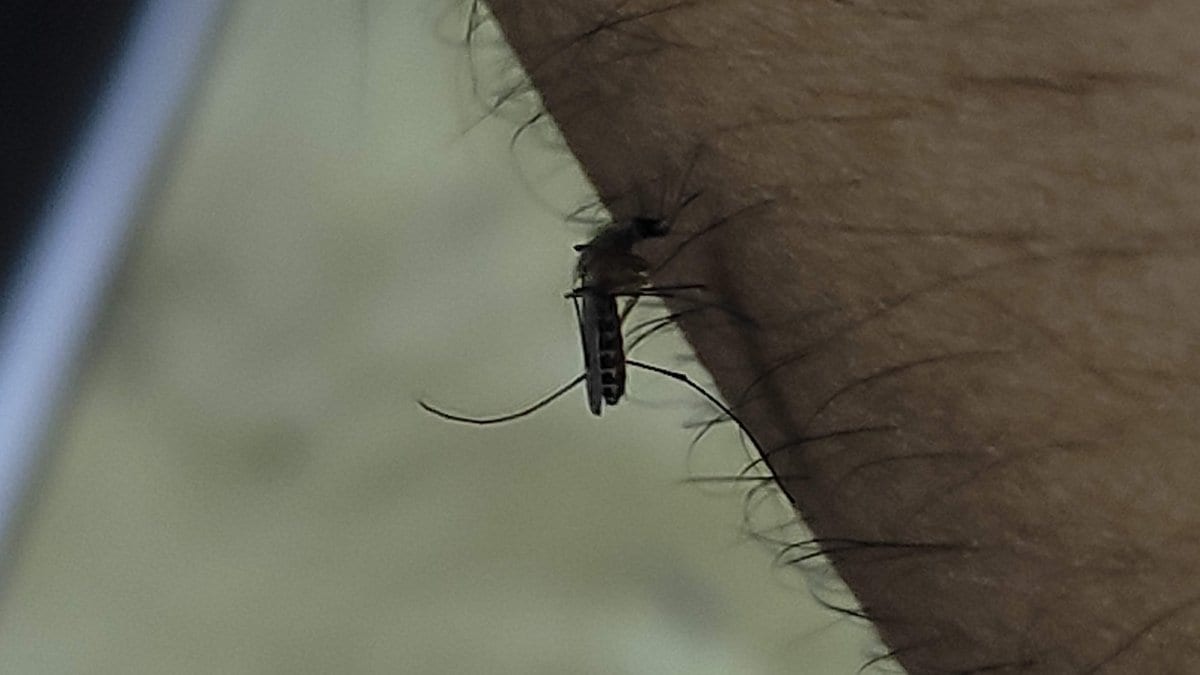
Watch a fruit fly hover over a bowl of ripe peaches, then a crane fly stumble across a windowpane, then a midge hang in a cloud at dusk. They look like utterly different aviators: different sizes, different silhouettes, different flight styles. Under the wing, though, they are running almost the same program. And a new survey of the fly family tree suggests they had very little choice in the matter.
Writing in PLOS Biology on 9 July 2026, Camille Le Roy and colleagues at Wageningen University compared how 133 species of Diptera fly, the vast insect order that includes house flies, fruit flies, crane flies, midges and mosquitoes. The team measured wing shape and body proportions across all 133, then filmed 46 of them with high-speed cameras and rebuilt the airflow around their wings using computational fluid dynamics. The bodies they studied spanned an enormous range, from 20-microgram midges to flies more than ten thousand times heavier.
You might expect that range of sizes and shapes to produce a matching range of flight techniques. It doesn't. Across nearly the whole order, wingbeat kinematics, the frequency and geometry of the stroke, stay hemmed into a tight band. Different bodies, strikingly similar wing motion. The authors read that sameness as a signature of constraint: the aerodynamics of a small flapping wing reward one efficient way of moving through air, and evolution keeps arriving at it. Flight, on this account, behaves less like an open design space than like a funnel.
Then there are the mosquitoes.
The exception you can hear
Mosquitoes and their close midge relatives (a lineage biologists call Culicomorpha, one of the earliest branches of the fly tree) sit far outside the efficient band. Their wingbeat frequency runs about 300 percent of the median for flies their size. The force their wings have to generate is inflated too: across the stroke, the researchers found normal and tangential force coefficients roughly 54 percent and 300 percent higher than in the rest of the order. In plain terms, a mosquito is working its wings much harder, and its flight costs it considerably more energy, on the order of a threefold penalty in aerodynamic effort compared with a similarly sized fly moving the efficient way.
So why hasn't evolution ironed the inefficiency out? A trait this expensive usually gets trimmed. The authors' answer is that the mosquito isn't optimising for economy at all. It is optimising for sound.
Mosquitoes mate in swarms, and they find each other in the crush by listening. The high-pitched whine of a beating wing is a courtship signal; males and females detect and tune to each other's flight tones, and a successful pairing depends on hitting the right note. A fast wingbeat is a loud, high, information-rich wingbeat. The researchers frame the mosquito's flight as an "aerodynamic–acoustic trade-off": the same rapid stroke that burns extra energy also produces the acoustic signature the insect needs to reproduce. Efficient flight would be quieter flight; quieter flight, for a mosquito, is a mating problem.
Why mosquitoes break the pattern
The mosquito matters here precisely because it breaks the pattern. If flapping flight really were a funnel, if physics allowed only one good answer, you would expect no lineage to stray far and stay there. The mosquito shows that a fly can operate well outside the most energy-efficient range, provided something is pushing hard enough in the other direction. For most flies, nothing is, so aerodynamic efficiency wins by default and the whole order converges. For mosquitoes, sexual selection favors the costly wing motion because of the acoustic signal it produces.
It is a tidy illustration of how evolution actually negotiates. A wing is never solving one problem in isolation; it is trading lift against energy against, in this case, the demands of a mate hunting by ear. Read that way, the annoying whine by your ear on a summer night is not a design failure. It is the sound of a trade-off working exactly as selection intended.
Sources
- PLOS BiologyPeer-reviewed