Feynman's Two Rules for Quantum Paths Finally Meet a Laboratory

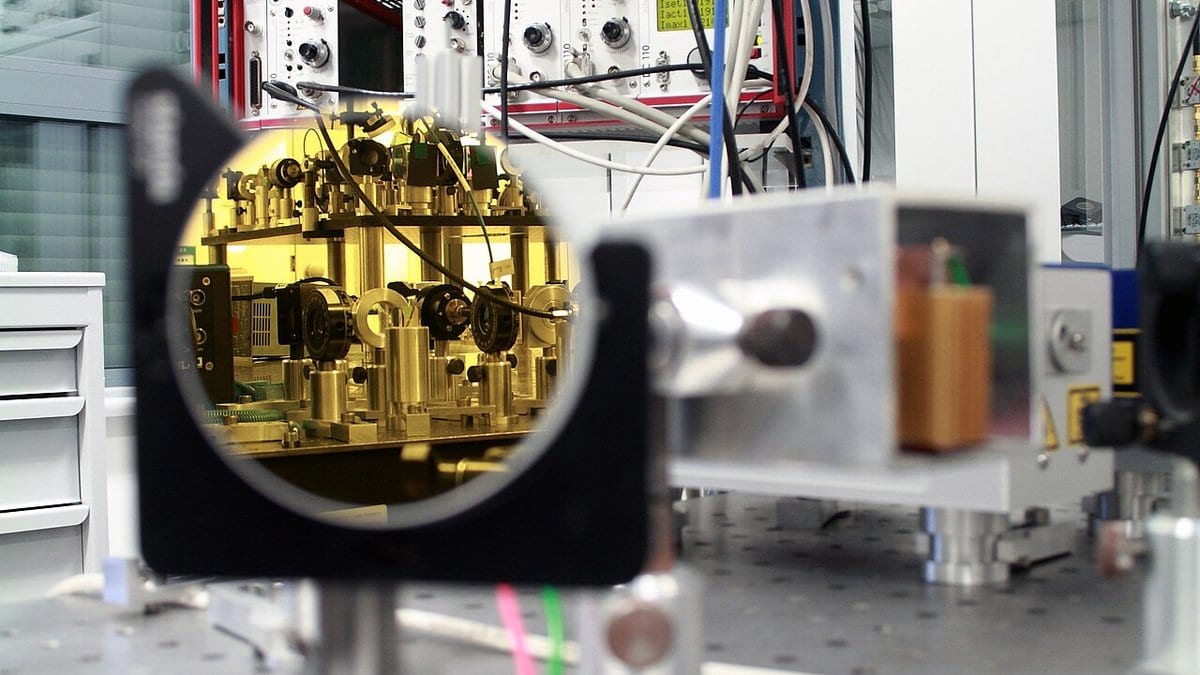
Ask a physicist how a particle gets from here to there and the answer can sound like a joke at the expense of common sense: it goes every way it possibly can. Straight across, out to the side and back, off toward the wall and around again. Every route contributes, and the ones that look absurd cancel each other out, leaving the ones that look sensible. Richard Feynman wrote that idea down as physics in 1948, and it worked so well that it became the ordinary language of quantum field theory.
Underneath the recipe sit two rules Feynman set out that year. First, the probability of finding the particle somewhere comes from adding up the contributions of all the possible paths, interference intact. Second, every path contributes an amount of the same size. What tells one path from another is only its phase, and that phase is fixed by the classical action along it, the same quantity classical mechanics uses to pick out the one trajectory a thrown ball follows. Generations of physicists have calculated with those rules. According to a paper published on August 26 in Science Advances, nobody had put them to a direct experimental test.
That is the test Yong-Li Wen, Shi-Liang Zhu and colleagues at South China Normal University in Guangzhou say they have now run. Their experiment chops the space between a photon's start and its finish into a grid: five steps, with seventeen possible positions at each step. Every way of picking one position per step counts as a path, which makes seventeen to the fifth power of them: 1,419,857, which the paper rounds to more than 1.4 million. That figure is a count of routes on a grid, not of photons, detections or journeys anyone watched happen; no photon separately takes any one of them, which is the whole point of the construction being tested.
Measuring that grid is harder than it sounds, because the quantity in question is not a probability. Probabilities are what detectors count. An amplitude has a size and a phase, and the postulates are claims about both. The team's route to it is what they call a rigorous propagator-based approach: the propagator is the object that carries an amplitude from one place and time to the next, and measuring it accurately enough, step by step, lets the amplitude of every path in the grid be reconstructed rather than inferred.
Both rules survived. The reconstructed amplitudes add coherently, interference and all, to give the probabilities a detector actually records, which is postulate one. They also come out the same size as one another, distinguished only by phase, with the phase tracking the classical action in units of the reduced Planck constant: postulate two. The classical world, in other words, sets the clock hands, and the quantum sum does the rest.
That the answer was expected is not the same as it being known. The path integral got adopted because it computes correctly, and a formalism can be right in everything it predicts while the assumptions underneath it go unchecked; the paper calls what it closes a longstanding foundational gap. A confirmation like this changes no calculation anyone was going to run tomorrow, but it moves the two rules out of the column marked assumed.
The claim to be first belongs to the authors, and it is narrower than it may look. Experiments have probed the path integral's predictions for years: multi-slit tests of how quantum probabilities add, and weak measurements that reconstructed the average trajectories of single photons through an interferometer. The abstract's word for that body of work is "scarce," not absent. A first direct test of the two postulates is a different thing from a first test of the path integral, whose consequences physicists have been checking for decades.
In the peer-reviewed paper, the authors also present the propagator method itself as the more portable part of what they did: a general framework for investigating path integrals in other quantum systems.
The data behind the reconstruction are openly deposited in the Dryad repository. On a claim about the foundations of quantum mechanics, that is not a small detail: any group that doubts the seventeen-by-five grid can pull the numbers and rebuild it.
Sources
- Science AdvancesPeer-reviewed