Before the Second Can Be Redefined, the World's Clocks Have to Agree. Europe Just Measured How Well

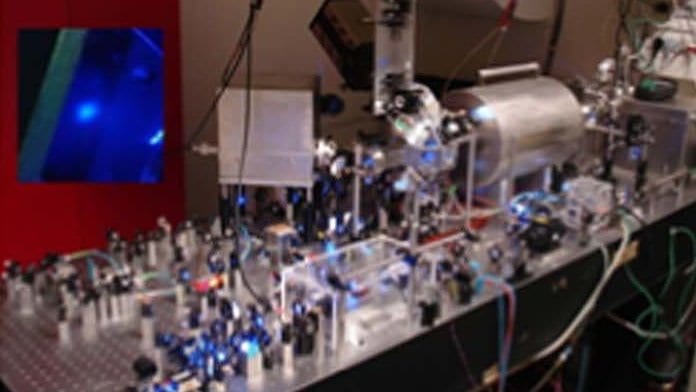
A second has been defined as 9,192,631,770 swings of a microwave field tuned to a cesium atom. The definition works: satellite navigation, power grids and financial timestamps all rest on it. The awkward part is that the best clocks in the world's measurement laboratories have long since outrun it. They run on visible light rather than microwaves, which oscillate far faster and lets them divide a second far more finely than cesium can.
So the definition is being replaced, and the obstacle is agreement. Before a new second can be written on an optical transition, clocks in different countries, built by different teams, have to be shown to keep the same rate. That is what a two-month campaign across Europe set out to test. Seven optical clocks at the national measurement institutes of Italy, France, Britain and Germany were run against one another, connected through the optical fiber network established in Europe. Marco Pizzocaro of Italy's INRIM and colleagues published the results on 1 September in Physical Review Research, a peer-reviewed, open-access journal.
An optical clock cannot be put in a crate and driven to Paris. Its accuracy comes from an apparatus of lasers, vacuum chambers and cooled atoms that has to be kept in one place and coaxed into working. So the institutes compare frequencies instead of times, and what they publish is a ratio: this clock's frequency divided by that one's, a pure number with no units attached. A ratio is the one thing two clocks in two countries can agree on without either of them moving, and it is only ever as good as the link between them.
The campaign produced ratios with uncertainties running from 7.7 × 10⁻¹⁸ to 6.1×10⁻¹⁷. The sharp end of that range is hard to picture. A clock kept to it, running since the Big Bang, would by now be out by a few seconds.
The tightest comparison in the set was between two clocks running on the same transition in a single ytterbium ion, one at Britain's National Physical Laboratory and one at Germany's Physikalisch-Technische Bundesanstalt. The two were designed and built separately, by teams that made their own choices about how to build one and how to account for every effect that can shift a frequency. They showed agreement within an uncertainty of 7.7×10⁻¹⁸. That figure is the sharpness of the check rather than the width of a gap: at the finest resolution the measurement could reach, the two clocks could not be told apart. The authors describe it as the first international verification of two independently developed optical clocks below one part in 10¹⁷.
That claim is narrower than it may look, and reading it as written matters. International clock comparison is not new, and this was not the largest one: a campaign published in Optica last year compared ten clocks over both fiber and satellite links. What is new here is the pair and the level.
A second result in the campaign came from a mercury clock at LNE-OP in Paris, the institute formerly known as LNE-SYRTE. Running it improved the uncertainties on its frequency ratios against the network's ytterbium-ion, ytterbium and strontium clocks. Cross-species measurement of this kind is how the field narrows its options. Nobody has yet settled which atom the new second should be counted on, and the candidates can only be ranked against one another by measuring them against one another.
The second is not the only thing riding on clocks like these. A clock's rate depends on where it sits in Earth's gravity field, so a network of them, compared continuously across a continent, becomes an instrument in its own right. The authors point to applications in fundamental physics, in tests of general relativity, and in geodesy, the science of measuring the shape of the planet by, among other things, sensing where time runs fractionally slower.
The choice is close. The General Conference on Weights and Measures, which owns the definition, has asked for proposals on the preferred species, or ensemble of species, to be brought to its next meeting, and for a new definition to be adopted at the meeting after that, in 2030. Whether clocks in different countries agree, and by how much, is one of the things the committee's own criteria are there to track.
None of that is settled by one campaign. This was a single measurement season on one continent, and other groups are working on a different route entirely, building clocks that count oscillations in an atomic nucleus rather than in the electrons around it. What the European measurement supplies is the specific evidence the timetable asks for: a demonstration, at the precision the new definition will need, that clocks built by different people in different countries keep the same rate.
Sources
- Physical Review ResearchPeer-reviewed